

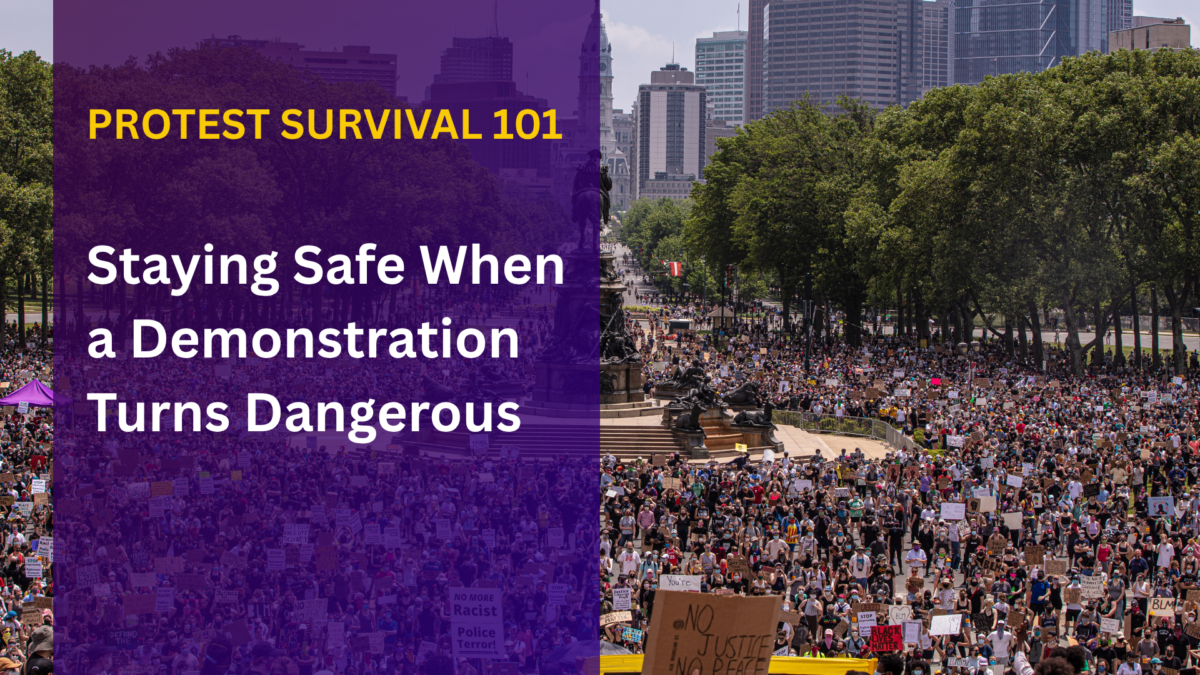
Protest safety is mostly decided before you arrive, not during the chaos. Once a crowd thickens and emotions run high, improvisation is a poor substitute for preparation, hence the first rule: if you can avoid it, never go alone. Go with at least one other person so you can watch each other’s backs, and assign roles before you leave the house. One person drives the group home if things get dicey, one carries first-aid training, one stays hyper-observant and monitors the surroundings. WIRED’s protest safety guide puts it plainly: meet up beforehand, stick together the entire time, and leave together.
Then write the plan down. Agree on a reunion spot if the group gets separated for example, if you lose each other for more than 30 minutes, everyone converges on a designated street corner. Have backup locations in case the first is inaccessible, and map multiple exit routes in case streets get blocked off. Check whether your city has a curfew and whether previous protests there have escalated. None of this takes more than an hour over coffee, and it is the difference between a group that regroups calmly and four people frantically calling each other on a congested network.
Just as important is what you leave behind. The ACLU of Washington advises against carrying anything with your private information, anything that could be construed as a weapon, and valuables like jewelry or sacred objects essentially, bring nothing you would not want on your person if arrested.
One caveat worth stating upfront: this guidance draws on US sources and US legal assumptions. Protest rights, police powers and the risks involved vary enormously by country, in some places, attending a demonstration at all carries serious legal exposure. Check your local law and local civil-liberties organizations before applying any of it elsewhere.
What to wear and carry: protection without provocation
Start with your eyes. If you wear contact lenses, take them out before you leave the house, this is prevention, not aftercare. WIRED warns that if tear gas or pepper spray is deployed, contacts trap the irritant against the eye and make everything worse, and the Human Rights Campaign lists contact lenses among items not to bring for the same reason. Wear glasses if you have them; goggles are better still. For the same reason, skip makeup and oil-based lotions, since the chemicals in police dispersion measures can cling to them.
The ACLU of Washington suggests a few items most people overlook: ear plugs against flash-bangs and loudspeakers, and a waterproof watch so you can keep track of time without reaching for your phone in a moment when doing so feels unsafe. Neutral clothing without distinguishable logos serves two purposes, it draws less attention and makes you harder to pick out later.
Masks deserve an honest treatment. They can protect your health in a dense crowd and complicate facial recognition, the ACLU of Washington notes that masks and makeup can confuse such software. Whether covering your face at a demonstration is lawful is a separate question, and one none of these sources settles: rules on face coverings vary by jurisdiction and have changed quickly in recent years. Check your local law before relying on one, rather than assuming either permission or prohibition.
Finally, assume your phone may be lost, dead or confiscated. WIRED’s guide advises writing emergency numbers down, put an emergency contact and, in the US, the National Lawyers Guild legal support hotline on a card in your pocket, or on your arm. Across Frontlines points readers to the hotline directory at nlg.org for their location. Paper does not run out of battery.
Reading the crowd: situational awareness and knowing when to leave
The single most useful skill at a demonstration is not bravery, it is noticing things early. The Human Rights Campaign points protesters to the OODA loop, a decision framework built for high-stress situations: Observe, Orient, Decide, Act. In practice that means continuously monitoring crowd movement and police posture, comparing what you see against how protests typically unfold, and deciding whether to stay, reposition, or leave then moving quickly and reassessing immediately. The loop never stops; a decision you made five minutes ago may already be wrong.
Across Frontlines adds two habits worth building. First, always track your exits, because situations can become dangerous faster than you can improvise a route out. Second, check in regularly with your buddy or team, heat and adrenaline degrade judgment, and a calm partner catches what you miss.
De-escalation matters as much as observation. HRC’s guidance is blunt: keep your voice steady, avoid provocative behavior, and do not engage agitators — step away and remove yourself if necessary. Your goal is to make a point, not to win a confrontation.
Example: your four-person group is mid-march when the lookout notices the crowd compressing near the southern exit — bodies tightening, movement slowing. That is the pre-agreed trigger. The lookout signals, the group does not debate it, and everyone moves together toward the alternate eastern route identified that morning. Two qualifications belong in any such plan.
First, on-scene police or official emergency instructions outrank your pre-plan: if officers direct a dispersal route, follow it even when it differs from your mapped exit, and regroup afterward. Second, plan for your least mobile member, not your fastest — choose routes without stairs or long distances, agree a pace the slowest person can hold, and assign one person to stay with them rather than leaving anyone behind in a crush. At the first rally point two streets over, each person sends a one-line text check-in. Total cost: ten minutes. Total benefit: you were never in the crush, and no one was abandoned in it.
One final point on conduct. Obey lawful orders, and remember that in the US you have the right to remain silent, compliance with instructions and assertion of your rights are not contradictions. Elsewhere, the boundary between lawful order and unlawful command differs, so know your local position before you need it.
If things go wrong: arrest, exposure, and getting everyone home
Even a well-run plan can end in an arrest or a face full of chemical irritant. What matters then is not improvisation, it is falling back on decisions you made hours earlier.
If you are arrested, the Human Rights Campaign’s advice is disciplined and short: do not resist or escalate, state clearly that you wish to remain silent and want a lawyer, and do not explain or negotiate. Anything you say in the adrenaline of the moment can work against you later, and arguing on the pavement changes nothing. Across Frontlines adds that you have the right to be told the reason for your arrest, and prompt access to a lawyer and your family but it cautions plainly that law enforcement often does not honor these rights. That gap between the law on paper and the conduct on the street is exactly why documentation matters: if it is safe, record events, and note names, badge numbers and times. This is US-grounded guidance; arrest powers and silence rights differ sharply elsewhere, so local legal advice is not optional.
For chemical-irritant exposure, the mistakes are instinctive ones. Do not rub your eyes or skin, that grinds the irritant in. Across Frontlines’ guidance that survives scrutiny is minimal: decontaminate your hands before touching any part of your body, and remove contact lenses if you are still wearing them.
Beyond that, the specific aftercare steps circulating in protest guides — eye-flushing technique, rinsing solutions, timing — are medical questions, and the supplied sources are too garbled to quote reliably. Before you go, check a current medical or civil-defense source in your country for decontamination procedure, and get out of the affected area first; treatment starts with ending exposure.
Two rules close out the day. First, the action is not over until everyone is home: keep checking in with your group, and if someone is detained, activate the legal hotline number written on paper that morning, in the US, the National Lawyers Guild runs one. Second, share any footage with trusted legal or advocacy organizations rather than posting it publicly; HRC notes this protects the identities of everyone in frame. Then debrief honestly — what worked, what failed, what changes next time. Preparedness, like protest itself, is iterative.