

A cell tower keeps a city talking for exactly as long as its backup batteries hold out, and that window is a lot shorter than most people assume. When Hurricane Milton tore through Florida in March 2026, roughly 12.3 percent of cell sites across the affected counties went dark, and carriers like Verizon were candid that many of their remaining towers were already running on generators while refueling crews scrambled to reach them before the fuel ran out. That is the honest picture of what a phone network actually is during a real emergency: a chain of towers, fiber links, and diesel tanks, all of which can be severed by the same storm that made you need to call for help in the first place.
The instinct to treat a smartphone as a permanent lifeline is understandable, since for most of daily life it is one. But the infrastructure underneath it was never built to survive the exact events that make communication most urgent, and understanding the tiers of alternatives, what each one actually does, what it costs, and where it fails, is the difference between a real plan and a false sense of security.
Why the Network Actually Goes Down
Cell towers fail in a fairly predictable sequence during a major disaster. They lose backhaul when the fiber line feeding data to and from the tower is physically cut, they lose grid power and fall back to batteries that typically last only a matter of hours, and generators brought in afterward eventually run out of fuel if refueling logistics cannot keep pace with a widespread outage.
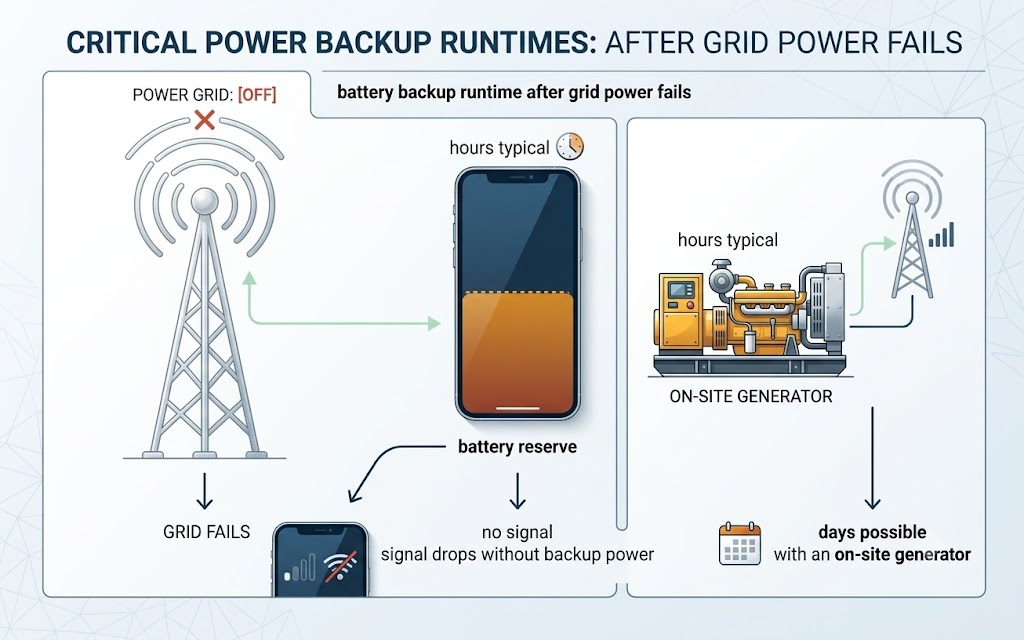
Layer direct wind or flood damage to the tower itself on top of that, and it becomes clear why a single storm can knock out over a tenth of a region’s cell infrastructure in a matter of hours. None of this is a flaw unique to one carrier. It is structural, and it means every household’s communication plan should assume the phone network is the least reliable link, not the most.
The First Rung: Short-Range Radio Without a License
Family Radio Service, or FRS, is the easiest entry point precisely because it requires no license and no test. FRS radios typically manage a range of one to two miles under realistic conditions, shrinking considerably in dense urban terrain where buildings and interference cut that range to well under a mile.
In the US and Canada that’s FRS. In the EU, UK, Norway, and the UAE it’s PMR446. Australia, New Zealand, Malaysia, and Indonesia use UHF CB. All three work the same way in practice: license-free handhelds good for roughly one to two miles under realistic conditions, shrinking considerably in dense urban terrain where buildings and interference cut that range to well under a mile. None of them are built for reaching help across a county, but for keeping a family or a small group of neighbors in contact with each other during a local emergency, which is a narrower and more achievable job than most people give it credit for. One thing worth flagging for anyone buying gear across borders: these standards don’t cross over. A PMR446 radio bought in Europe won’t legally operate on FRS frequencies in the US, and an American FRS or GMRS radio isn’t legal to use on PMR446 channels in Europe.
One step up sits GMRS, the General Mobile Radio Service, which does require a license but a strikingly easy one to get. A GMRS license costs 35 dollars, lasts ten years, requires no test, and covers the licensee’s entire immediate family under a single registration. In exchange for that modest paperwork, GMRS radios reach somewhere between five and twenty miles depending on terrain and antenna height, a meaningful jump over FRS that makes it the more serious option for households that actually want a working local network rather than a walkie-talkie toy. Most countries outside North America don’t have a direct equivalent to this middle tier. If you’re not in the US or Canada, the honest picture is that license-free PMR446 or UHF CB is usually where the paperwork-free options end, and the next real step up is a full amateur radio license.
The Serious Tier: Amateur Radio
Ham radio, formally amateur radio, remains the option with the longest reach and the fewest strings attached to any single company or piece of infrastructure. The entry-level Technician license requires passing a multiple-choice exam but no longer requires learning Morse code, a barrier that used to keep the hobby smaller than it needed to be.
That entry license typically opens access to the popular 2-meter and 70-centimeter bands, which is enough for regional communication, while higher license classes unlock the high-frequency bands capable of reaching hundreds of miles without relying on any repeater, satellite, or cell infrastructure at all. Check your national telecommunications regulator or ham radio society for the exact tiers where you live, since the ladder differs by country even though the shape of it is broadly the same everywhere. That last property, HF’s independence from any repeater or satellite, is what separates ham radio from everything else on this list: it does not depend on anyone else’s network staying up. It depends on the atmosphere and a functioning radio, which is precisely why emergency management agencies worldwide still lean on amateur radio operators as a backstop when every modern system has failed simultaneously.
When Local Isn’t Enough: Satellite Messengers
Radio, at every license tier above, is fundamentally local or regional. When the need is to reach someone far away, or to summon help from a location with no infrastructure at all, satellite messengers close that gap. Devices like the Garmin inReach Mini and the Zoleo Satellite Communicator use dedicated satellite constellations, most commonly Iridium, to send short text messages and trigger SOS alerts from essentially anywhere on the planet, oceans and poles included. The tradeoff is cost. These devices run from roughly two hundred to several hundred dollars up front, and every one of them requires an active monthly subscription plan to actually send a message, which is a recurring cost that a GMRS radio simply does not carry once the one-time license fee is paid.
What is genuinely new as of 2026 is that dedicated hardware is no longer strictly necessary for basic emergency messaging. Direct-to-cell satellite service, led by T-Mobile’s partnership with Starlink, now supports emergency text-to-911 messaging on an ordinary smartphone with no extra hardware, and Apple’s Emergency SOS via satellite has extended similar functionality to iPhone 14 and later models through the Globalstar network. Coverage is still limited and message throughput is slow compared to normal cellular data, but the direction is unmistakable: satellite emergency messaging is migrating from a specialty purchase into a background feature of the phone already in your pocket, which lowers the floor of preparedness for people who will never buy a dedicated radio.
Starlink
What is genuinely new as of 2026 is that dedicated hardware is no longer strictly necessary for basic emergency messaging, and this is no longer a US story. Starlink’s direct-to-cell service, launched with T-Mobile in the US, now runs in more than 20 countries and reaches over 400 million people, with live service in Canada, Australia, Japan, Chile, and Peru, and Ukraine’s Kyivstar set to be the first European carrier to switch it on. Apple’s Emergency SOS via satellite, powered by Globalstar, covers iPhone 14 and later models and extends emergency-only messaging to 17 countries.
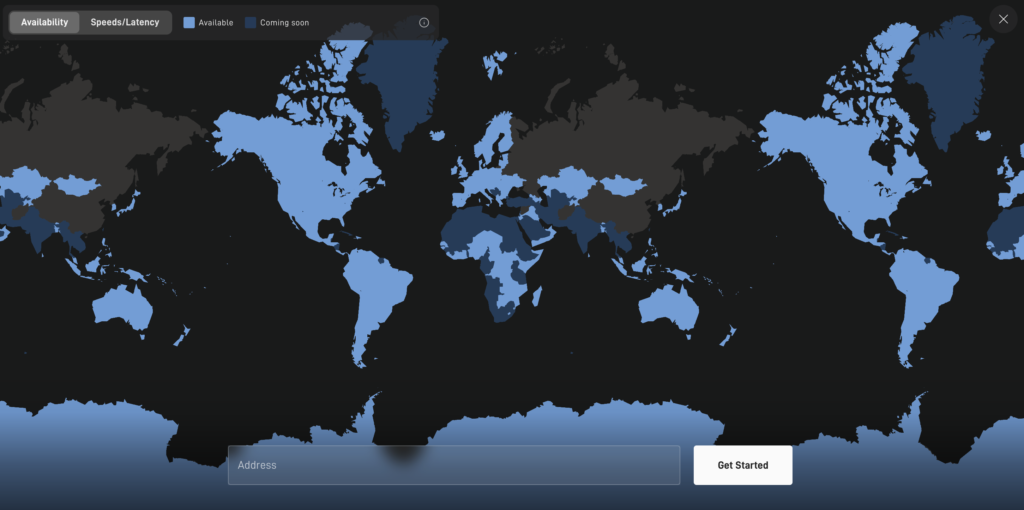
Coverage is still limited by carrier partnerships and message throughput is slow compared to normal cellular data, but the direction is unmistakable: satellite emergency messaging is migrating from a specialty purchase into a background feature of the phone already in your pocket. This is also a fast-moving space, so treat any specific country list, including this one, as a snapshot rather than a permanent fact, and check current availability for your own carrier before relying on it.
The One-Way Channel Nobody Should Skip
Every option discussed so far is about sending a message. Receiving official, verified information during a disaster is a separate problem, and it has arguably the cheapest and most overlooked solution of all. NOAA Weather Radio broadcasts alerts directly from the National Weather Service the moment they are issued, independent of cell towers, internet service, or grid power once the unit is running on batteries or a hand crank. It carries far more than weather, covering the full Emergency Alert System including AMBER alerts and technological accidents, and unlike a phone that has to be awake and connected to push a notification, a NOAA radio with alert functionality will sound on its own in the middle of the night specifically because that is when the warning matters most and a sleeping household is least likely to check a phone.
Building the Actual Plan
None of these tools substitutes for the others, and treating any single one as sufficient is the mistake worth avoiding. A functional household plan layers them: FRS or GMRS for keeping a family in contact within a few miles, a NOAA weather radio for receiving official alerts regardless of what else has failed, and either a satellite messenger or a phone with direct-to-cell satellite capability as the long-range option for reaching help or checking in with someone outside the disaster zone entirely. Ham radio sits above all of it for anyone willing to study for the license, offering a reach and independence that no consumer device can match. The mistake most households make is not owning none of these tools. It is owning one, usually the phone already in their pocket, and assuming that the single most fragile link in the chain will be the one still standing when everything else goes dark. What does your own plan actually look like once the towers are the first thing to fail?
204 Comments