
Ukraine’s Supreme Court has issued a significant clarification on power outages and legal liability, tied to a case involving a 110 million UAH fine (roughly 2.7 million USD). The ruling addresses a question that has become routine for Ukrainian businesses and residents: when does a blackout excuse someone from fines or broken contractual obligations?
The context matters. Ukraine has endured repeated, large-scale power outages driven by damage to its energy infrastructure. Rolling blackouts and emergency shutdowns have affected millions of households, businesses, hospitals, and water systems, sometimes for hours or days at a time. These are wartime grid disruptions, not geomagnetic-storm events — so this alert is not connected to space weather.
The Court’s guidance, as reported by the Sudovo-yurydychna Hazeta (Judicial-Legal Gazette), essentially holds that a power outage does not automatically free a party from liability. Whether an outage counts as force majeure — an unforeseeable, unavoidable event — depends on the specifics: whether the outage was genuinely beyond the affected party’s control, whether it directly prevented performance, and whether the party took reasonable steps to mitigate the impact. The 110 million UAH fine at the center of the case shows how high the stakes are when businesses fail to document outages properly.
What readers might notice
If you are in Ukraine or do business there, this ruling affects contracts, utility disputes, and penalties for late delivery or non-payment during blackouts. For preparedness readers elsewhere, it is a useful case study: in prolonged outage scenarios, documentation matters. Keep records of outage times, official blackout schedules, and any losses incurred — that paper trail is what separates an excused failure from a costly fine.
Practical watch-items: (1) businesses in outage-prone regions should review contracts for force majeure clauses and keep generator or backup-power logs; (2) households should continue standard blackout readiness — charged power banks, flashlights, shelf-stable food, and a way to keep phones online; (3) follow official outage schedules from your regional energy provider so you can plan around announced shutdowns rather than being caught off guard.
Data and reporting for this event come from Ukrainian judicial reporting via the Sudovo-yurydychna Hazeta and public statements of the Supreme Court of Ukraine.
Frequently Asked Questions
Is this blackout connected to a geomagnetic storm or space weather?
No. Ukraine's large-scale outages stem from damage to energy infrastructure and grid management, not solar storms. No space-weather event is involved in this ruling or the blackouts it addresses.
Does a power outage automatically cancel fines or contract penalties?
No. The Supreme Court clarified that outages only exempt a party from liability when the outage genuinely made performance impossible and reasonable mitigation steps were taken — documentation of the outage is essential.
What was the 110 million UAH figure?
It is the fine at stake in the case the Supreme Court reviewed — roughly 2.7 million USD — illustrating how costly it can be when a blackout is not properly proven as grounds for non-performance.
What should households or businesses do to protect themselves during outages?
Keep records of outage times and official schedules, maintain backup power where possible, and review contracts for force majeure clauses. Standard readiness — charged devices, light, water, and food — still applies.
Keep tracking this:
Source: the original source
Related Reading
Sky & Solar Conditions at the Time
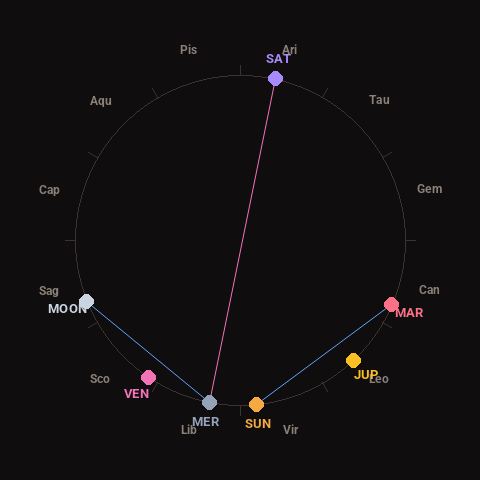
Moon: First Quarter (36% illuminated), in Sagittarius.
Notable planetary angles: Sun sextile Mars (61°), Mercury opposite Saturn (178°), Moon sextile Mercury (58°).
Concurrent space weather: planetary Kp index 1.7; strongest recent solar flare: nothing notable.
This is a factual snapshot, not a claim of cause and effect – researchers are divided on whether lunar, planetary or solar factors influence seismic or weather activity. It’s included so readers can track the pattern for themselves over time.