
Every one of the five best-selling pre-packed bug out bags we looked at is sold as a 72-hour kit for two people, and not one of them carries enough water to get those two people through a single day. The best of them hold three litres. The government guidance they all gesture towards calls for nearly twenty-three.
That sounds like a scandal, and in one sense it is. In another sense it is simply physics, and the physics is more useful to understand than any individual product verdict. A backpack cannot carry three days of water for two adults, because that much water weighs more than most people can walk with. The honest question, then, is not “how much water is in the bag” but “what does the bag do once the water runs out”. That turns out to be the line item the listings say least about.
Survival Siren is a participant in the Amazon Services LLC Associates Program. If you buy something through a link on this page we may earn a commission, at no extra cost to you. It doesn’t change what we found.
How we did this. We did not test these in hand. This is a specification and owner-report investigation: we took five best-selling pre-packed bug out bags on Amazon as of October 26, 2026, compared what each listing claims against federal preparedness guidance and basic arithmetic, checked the regulatory standards their food carries, and looked for corroborated owner-reported failure patterns. Where we could not verify something, we say so.
What we checked, and why it matters
There is no product standard for a “72-hour kit”. There is no equivalent of the flashlight industry’s lumen standard or the water-filter world’s NSF certifications. What exists instead is government guidance, and it is unusually specific. Ready.gov, the federal preparedness campaign, recommends one gallon of water per person per day for at least three days, covering drinking and hygiene. Of that gallon, a normally active adult needs to drink at least two quarts, roughly two litres, and hot weather can double it.
Every kit here uses the same water format: sealed 125 ml pouches with a five-year shelf life. So the arithmetic is simple.
FEMA guidance, 2 people × 3 days:  3.785 L × 6 = 22.7 L  →  182 pouches
Drinking-only minimum, 2 × 3:      2 L × 6     = 12 L    →  96 pouches
Best-equipped kit here:            24 pouches  = 3 L     →  18 hours for two people
Twenty-two litres of water is twenty-two kilograms before you add a single bandage. No one is carrying that in a 45-litre pack, and no listing pretends otherwise in so many words. What they do instead is print “72 hours” and “2 people” on the box and let the reader assume the water matches the label.
The food tells a more forgiving story, and it has an interesting history. Four of the five kits use the same kind of dense ration bar, and the “US Coast Guard approved” badge they all carry is real. It refers to 46 CFR 160.046, the federal standard for emergency provisions carried in lifeboats and liferafts. The 3,600-calorie SOS bar, for instance, carries USCG approval 160.046/36/0 and is rated for storage from −30 °C to 65 °C. In other words, the food in your bug out bag was designed for shipwreck survivors, and it is very good at being that: stable, compact, deliberately low in protein so it doesn’t drive thirst.
What the badge does not tell you is how much of it is in the bag. The bar maker’s own instruction is three 400-calorie bars per person per day, which is 1,200 calories. Four of our five kits land on exactly that number. It is a ration, not a diet, but for three days a healthy adult can manage on it. Hence the food is labelled honestly enough. It is the water where the label stops meaning anything.
So the real differentiator in this category is water treatment — a filter, tablets, a way to make the creek or the bathtub drinkable once the pouches are gone. And it is precisely here that every listing goes vague. None of the five names its filter model. None states its tablet chemistry. None offers a certification we could check.
The five best sellers, and what the numbers say
All figures below are for the two-person version of each kit, the one tier every brand sells.
| Product | Claimed | Stored water vs 2 L/day drinking minimum | Food per person per day | Water treatment | Verdict |
|---|---|---|---|---|---|
| TacPreps 72-Hour Kit (45L) | 2 people, 72 h | 1.5 L — 12% | 1,200 kcal | Filter (model unnamed) | Inflated; filter unverifiable |
| EVERLIT Complete 72 Hours | 2 people, 72 h | 3.0 L — 25% | 1,200 kcal | Tablets, 25 qt (chemistry unstated) | Inflated; best treatment-to-need ratio |
| Sirius Pre-Packed (50L) | 2 people, 72 h | 3.0 L — 25% | 1,200 kcal* | Straw filter (model unnamed) | Inflated; contents partly unverified |
| Ready America 70280 | 2 people, 3 days | 1.5 L — 12% | 800 kcal | None | Inflated on both counts |
| Emergency Zone Urban (2p) | 2 people, 72 h — or “1 person, 144 h” | 1.5 L — 12% | 1,200 kcal | Chlor-Floc, 5 L | Inflated; solo-6-day claim weakest |
*Sirius total calories come from a secondary source; the brand’s own listing confirms the bar type but we could not confirm the quantity.
1. TacPreps 72-Hour Survival Kit, 45L
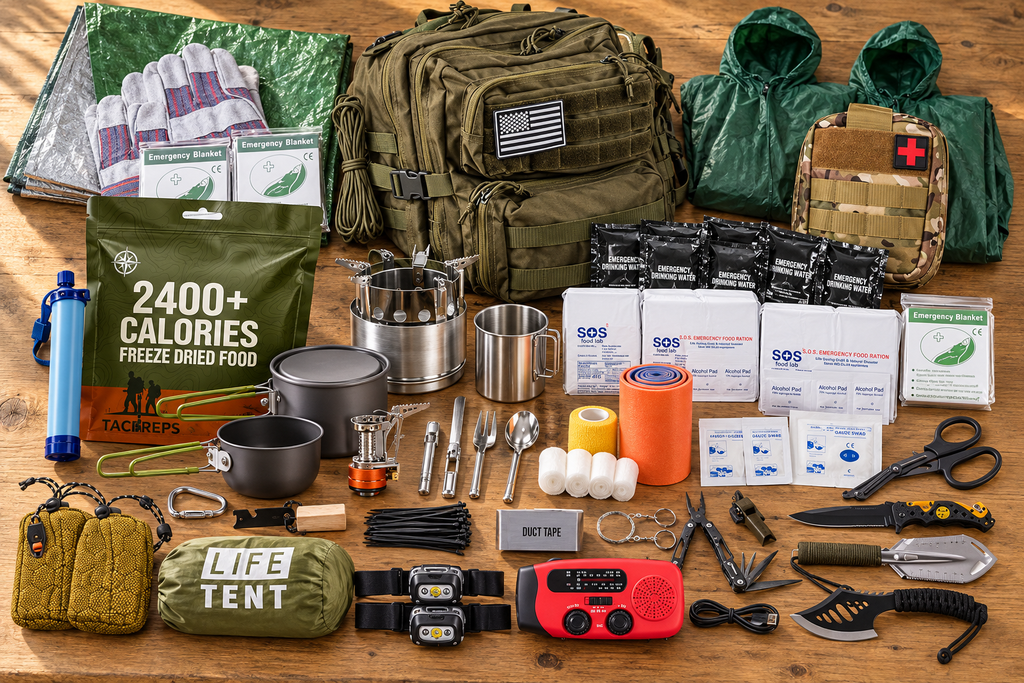
What it claims. The two-person tier lists “2400+ Calories Freeze Dried Meal, 2x Food Bar Packs (Total 7200 Calories)”, a water filter “processing up to 1,300 gallons”, and 12 water pouches. It also ships a portable stove, cookware and tinder, which nothing else on this list does.
What the numbers say. The food works out to 1,200 calories per person per day, the same ration the lifeboat bars are built around. The water is 1.5 litres for two people, which is about nine hours of drinking at the minimum. The filter is meant to close that gap, and in principle a filter is the right answer for a bag you have to carry. However, the listing never names the filter model, so we could not check its 1,300-gallon claim or find a certification for it. It also matters what kind of filter it is. The hollow-fibre straws and squeeze filters common in this price class remove bacteria and protozoa but not viruses. For a hike that is usually fine; for a flooded city it is not. We can’t tell you which this is, and neither can the listing.
What owners report. Missing items on arrival came up in more than one place, including in Forbes Vetted’s write-up. We found no corroborated long-term durability failure, but the evidence base here is thin.
Listing check. TacPreps sells this kit across several listings and tiers, and at least one tier is a “Deluxe without Food” version sold under the same “72 Hour Survival Kit” naming. Check which tier you have selected. A “72-hour kit” with no food in it is a real possibility on this page.
Who it’s actually for. A couple who wants the only kit here that lets them boil water and cook, and who will replace the filter with a named, certified model. At a stated 19 lb for the two-person version, it is also the heaviest bag here.
TacPreps 72-Hour Survival Kit on Amazon
2. EVERLIT Complete 72 Hours Earthquake Bug Out Bag
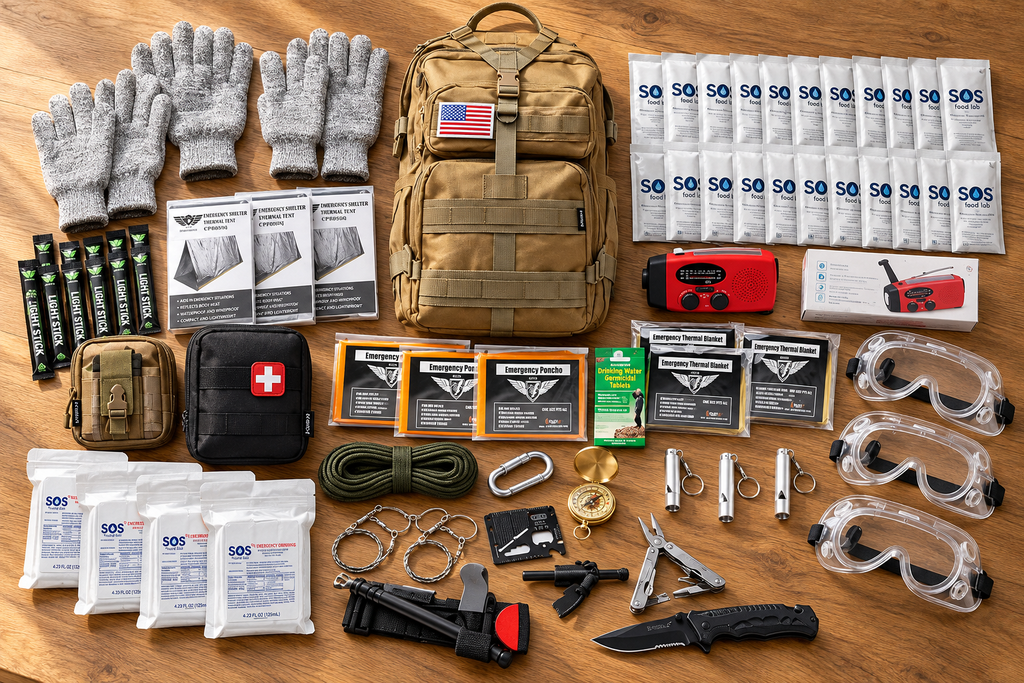
What it claims. “24 Packs of 125ML Emergency Drinking Water and 2 Packs of 3600 Calorie Emergency Food Bar”, both Coast Guard approved, with water purification tablets, a hand-crank radio, a 200-piece first aid kit and a “C-A-T Tourniquet (gen 7)”, all in a 1000D polyester MOLLE pack. The three-person version of the listing adds that it “Meets FEMA Guideline for a minimum 1000 calories/day/person”.
What the numbers say. Food comes to 1,200 calories per person per day. Stored water is three litres, double what most of the others carry, which still only covers about eighteen hours of drinking for two. The tablets are where this kit earns its place: the listing says they treat up to 25 quarts, about 23.7 litres. That is enough to cover the full drinking-minimum shortfall for two people over three days, provided you can find water to treat. The tablet chemistry isn’t stated, which matters, because chlorine-based tablets handle viruses well but struggle with Cryptosporidium.
As for the FEMA calorie guideline, we could not locate it. The Ready.gov guidance we found asks for a three-day supply of non-perishable food and gives no calorie figure. If EVERLIT has a source, the listing should cite it.
What owners report. We found no corroborated failure pattern. What we did find is telling in a different way: dozens of “we tested it” roundups describe this exact kit with contradictory contents — 2,400-calorie bars in one, 3,600 in another, anywhere from 6 to 36 water pouches. The Amazon listing itself is consistent. The roundups are not, which tells you how many of them had the bag in hand.
Listing check. The tourniquet deserves one paragraph of its own. Counterfeit C-A-T tourniquets sold on Amazon and eBay have failed during real use, according to a New Hampshire EMS clinical bulletin that relays North American Rescue’s own warning. We have no evidence that EVERLIT’s unit is counterfeit. We also have no way to confirm it is genuine. If you buy this kit, inspect the tourniquet against North American Rescue’s identification guidance before you trust a life to it.
Who it’s actually for. A household sheltering in place, or a couple who wants the most water and the most treatment capacity in one bag.
EVERLIT Complete 72 Hours Bug Out Bag on Amazon
3. Sirius Survival Pre-Packed Bug Out Bag, 2 People (50L)
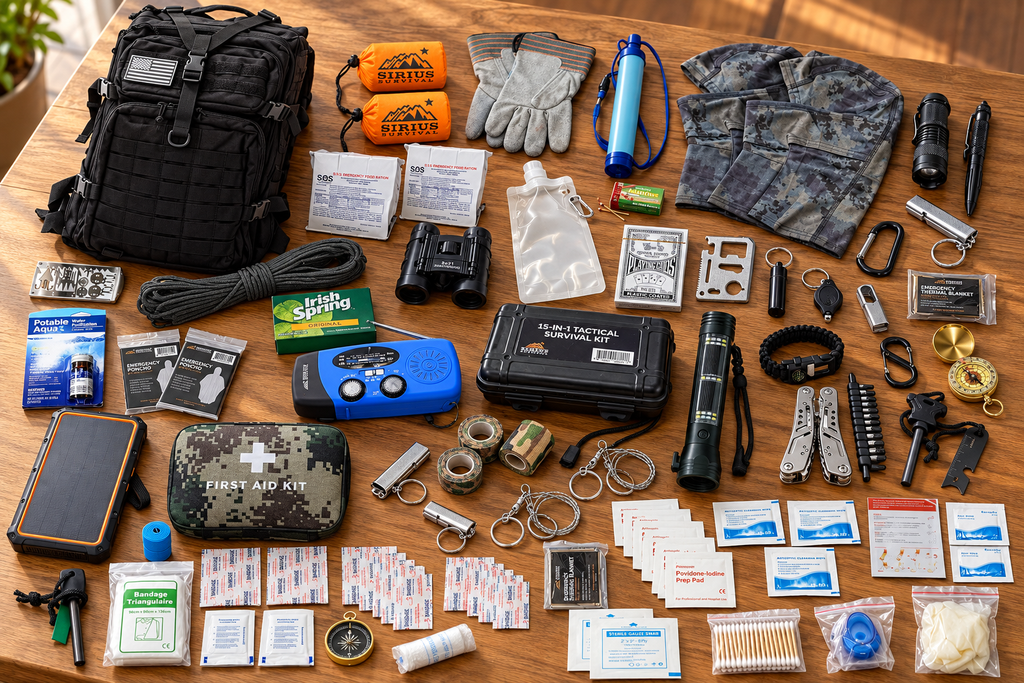
What it claims. SOS-brand 3,600-calorie rations, 24 pouches of 4.2-oz emergency water, a water filter straw, a 2-litre bladder, and a solar AM/FM/NOAA radio with a power bank.
What the numbers say. If the kit contains the 7,200 calories a secondary source reports, that is again 1,200 per person per day. The brand’s listing confirms the bar type but not the quantity, so treat that figure as unconfirmed. Stored water matches EVERLIT at three litres. The straw filter and bladder give it a genuine resupply path, but as with TacPreps, the filter is unnamed and uncertifiable, and the solar panel’s wattage and the power bank’s capacity aren’t stated anywhere we could find.
What owners report. Nothing corroborated. One roundup mentioned a missing notebook, which is a single report and not a pattern.
Who it’s actually for. On paper, the most self-sufficient bag here for a pair on the move. On evidence, the one we know least about. Confirm the contents on the live listing before you rely on it.
Sirius Survival Pre-Packed Bug Out Bag on Amazon
4. Ready America 70280 2-Person 3-Day Emergency Backpack
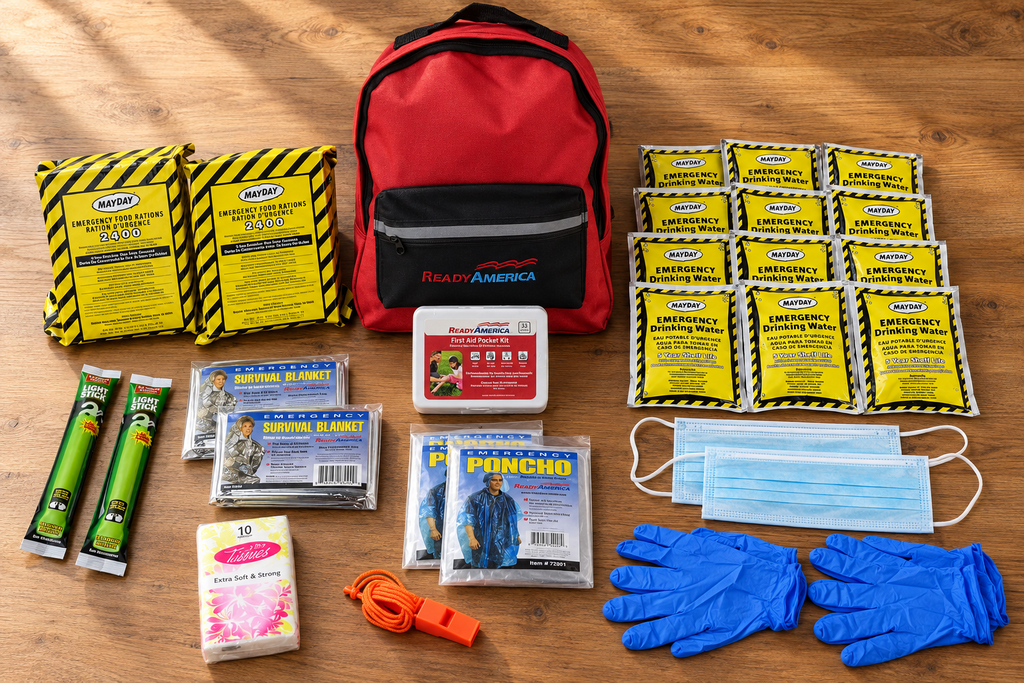
What it claims. “(2) Food Bars (2400 Calorie)”, “(12) Water Pouches (4.225 oz)”, two survival blankets, a 33-piece first aid kit, two 12-hour lightsticks, ponchos, masks and gloves.
What the numbers say. This is the thinnest kit in the group by a distance. Two 2,400-calorie bars across two people and three days is 800 calories per person per day. Twelve pouches is 1.5 litres. There is no water treatment of any kind, no blade, no fire source and no torch beyond two lightsticks.
4,800 kcal ÷ (2 people × 3 days) = 800 kcal per person per day
1.5 L ÷ (2 people × 2 L/day)     = 0.375 days ≈ 9 hours
One retailer’s copy for this exact model manages to say both “Sustains two people for three days” and “Everything two people need to survive for two days” on the same page. Neither is supported by the contents.
What owners report. The backpack itself is the recurring complaint. Reviewed.com’s hands-on test of a sibling Ready America kit called the backpack poor quality and uncomfortable when loaded; OFFGRID’s hands-on of the four-person version described it as flimsy with zippers that felt like they could fail; and owners of the 70280 say much the same. Those reports span the Ready America backpack family rather than this exact model alone, but they agree.
Who it’s actually for. Not a bug out bag. It is, however, a compact and cheap car-boot supplement, nothing to charge and small enough to forget about, if you put a case of bottled water next to it.
5. Emergency Zone Urban Survival Bug-Out Bag (2-Person)
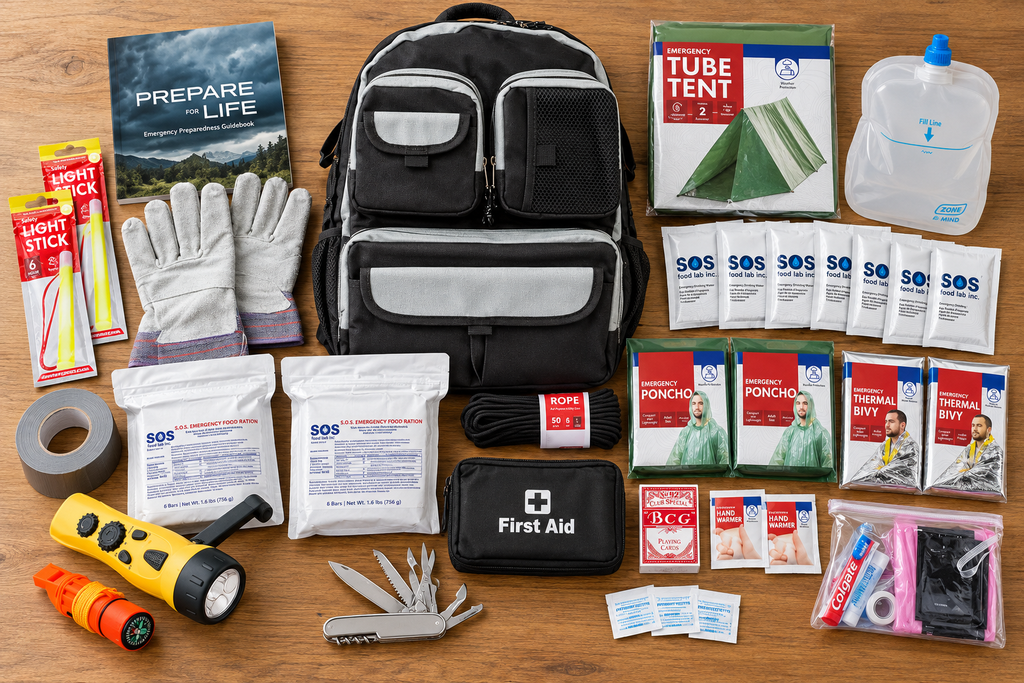
What it claims. Two 3,600-calorie food bars, 12 water pouches, a folding 1-litre container with five packets of Chlor-Floc purification powder, two reflective sleeping bags, a tube tent, hand warmers, a dynamo radio and flashlight, and a multitool, in a deliberately plain backpack. The listing adds that it is “Great for 2 person for 72 hours (3 days) or 1 person for 144 hours (6 days)”.
What the numbers say. Food is 1,200 calories per person per day. Stored water is 1.5 litres, and the five Chlor-Floc packets treat roughly five more, for 6.5 litres in total, a little over half the drinking minimum for two people across three days.
The “one person for 144 hours” line is the weakest claim in this entire investigation. Spread across six days, the stored water is 250 millilitres a day. Even with every treatment packet used, it comes to about 1.1 litres a day, against a minimum of two.
What owners report. No corroborated failure pattern found.
Who it’s actually for. Someone who values the discreet bag and the sleeping bags and tube tent, which are better shelter than most kits here offer, and who will add a proper filter.
Emergency Zone Urban Survival Bug-Out Bag on Amazon
Scored by scenario
We score against use cases rather than an overall “best”, because the lightest bag to walk out with and the best bag to leave in a car boot are rarely the same product. Where we had no evidence for a criterion, we scored it at the midpoint of 5 and say so; durability and weight were unevidenced for most of these kits.
Bug-out (72-hour carry)
| Criterion | Weight |
|---|---|
| Weight and packed volume | 30% |
| Durability under repeated handling | 25% |
| Function per gram | 25% |
| Independence from consumables (water treatment, recharge path) | 20% |
72-hour blackout (shelter in place)
| Criterion | Weight |
|---|---|
| Stored capacity (water, food, power) | 30% |
| Ease of use under stress | 25% |
| Reliability from cold storage | 25% |
| Resupply path without the grid | 20% |
Vehicle kit
| Criterion | Weight |
|---|---|
| Temperature and vibration tolerance | 35% |
| Shelf stability in storage | 30% |
| Works with zero maintenance | 20% |
| Compactness | 15% |
| Product | Bug-out | 72-hr blackout | Vehicle kit |
|---|---|---|---|
| TacPreps 72-Hour | 54 | 54 | 42 |
| EVERLIT Complete 72 Hours | 54 | 62 | 65 |
| Sirius Pre-Packed | 56 | 62 | 56 |
| Ready America 70280 | 46 | 43 | 65 |
| Emergency Zone Urban | 52 | 52 | 65 |
Best for a bug-out bag: no clear winner. Sirius edges ahead on paper, but the top three sit within a few points of each other and most of the gap rests on criteria we had to score at the midpoint. Pick on water treatment, and replace whatever filter ships with a named, certified one.
Best for a 72-hour blackout: EVERLIT and Sirius, tied. EVERLIT’s case is firmer, because its stored water and 25-quart tablet capacity are on the listing in plain numbers.
Best for a vehicle kit: a three-way tie between EVERLIT, Emergency Zone and, surprisingly, Ready America. The lifeboat rations tolerate heat, nothing needs charging, and in a car, weight is no penalty, so you can simply add water. TacPreps scores worst here because its rechargeable electronics and freeze-dried meal are the least suited to a summer car interior.
What we’d look for instead
Since no bag can carry three days of water, judge a 72-hour kit on what happens after the first day. Look for a filter or purifier identified by brand and model, so you can look up its certification. For a flooded or urban scenario, that means a purifier tested against NSF Protocol P231, which covers viruses, or chemical treatment whose chemistry is stated. Chlorine dioxide handles Cryptosporidium better than plain chlorine.
Do the calorie arithmetic yourself. Divide total calories by people, then by days. At 1,200 you have a ration; at 800 you have a problem.
Be wary of any listing that offers to stretch a two-person kit to one person for twice as long without telling you what the water works out to per day.
If a kit includes a tourniquet, assume nothing until you have checked it against the manufacturer’s identification guide.
And check which tier you are actually buying. In this category, the same title can sit above a version with no food in it.
The more uncomfortable conclusion is that the bag is the least important part of a bug out plan. A pre-packed kit buys you convenience and a decent first-aid and shelter starting point. It does not buy you water, and nothing in a backpack ever will. The question every buyer should really be asking is where the next twenty litres will come from.
Method and sources
Bestseller status was read on October 26, 2026 from Amazon’s Camping Survival Kits and Home Emergency Survival Kits Best Seller lists and Amazon search results for “bug out bag” and related terms. Rankings move constantly; this is a snapshot. We compared the two-person tier of each kit.
Standards and guidance used:
- Ready.gov kit guidance (via Georgia EMA) and UGA Extension on emergency water
- 46 CFR 160.046 — lifeboat and liferaft emergency provisions
- Canadian Red Cross listing for the SOS 3,600 kcal ration, with USCG approval number
- New Hampshire EMS Clinical Bulletin 27 on counterfeit C-A-T tourniquets
- Hands-on editorial testing of sibling Ready America kits by Reviewed and OFFGRID