
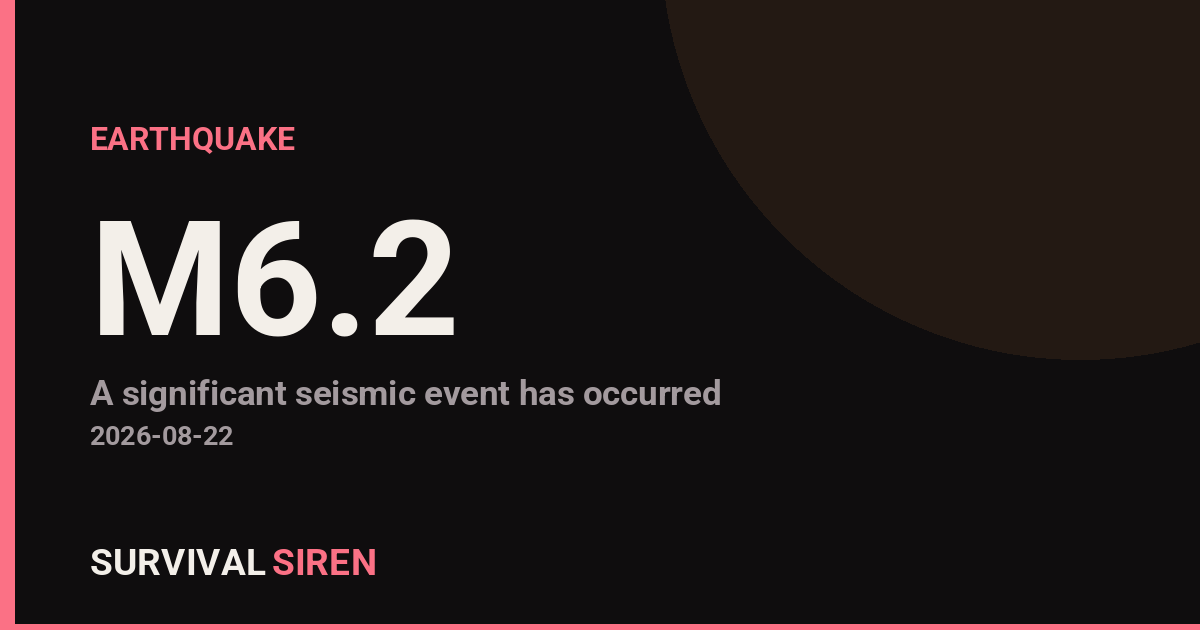
A magnitude 6.2 earthquake struck Scotia Sea at a depth of about 10 km, reported by the USGS. Earthquakes of this size can cause significant damage to vulnerable structures near the epicenter.
What this means for you
Most space weather passes without anyone noticing – but events like this are exactly why we watch the data. If conditions escalate, the first things affected are GPS accuracy, shortwave radio and, in severe cases, power grids. Now is a good moment to make sure your devices are charged and you know where your backup light sources are.
We track this in real time on our Space Weather Command Center – live storm levels, aurora maps and official NOAA alerts, explained in plain English.
Detected automatically from NOAA Space Weather Prediction Center data, August 22, 2026 at 08:45 UTC.
Source: USGS
Related Reading
- Earthquake Survival: Precautions, Kit & Early Warning in 2026
- Analyzing Low-Radiation Nuclear Explosions: Tactical Assessments and Survival Strategies
Sky & Solar Conditions at the Time
Moon: Waxing Gibbous (71% illuminated), in Sagittarius.
Notable planetary angles: Moon trine Mercury (120°), Venus opposite Saturn (179°), Jupiter trine Saturn (117°), Venus sextile Jupiter (63°).
Concurrent space weather: planetary Kp index 0.7; strongest recent solar flare: nothing notable.
This is a factual snapshot, not a claim of cause and effect – researchers are divided on whether lunar, planetary or solar factors influence seismic or weather activity. It’s included so readers can track the pattern for themselves over time.