
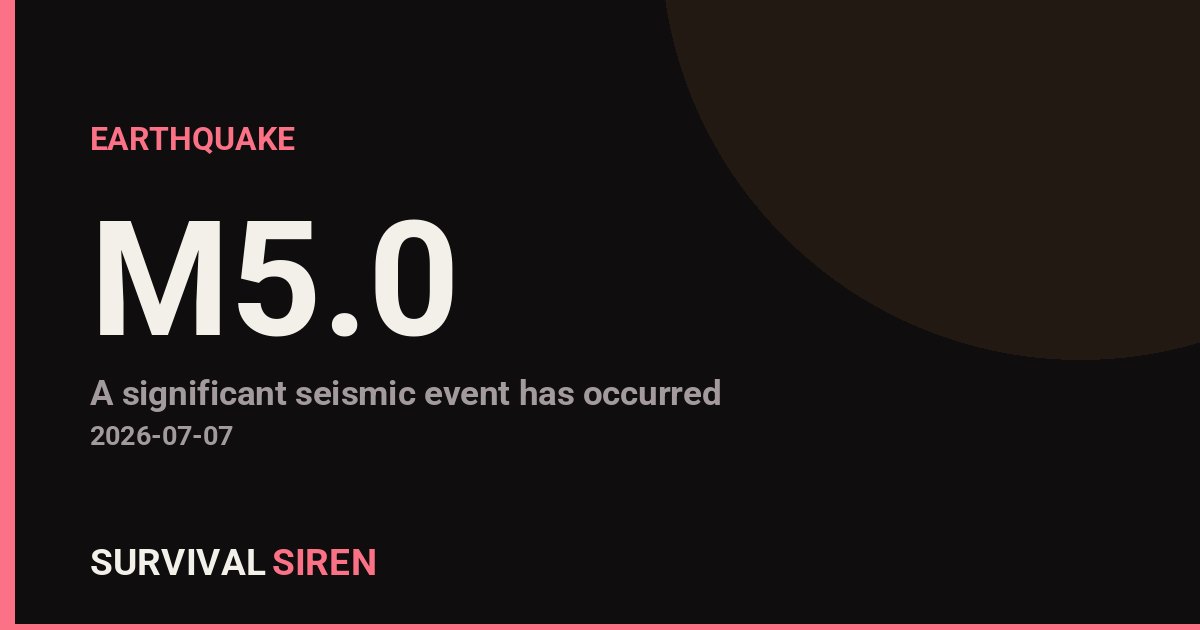
A magnitude 5.0 earthquake occurred at the Reykjanes Ridge, located off the coast of Iceland, at a depth of approximately 10 kilometers, according to the U.S. Geological Survey. While this is a moderate-sized seismic event, its remote ocean location means impacts on populated areas are expected to be limited.
The Reykjanes Ridge is part of the Mid-Atlantic Ridge system, a geologically active underwater mountain range where tectonic plates are continuously spreading. Earthquakes in this region are relatively common due to ongoing volcanic and tectonic activity.
What You Might Notice
Residents in coastal Iceland and nearby areas may have felt noticeable shaking, though the remote offshore location means the earthquake’s effects diminish quickly with distance. There is no tsunami warning issued at this time for this event.
Who Is Affected: Primarily Iceland and adjacent coastal communities. Distant populations are unlikely to experience any effects.
Practical Watch Items:
1. Monitor official channels: Check USGS earthquake updates and Iceland’s Icelandic Meteorological Office for any follow-up activity, including aftershocks or volcanic monitoring updates, as this region can experience both seismic and volcanic events.
2. Stay aware of local conditions: If you’re in Iceland or North Atlantic coastal areas, keep emergency supplies accessible and know your evacuation routes—standard earthquake preparedness applies even when events occur offshore.
3. Review your earthquake kit: This is a good reminder to check that household emergency supplies (water, first aid, flashlights, batteries) are current and accessible, regardless of your location’s seismic risk level.
For real-time space weather and seismic activity tracking, visit the live dashboard at https://survivalsiren.com/spaceweather/feed.html, powered by NOAA and USGS data.
Sky Conditions at the Time
Moon: Last Quarter (55% illuminated), in Aries.
Notable planetary angles: Sun square Saturn (91°), Moon sextile Mars (56°).
This is a factual snapshot, not a claim of cause and effect – researchers are divided on whether lunar, planetary or solar factors influence seismic or weather activity. It’s included so readers can track the pattern for themselves over time.
Earthquakes Within ~400 km, Past 30 Days
For context, here is other recent seismic activity in the surrounding region (M2.5+, via USGS):
| Date & Time (UTC) | Magnitude | Location |
|---|---|---|
| 2026-07-07 05:55 UTC | M5.3 | Reykjanes Ridge |
| 2026-07-07 05:00 UTC | M5.0 | Reykjanes Ridge |
| 2026-07-07 04:56 UTC | M4.4 | Reykjanes Ridge |
| 2026-07-04 15:25 UTC | M4.4 | Reykjanes Ridge |
| 2026-07-04 14:13 UTC | M4.2 | Reykjanes Ridge |
| 2026-07-04 12:42 UTC | M5.0 | Reykjanes Ridge |
| 2026-07-04 12:34 UTC | M5.0 | Reykjanes Ridge |
| 2026-07-04 12:32 UTC | M4.4 | Reykjanes Ridge |
| 2026-07-04 12:26 UTC | M4.9 | Reykjanes Ridge |