
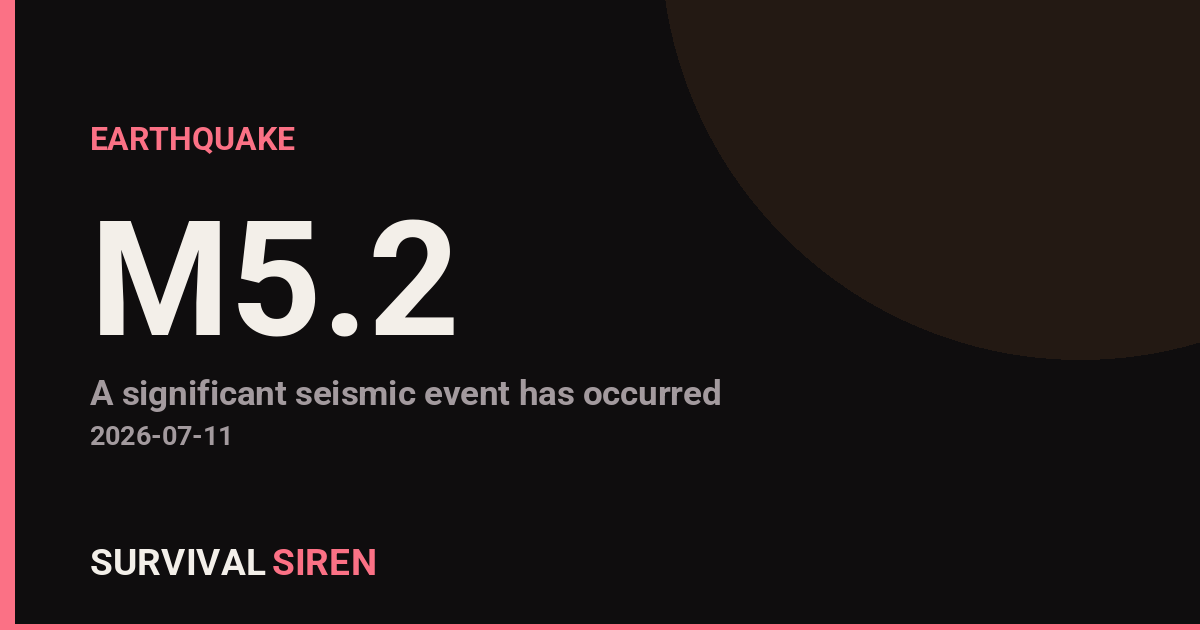
A magnitude 5.2 earthquake struck approximately 56 kilometers south-southwest of Sarangani, Philippines early today. The USGS reported the quake originated at a depth of about 62 kilometers beneath the seafloor, which is relatively deep and typically reduces potential damage compared to shallower events.
Residents in Sarangani and nearby provinces likely felt moderate shaking. Earthquakes of this magnitude can be felt over a wide area but rarely cause significant structural damage, particularly in well-constructed buildings. The deeper depth means energy dispersed more gradually rather than concentrating at the surface.
Who This Affects
The primary impact zone includes Sarangani Province and surrounding areas in Mindanao’s southern region. Coastal communities should be aware that any undersea earthquake warrants brief tsunami monitoring, though the USGS and Pacific Tsunami Warning Center assess risk based on depth and location.
People across the broader region—including General Santos City and nearby provinces—may have experienced noticeable shaking that likely caused no lasting effects beyond knocked-over items.
What to Watch For
1. Aftershocks: Earthquakes of this size sometimes trigger smaller aftershocks in the following hours or days. These are typically weaker but worth noting if you feel additional tremors.
2. Tsunami alerts: Monitor official Philippine Institute of Volcanology and Seismology (PHIVOLCS) and Pacific Tsunami Warning Center updates for any coastal advisories, though deep earthquakes rarely generate dangerous waves.
3. Structural checks: If you live in the affected region, walk through your home to check for any new cracks in walls or ceilings and ensure heavy items remain securely positioned.
This is a reminder that earthquake preparedness—securing furniture, knowing safe spots in your home, and having emergency supplies accessible—remains one of the most practical steps for anyone living in seismic zones.
Data sourced from USGS earthquake monitoring. For real-time space weather and natural hazard tracking, visit our live dashboard.
Source: USGS
Related Reading
Sky Conditions at the Time
Moon: Waning Crescent (10% illuminated), in Gemini.
Notable planetary angles: Sun conjunct Mercury (2°), Moon sextile Saturn (58°), Moon conjunct Mars (3°).
This is a factual snapshot, not a claim of cause and effect – researchers are divided on whether lunar, planetary or solar factors influence seismic or weather activity. It’s included so readers can track the pattern for themselves over time.
Earthquakes Within ~400 km, Past 30 Days
For context, here is other recent seismic activity in the surrounding region (M2.5+, via USGS):
| Date & Time (UTC) | Magnitude | Location |
|---|---|---|
| 2026-07-18 02:23 UTC | M5.3 | 119 km SW of Sarangani, Philippines |
| 2026-07-17 16:12 UTC | M5.2 | 11 km SE of Kiupo, Philippines |
| 2026-07-16 05:55 UTC | M4.7 | 86 km SSW of Sarangani, Philippines |
| 2026-07-14 15:49 UTC | M6.2 | 32 km WSW of Sarangani, Philippines |
| 2026-07-14 13:15 UTC | M5.2 | 6 km NW of Nuing, Philippines |
| 2026-07-14 06:37 UTC | M4.4 | 191 km N of Tobelo, Indonesia |
| 2026-07-14 01:38 UTC | M4.6 | 34 km SE of Sarangani, Philippines |
| 2026-07-13 17:44 UTC | M5.0 | 5 km SE of Butulan, Philippines |
| 2026-07-12 22:10 UTC | M4.4 | 167 km SSE of Sarangani, Philippines |
| 2026-07-12 00:43 UTC | M4.9 | 241 km NNW of Tobelo, Indonesia |
| 2026-07-11 10:51 UTC | M5.4 | 41 km S of Sarangani, Philippines |
| 2026-07-11 00:47 UTC | M4.7 | 1 km SE of Batiano, Philippines |
| 2026-07-10 15:25 UTC | M4.4 | 1 km E of Caraga, Philippines |
| 2026-07-10 12:42 UTC | M4.5 | 7 km SE of Sarangani, Philippines |
| 2026-07-09 21:55 UTC | M4.5 | 145 km NNW of Ternate, Indonesia |
| 2026-07-09 17:50 UTC | M4.5 | 59 km WSW of Balangonan, Philippines |
| 2026-07-09 16:36 UTC | M4.6 | 43 km SSW of Sarangani, Philippines |
| 2026-07-08 13:35 UTC | M4.3 | 85 km SW of Balangonan, Philippines |
| 2026-07-08 04:36 UTC | M4.3 | 43 km SW of Balangonan, Philippines |
| 2026-07-07 14:21 UTC | M4.5 | 172 km NNW of Tobelo, Indonesia |
Emergency number for Philippines: 911 (General guidance – always verify locally, as this can vary by region.)