
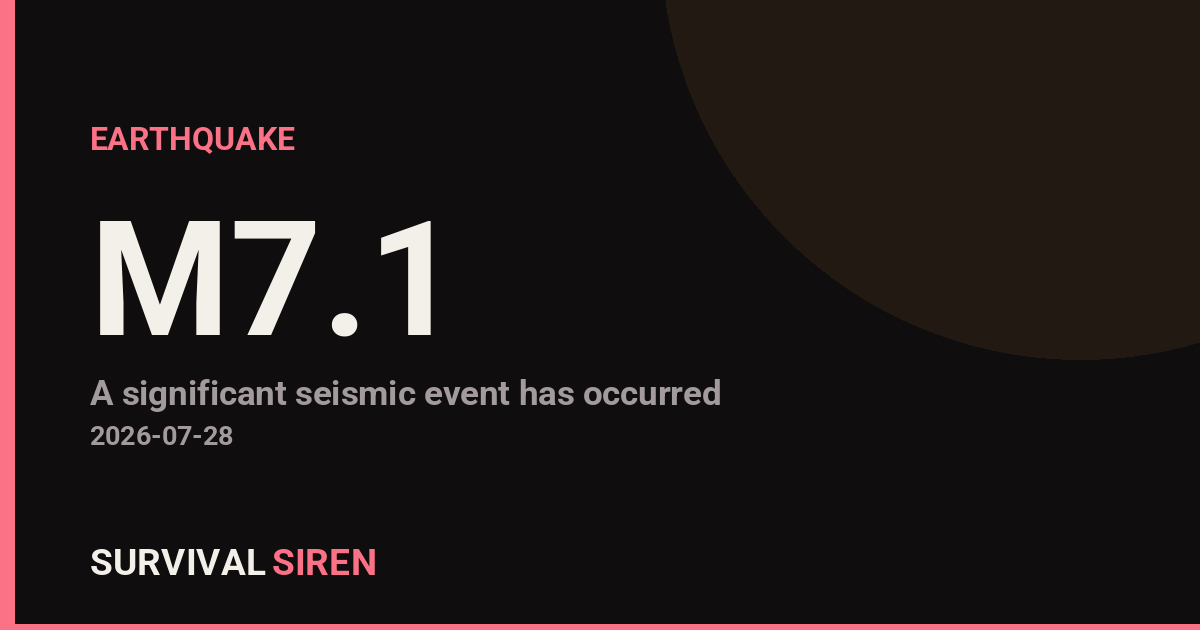
A magnitude 7.1 earthquake struck approximately 4 kilometers southeast of Uki, Japan at a shallow depth of 10 kilometers, according to the U.S. Geological Survey. This is a major earthquake—strong enough to cause significant damage in the immediate area and potentially generate a tsunami if underwater rupture occurred.
What Residents and Travelers Might Experience
People in and around the Uki region will have felt strong shaking, with potential for structural damage to buildings, infrastructure disruptions, and landslides in hilly terrain. Coastal areas should be alert for tsunami waves, which can arrive within minutes of a shallow earthquake and may continue for several hours.
Who Is Affected
This impacts residents and visitors throughout the Kumamoto Prefecture region and surrounding areas. Japan’s sophisticated earthquake early-warning system has likely already alerted the public; however, those in remote or coastal zones should verify official Japanese Meteorological Agency (JMA) updates for tsunami guidance and evacuation orders.
Practical Watch Items
1. Tsunami alerts: Monitor official Japanese authorities and international tsunami warning centers for coastal impact forecasts. Even if no tsunami develops, remain cautious for 2–3 hours after the initial quake.
2. Aftershocks: Magnitude 7+ earthquakes commonly trigger aftershocks of 5.0 or greater. Expect secondary shaking and take precautions accordingly—stay away from damaged structures and be prepared to drop, cover, and hold on again.
3. Infrastructure status: Roads, power, and water services may be disrupted. Keep battery-powered radios, flashlights, and bottled water accessible if you’re in the region.
For real-time updates on seismic activity and related hazards, visit our live space weather and geological monitoring dashboard at https://survivalsiren.com/spaceweather/feed.html, which aggregates data from NOAA and the USGS.
Source: USGS
Related Reading
- Earthquake Survival: Precautions, Kit & Early Warning in 2026
- Analyzing Low-Radiation Nuclear Explosions: Tactical Assessments and Survival Strategies
Sky & Solar Conditions at the Time
Moon: Full Moon (98% illuminated), in Capricorn.
Notable planetary angles: Venus square Mars (90°), Sun conjunct Jupiter (1°), Moon trine Venus (121°), Mercury square Saturn (92°).
Concurrent space weather: planetary Kp index 1.3; strongest recent solar flare: nothing notable.
This is a factual snapshot, not a claim of cause and effect – researchers are divided on whether lunar, planetary or solar factors influence seismic or weather activity. It’s included so readers can track the pattern for themselves over time.
Earthquakes Within ~400 km, Past 30 Days
For context, here is other recent seismic activity in the surrounding region (M2.5+, via USGS):
| Date & Time (UTC) | Magnitude | Location |
|---|---|---|
| 2026-07-16 21:49 UTC | M5.2 | 48 km E of Nishinoomote, Japan |
| 2026-06-30 23:40 UTC | M4.8 | 10 km W of Hyūga, Japan |
Emergency number for Japan: 110 (police) / 119 (fire & ambulance) (General guidance – always verify locally, as this can vary by region.)