
Just over half the lower 48 states were sitting in drought as of early 2026, and North Carolina had the dubious distinction of becoming the first state on record, since systematic monitoring began in 1895, to have every single one of its 100 counties inside a drought boundary at the same time. California’s response tells you how seriously water managers are taking it: all 13 major cities tracked across the state are now under mandatory restrictions, San Antonio has triggered its first Stage 3 water alert since 2024, and Austin has been rationing since mid-2025. None of this is a distant, theoretical scenario. It is the water situation much of the country is living through right now, and it is exactly the environment in which knowing how to catch and store your own rain stops being a fringe prepper hobby and starts being basic household resilience.
An Old Problem With an Old Solution
Catching rain is not a modern innovation dressed up in survivalist branding. Waterproof lime-plaster cisterns were already being built into the floors of Levantine houses by roughly 4000 BC, and the practice was independently refined across India, China, and Mesopotamia before the Romans formalized it into an engineering discipline. The most impressive ancient example sits in the desert at Petra, where the Nabataeans carved channels into cliff faces to funnel seasonal runoff into shaded, waterproofed underground cisterns, keeping the water cool and slowing evaporation in one of the driest climates in the ancient world. That system was sophisticated enough to sustain a city of an estimated 20,000 to 30,000 people in the middle of a desert, using nothing but gravity, stone channels, and an understanding of where rain actually goes when it falls. The physics have not changed since. Only the materials have.
Building the System: Catchment, First Flush, Storage
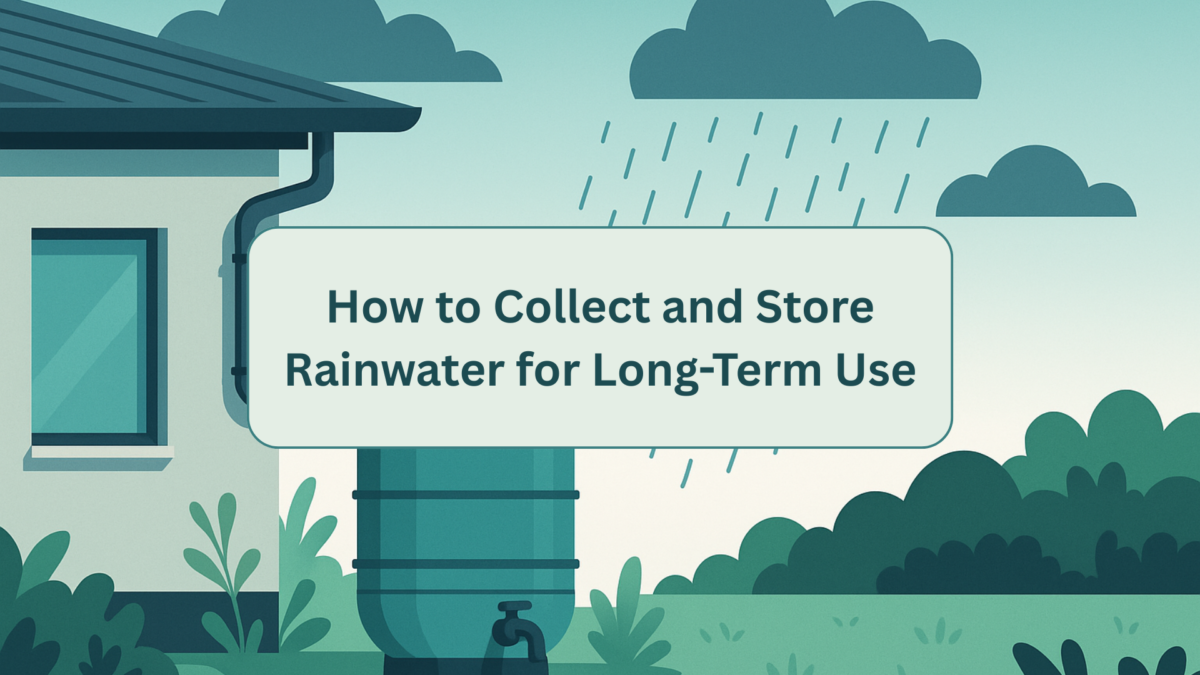
A rainwater system has three components, and skipping any one of them is where most amateur setups fail. The first is catchment area, almost always the roof, and the math on this is more generous than most people expect: one inch of rain falling on a 1,000-square-foot roof yields roughly 600 gallons, meaning a single moderate storm can fill several barrels without any effort beyond having somewhere to put the water. Roof material matters more than people assume. Research from the Texas Water Development Board found that metal roofing produces the cleanest runoff of common roofing materials, while asphalt shingles shed higher levels of dissolved organic carbon that complicate chlorine-based treatment later, though shingle roofs remain broadly usable if you filter and treat what comes off them.
The second component is the part most DIY setups skip, and it is the one that actually protects the water: a first-flush diverter. The opening minutes of any rainfall wash the accumulated dust, bird droppings, pollen, and roofing debris off the catchment surface, and that first flush carries the overwhelming majority of contamination in the entire collection event. A first-flush diverter is a simple standpipe fitted into the downspout that fills first, capturing that dirty initial runoff, and once it is full a float valve seals it off and routes the now-cleaner water onward into storage. It is a low-tech, largely passive device, and it is the single cheapest upgrade that meaningfully improves what ends up in your tank.
Storage itself should be food-grade, opaque, and sealed. Opaque matters because sunlight reaching stored water is what feeds algae blooms, and a tank kept dark and cool will stay usable far longer than one left exposed. Sealed matters because standing water is exactly what mosquitoes are built for: eggs laid in still water hatch into larvae within seven to ten days, so any gap, crack, or uncovered vent in a storage system is an open invitation. For anyone storing more than a couple of barrels’ worth, an underground or shaded cistern extends both of these advantages considerably, echoing, whether the builder realizes it or not, exactly what the Nabataeans figured out three thousand years ago.
Know the Legal Ground You’re Standing On
The good news is that rainwater collection is legal in all 50 states, and the federal government imposes no restriction on it whatsoever. The complication sits at the state level, and it is worth knowing before investing in a large system. Colorado, rooted in a prior-appropriation water rights doctrine that predates the state itself, caps residential collection at 110 gallons across no more than two containers, restricts use to outdoor, non-potable purposes, and requires that the water be used on the same property where it fell. Utah is more permissive but still regulated: residents may store up to 2,500 gallons, and any system exceeding 100 gallons or using more than two containers must be registered with the state, free of charge, under the amended water code. Every other state allows rainwater harvesting with few or no volume restrictions, and the practical threshold worth remembering is that staying under roughly 1,000 to 2,000 gallons of aboveground storage, used on your own property, keeps almost any household system clear of regulatory friction anywhere in the country.
Making It Safe to Drink
Collected rainwater is not automatically potable, and treating it as an emergency-only supply until it has been properly processed is the right default. Filtration removes sediment and larger particulates but does not reliably kill the smaller bacteria and viruses that can survive in stored water, so filtration on its own is a half-measure. Boiling water at a rolling boil for roughly five minutes has been shown to reduce fecal coliform counts by around 99 percent, though it does nothing for dissolved heavy metals or chemical contaminants that may have leached from roofing or piping. The more durable approach, and the one most water treatment guides converge on, is a layered barrier: pre-filter through mesh and sediment stages to strip out debris, then disinfect through chlorination, UV treatment, or boiling before drinking. Chlorine is the cheapest and most accessible option for most households, though it needs periodic replenishment, because its protective effect out-gasses over time, at which point stored water re-enters what maintenance guides call the caution zone and needs attention again.
That caution zone is worth taking seriously on its own. Water sitting in a properly sanitized, sealed tank is generally considered safe for roughly zero to three months. Between three and six months it tends to develop a stale, flat taste as dissolved oxygen escapes, and warm storage conditions accelerate both bacterial growth and algae blooms well before that window closes. Draining, scrubbing, and disinfecting the tank at least annually, storing it somewhere shaded, and periodically rotating stock rather than letting it sit indefinitely are the unglamorous habits that separate a working long-term water reserve from a barrel of stagnant liquid you discover too late is unsafe.
The Actual Payoff
None of this requires the scale of a Roman aqueduct or a Nabataean cliff system. A single 55-gallon barrel with a simple first-flush diverter, positioned under a downspout and kept sealed and shaded, will quietly accumulate more water than most households realize during an ordinary rainy season, and scaling that up to a few connected barrels or a proper cistern turns it into a real buffer against a municipal shutoff or a drought-driven restriction order. The households now facing mandatory watering days in Sacramento or historic Stage 3 alerts in San Antonio did not see those restrictions coming with much warning. The rain that will refill their reserves next season, however, is entirely predictable in one respect: it falls on the same roof it always has. The only question is whether anything is there to catch it.