
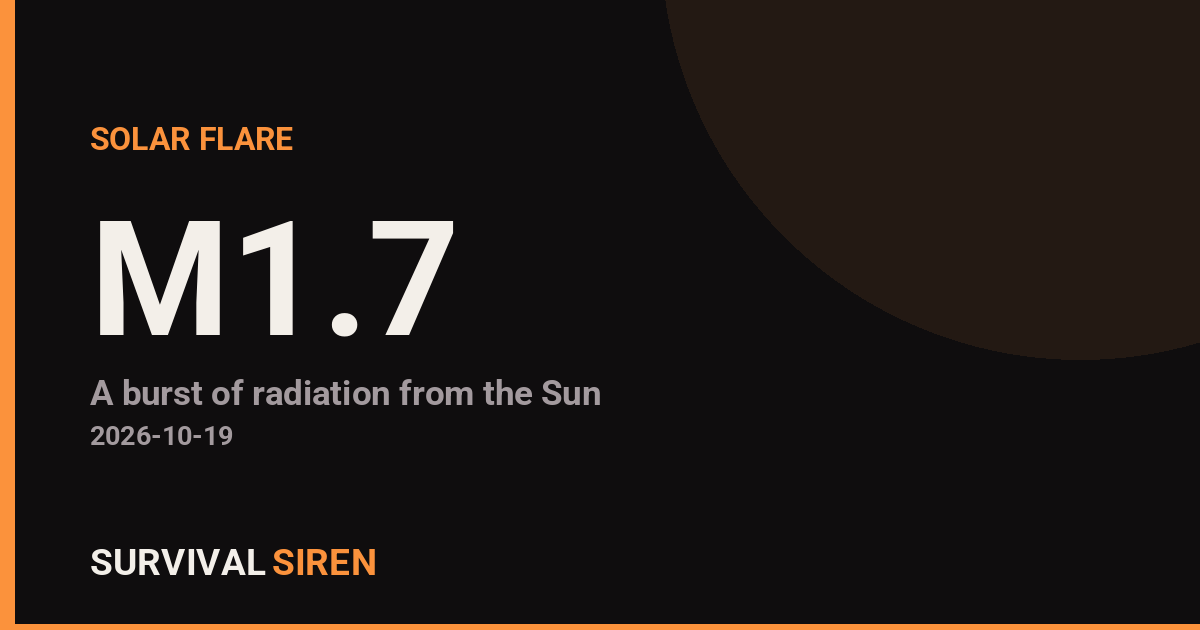
GOES satellites detected a M1.7-class solar flare that peaked at 09:03 UTC on October 19, 2026. Solar flares are sudden bursts of energy from the Sun’s surface, classified by strength from weakest to strongest as A, B, C, M, and X. An M-class flare is the second-strongest category – notable, but on the lower end of the range at 1.7. This flare’s X-ray flux measured 1.7e-5 watts per square meter.
Flares like this one can cause brief, immediate disruptions to high-frequency (shortwave) radio communications on the sunlit side of Earth. This event rates around R1 on NOAA’s radio blackout scale, the lowest level, which means minor degradation of shortwave radio signals for up to an hour or so. Amateur radio operators, aviation on polar routes, and ships relying on shortwave may have noticed static or dropped signals. Everyday services – cell phones, internet, TV, and most GPS use – are not affected by a flare of this size.
The thing worth watching now is whether this flare launched a coronal mass ejection (CME), a cloud of solar material, in Earth’s direction. If it did, that material would arrive in roughly 1 to 3 days and could trigger a geomagnetic storm. Forecasters will be watching the Kp index, a 0-9 scale measuring geomagnetic activity. A moderate storm could make auroras visible at higher latitudes than usual and cause minor fluctuations in power grids and satellite operations.
What to watch for
1. CME confirmation: Space weather forecasters will analyze satellite imagery over the next several hours to determine if a CME is Earth-directed. 2. Kp index: If a storm is forecast, a Kp of 5 or higher means auroras may be visible farther south than normal. 3. No action needed: There is nothing individuals need to do right now – this is a routine level of solar activity that occurs many times per year near solar maximum.
Data for this alert comes from NOAA’s Space Weather Prediction Center and the GOES satellite network.
Frequently Asked Questions
Is an M1.7 flare dangerous to people on the ground?
No. Earth's atmosphere and magnetic field protect us completely from flare radiation at the surface. M-class flares are common, especially near the peak of the solar cycle, and happen multiple times a month.
Will my phone, GPS, or internet stop working?
No. A flare of this size only affects high-frequency shortwave radio on the sunlit side of Earth, and only briefly. Consumer GPS, cell service, and internet are unaffected at the R1 blackout level.
Could this cause a power outage or a bigger storm later?
Not from the flare itself. The only scenario for grid effects would be if an associated CME hits Earth in 1-3 days, and even then an M1.7 flare typically produces, at most, a minor-to-moderate geomagnetic storm that grid operators routinely manage.
Will there be auroras from this event?
Possibly, but only if a CME was launched toward Earth and arrives in the next 1-3 days. If forecasts show a Kp index of 5 or higher, skywatchers at higher latitudes should check for aurora visibility after dark.
Keep tracking this:
Source: NOAA GOES X-ray Flux
Sky & Solar Conditions at the Time
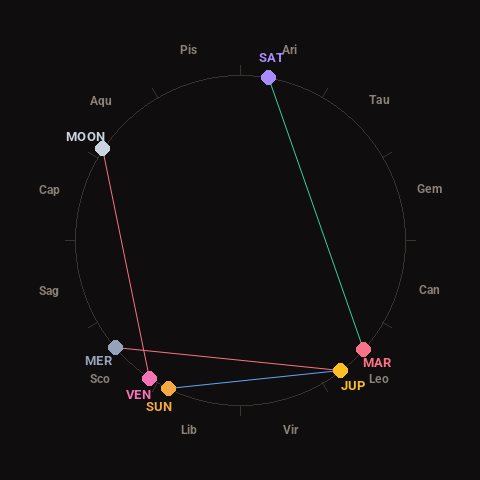
Moon: First Quarter (57% illuminated), in Aquarius.
Notable planetary angles: Moon square Venus (90°), Mars trine Saturn (122°), Mercury square Jupiter (87°), Sun sextile Jupiter (63°).
Concurrent space weather: planetary Kp index 0.3; strongest recent solar flare: M1.7-class.
This is a factual snapshot, not a claim of cause and effect – researchers are divided on whether lunar, planetary or solar factors influence seismic or weather activity. It’s included so readers can track the pattern for themselves over time.