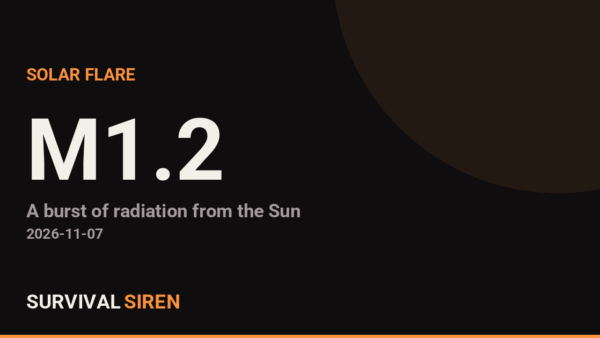

Satellites monitoring the Sun detected a moderate solar flare today, peaking at 18:42 UTC on November 7, 2026. The flare was classified as M2.0, a mid-level event on the scale scientists use to rank solar flares, which run from small C-class flares up through M-class and the largest X-class eruptions. For perspective, M-class flares are fairly common during active periods on the Sun and rarely cause problems for people on the ground.
A solar flare is a sudden burst of energy and radiation from the Sun’s surface. The energy travels at the speed of light, so its immediate effects – if any – arrive about eight minutes after the flare occurs. In this case, the flare was strong enough to potentially cause brief, minor disruptions to high-frequency shortwave radio signals on the sunlit side of Earth at the time it peaked. This falls at roughly the R1 level on NOAA’s radio blackout scale, which is the weakest category.
What you might notice
For the vast majority of readers: nothing at all. Everyday technology – cell phones, internet, television, and power service – is not affected by a flare of this size. The people most likely to notice anything are shortwave radio operators, aviation and marine radio users on the daytime side of the planet, and some emergency communication services that rely on high-frequency radio. Any such blackout would have been brief and is already over.
The more interesting question is what comes next. Solar flares sometimes launch a coronal mass ejection, or CME – a large cloud of solar material that travels more slowly, taking one to three days to reach Earth if it is aimed our way. If this flare produced an Earth-directed CME, a geomagnetic storm could follow, which can bring stronger auroras visible farther from the poles than usual and, in stronger cases, minor impacts to power grids and satellites. At this point, forecasters are still analyzing whether a CME was launched.
Sensible things to watch over the next couple of days: first, the Kp index, a simple 0-9 scale that measures geomagnetic activity – values of 5 or higher indicate a storm is underway. Second, if you enjoy aurora watching, check forecasts over the weekend, since a CME arrival could push the northern lights into view for mid-latitude locations. Third, there is no action needed regarding power, communications, or travel – this is a watch-and-see situation, not a prepare-for-impact one.
This alert is based on data from NOAA’s Space Weather Prediction Center and the GOES satellite fleet.
Frequently Asked Questions
What does an M2.0 flare actually mean?
M-class flares are the second-strongest category, and the 2.0 rating places this one near the low end of that class. It is a moderate, routine event – the Sun produces flares like this regularly during active periods.
Will this affect my phone, internet, or power?
No. A flare of this size has no impact on consumer electronics, the internet, or the power grid. Only shortwave radio users on the sunlit side of Earth may have noticed a brief, minor signal fade.
Is a geomagnetic storm coming?
Possibly, but it is not confirmed. Forecasters are checking whether the flare launched a coronal mass ejection toward Earth; if so, it would arrive in one to three days and could produce a geomagnetic storm, tracked via the Kp index.
Could I see the northern lights from this?
Only if an Earth-directed CME follows and triggers a geomagnetic storm. If that happens, auroras could be visible farther south than usual over the next one to three days – worth checking aurora forecasts this weekend.
Keep tracking this:
Source: NOAA GOES X-ray Flux
Sky & Solar Conditions at the Time
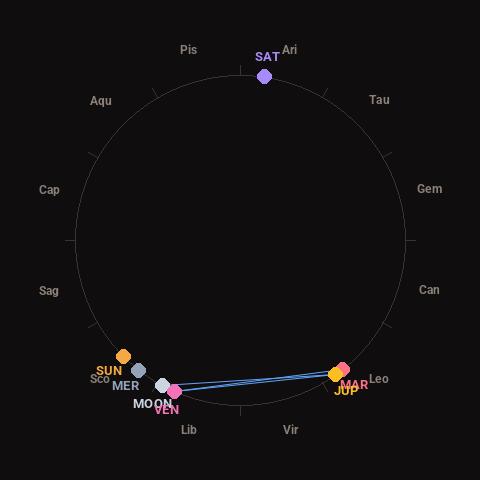
Moon: New Moon (2% illuminated), in Libra.
Notable planetary angles: Venus sextile Jupiter (59°), Venus sextile Mars (62°), Moon sextile Jupiter (63°), Mars conjunct Jupiter (3°).
Concurrent space weather: planetary Kp index 3.0; strongest recent solar flare: M2.0-class.
This is a factual snapshot, not a claim of cause and effect – researchers are divided on whether lunar, planetary or solar factors influence seismic or weather activity. It’s included so readers can track the pattern for themselves over time.