
What We Found
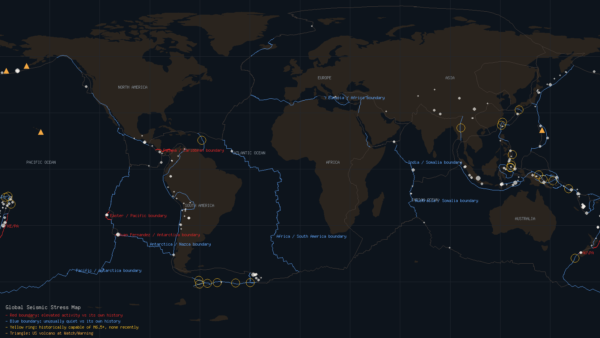
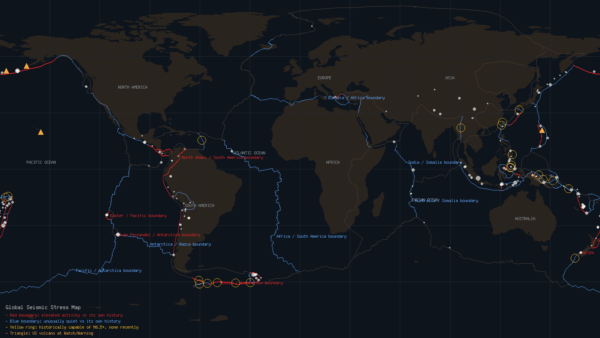
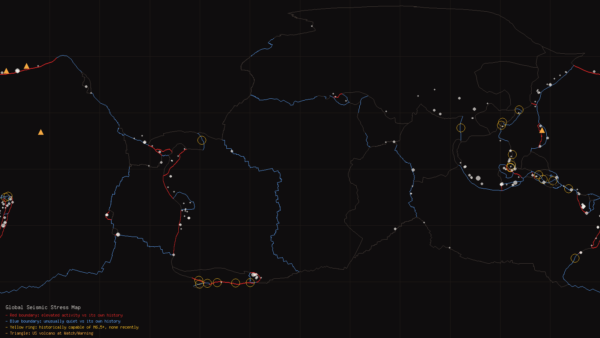
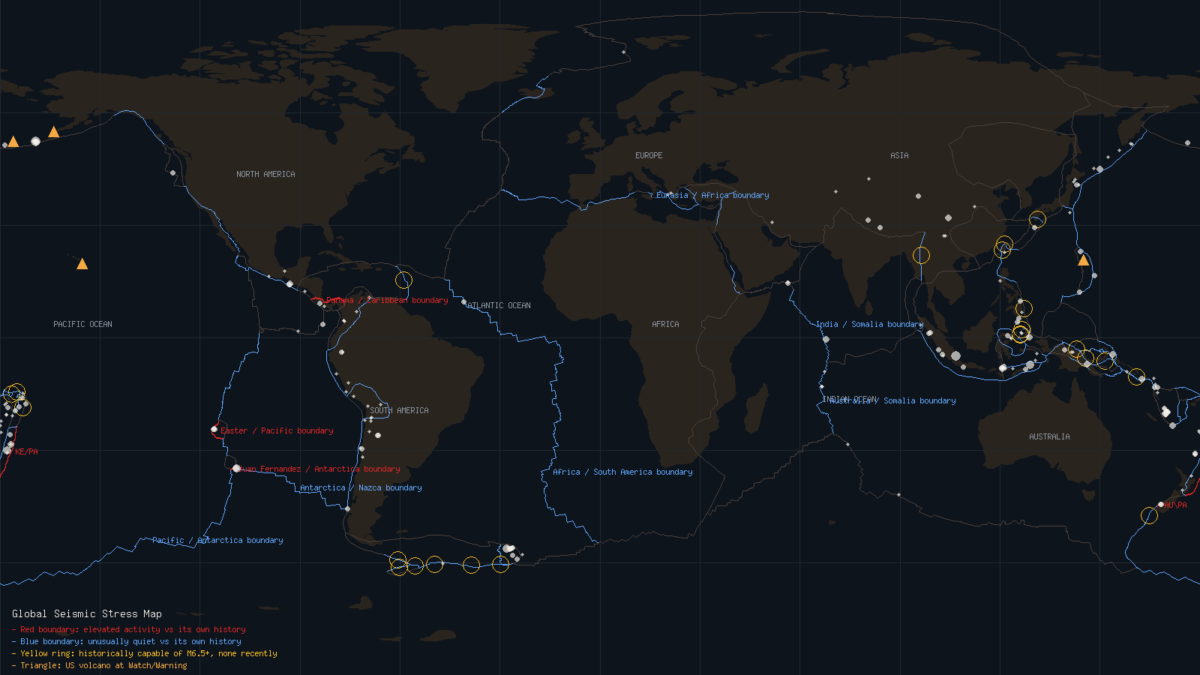
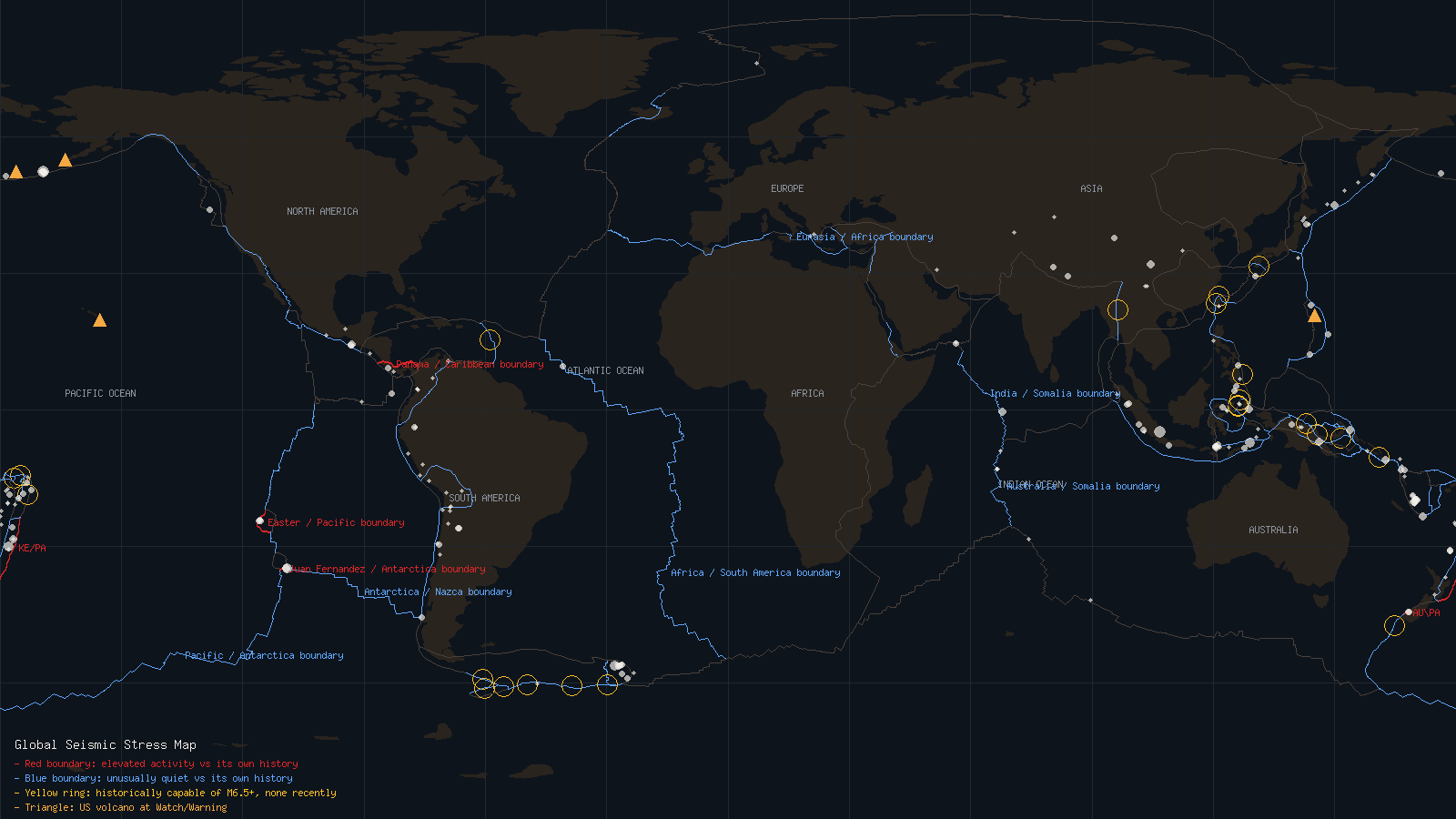
We looked at 200 earthquakes (magnitude 4.5 or bigger) recorded worldwide in the last 14 days, and compared activity in 241 major fault zones worldwide against each zone’s own long-term average.
Here’s the core idea, in plain words. Earthquakes happen when built-up pressure along a fault gets released. A fault zone that’s normally active but has gone unusually quiet may be building up pressure instead of releasing it regularly – that’s what scientists call a fault going quiet for longer than its history suggests it should. The flip side also matters: a zone suddenly busier than usual is releasing a lot of pressure right now.
Zones With More Earthquakes Than Usual
Five zones stood out for releasing far more energy than they normally do in two weeks. Energy matters more than raw counts here, because one big quake can outweigh many small ones.
The Easter / Pacific boundary, out in the remote South Pacific, has had 3 earthquakes in the last two weeks, releasing about 20.69 times its usual two-week energy – well above normal. The largest was a magnitude 5.2. This is the first time we’ve flagged this zone.
The Juan Fernandez / Antarctica boundary, also in the South Pacific off Chile, has had 2 earthquakes, releasing about 17.12 times its normal two-week energy. The largest was a magnitude 5.9. First time flagged.
The Australia / Pacific boundary near New Zealand’s South Island (listed as AU\PA) has had 2 earthquakes, releasing about 13.84 times its usual energy, with the largest at magnitude 5.3. First time flagged.
The Kermadec / Pacific boundary northeast of New Zealand (listed as KE/PA) has had 2 earthquakes, releasing about 4.11 times its normal energy. To be clear: most of that came from ONE large earthquake – a magnitude 5.8 – and its aftershocks. This was not many separate events spread across the zone, so it doesn’t point to widespread unrest. First time flagged.
The Panama / Caribbean boundary has had 1 earthquake, a magnitude 5.0, releasing about 2.66 times its usual two-week energy. First time flagged.
Zones That Have Gone Quiet
Six zones recorded zero earthquakes in the last two weeks. A quick honesty note: all six are zones that don’t average many quakes to begin with, so a quiet fortnight there is less striking than it would be on a very busy fault. Still, each one is worth listing.
The Australia / Somalia boundary, in the Indian Ocean, normally sees about 0.05 earthquakes every two weeks and has had none recently. Based on the data we have, this suggests pressure may be building there rather than being released – though with averages this low, quiet stretches are common.
The Eurasia / Africa boundary, near the Mediterranean, normally sees about 0.04 earthquakes every two weeks and has had none. Same caution applies.
The India / Somalia boundary, in the Indian Ocean, normally sees about 0.08 earthquakes every two weeks and has had none.
The Africa / South America boundary, in the South Atlantic, normally sees about 0.06 every two weeks and has had none.
The Antarctica / Nazca boundary, in the southeast Pacific, normally sees about 0.05 every two weeks and has had none.
The Pacific / Antarctica boundary, in the far southern Pacific, normally sees about 0.09 every two weeks and has had none.
All six are first-time flags, and none of these quiet zones is anywhere near a large population center on its immediate stretch.
A Word on Why Quiet Zones Matter
There’s a real historical example of pressure moving along a fault. In Turkey, a chain of major earthquakes moved westward along the North Anatolian Fault through the 1900s, starting with a magnitude 7.8 quake at Erzincan in 1939. Each quake added pressure to the next unbroken stretch of the fault to its west. By 1999, scientists had identified extra pressure building on the stretch near the city of Izmit – it then broke in the magnitude 7.6 Izmit earthquake in 1999. Today, scientists still watch the next unbroken stretch, near Istanbul, closely for the same reason. That’s why we track quiet stretches at all.
Volcanoes on Watch
An eruption is another way built-up underground pressure gets released, alongside earthquakes. Right now, two U.S. volcanoes are at Watch level. Great Sitkin in Alaska has a slow eruption of lava continuing within its summit crater. Kilauea in Hawaii is intermittently erupting short lava flows – over 100 recorded since the activity that began September 7 – and its next fountaining episode is likely today or tomorrow if current patterns hold. Shishaldin in Alaska and Ahyi Seamount in the Northern Mariana Islands are at the lower Advisory level, with low-level unrest and faint water discoloration respectively.
Our Track Record So Far
Here’s the honest scorecard. Across 3 of our past reports old enough to check, we flagged 14 zones total. Of those, 2 later had a magnitude 6 or bigger earthquake within 90 days. The other 12 did not. That’s a real signal – better than random – but it also means most of our flags don’t lead to a big quake in the following three months. We’ll keep publishing these counts every report so you can judge for yourself.
What This Doesn’t Tell Us
No scientist can predict exactly when or where an earthquake will strike. This report is just tracking real patterns over time, and a quiet zone is not guaranteed to have a big earthquake – many quiet stretches end with nothing at all. Think of this as a weather map for underground pressure, not a forecast you can set your watch by.