
What We Found
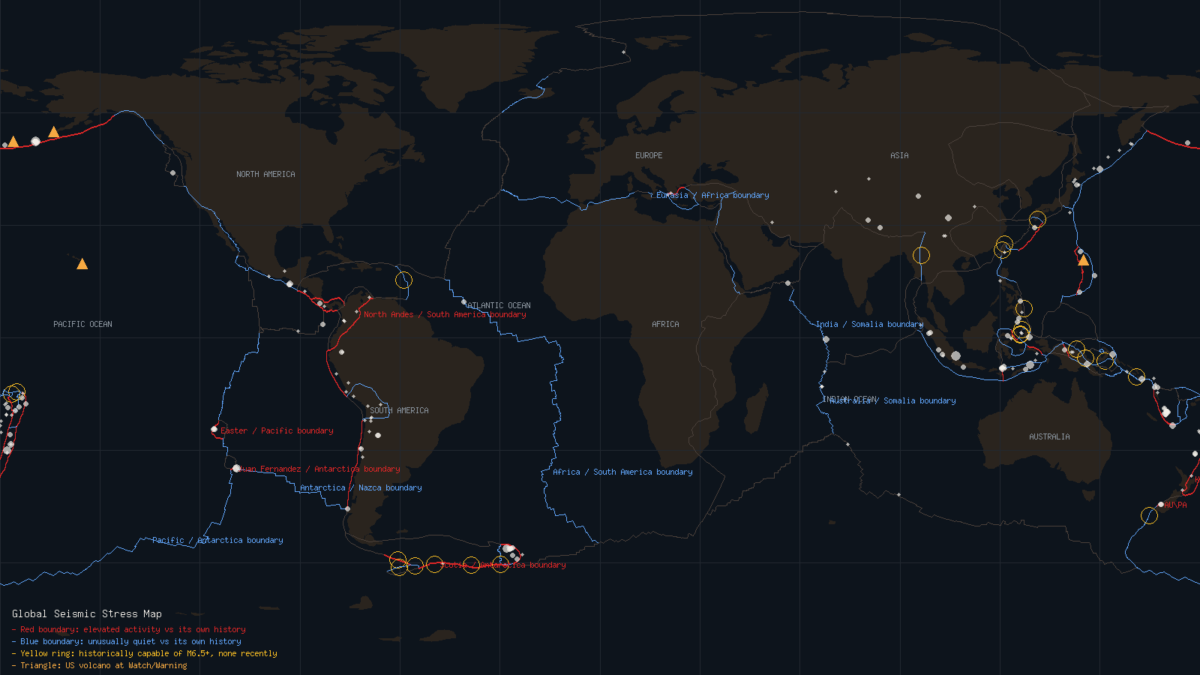
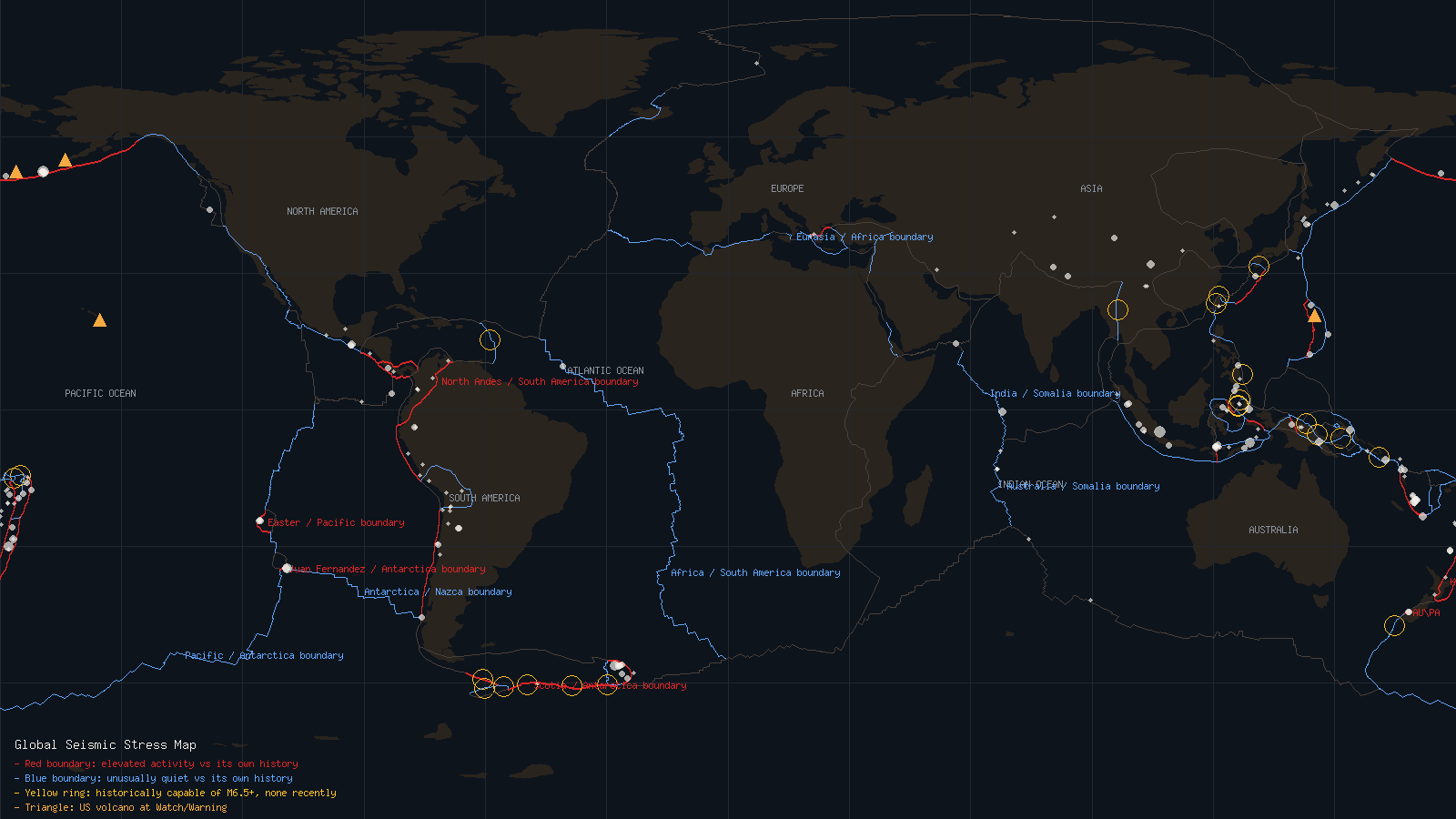
We looked at 198 earthquakes (magnitude 4.5 or bigger) recorded worldwide in the last 14 days, and compared activity in 241 major fault zones worldwide against each zone’s own long-term average.
Here’s the basic idea behind this report. Earthquakes happen when built-up pressure along a fault gets released. A fault zone that’s normally active but has gone unusually quiet may be building up pressure instead of releasing it regularly – that’s what scientists call a fault going quiet for longer than its history suggests it should.
Zones With More Earthquakes Than Usual
The Australia/Pacific plate boundary near New Zealand has had 2 earthquakes in the last two weeks, compared to its usual average of about 0.04 – well above normal. The largest recent one was a magnitude 5.3. This is the first time we’ve flagged this zone.
The Easter/Pacific boundary, out in the South Pacific, has had 3 earthquakes in the last two weeks, compared to its usual average of about 0.09 – well above normal. The biggest was a magnitude 5.2. First time flagged.
The Juan Fernandez/Antarctica boundary, also in the South Pacific, has had 2 earthquakes in the last two weeks, compared to its usual average of about 0.06 – well above normal. Its largest recent quake was a magnitude 5.9, the biggest of this fortnight’s elevated zones. First time flagged.
The Kermadec/Australia boundary, northeast of New Zealand, has had 1 earthquake in the last two weeks, compared to its usual average of about 0.04 – well above normal. It was a magnitude 4.5. First time flagged.
The Scotia/Antarctica boundary, down in the far South Atlantic, has had 1 earthquake in the last two weeks, compared to its usual average of about 0.04 – well above normal. It measured magnitude 4.6. First time flagged.
The North Andes/South America boundary, running through Colombia, has had 1 earthquake in the last two weeks, compared to its usual average of about 0.04 – well above normal. It was a magnitude 4.5. First time flagged.
One thing worth noting: these zones are all normally very quiet, so even one or two moderate earthquakes counts as a big jump. None of the recent quakes came close to the largest each zone has produced in its 3-year history. For example, the Juan Fernandez/Antarctica boundary has seen a magnitude 6.3 before, and the Scotia/Antarctica boundary a magnitude 6.2.
Zones That Have Gone Quiet
The Australia/Somalia boundary, in the Indian Ocean, normally sees about 0.05 earthquakes every two weeks but has had 0 recently. Based on the data we have, this suggests pressure may be building there rather than being released. Its largest quake in the last 3 years was a magnitude 6.3. First time flagged.
The Eurasia/Africa boundary, running through the Mediterranean region, normally sees about 0.04 earthquakes every two weeks but has had 0 recently. Based on the data we have, this suggests pressure may be building there rather than being released. Its 3-year largest was a magnitude 6.2. First time flagged.
The India/Somalia boundary, in the Indian Ocean, normally sees about 0.08 earthquakes every two weeks but has had 0 recently. Based on the data we have, this suggests pressure may be building there rather than being released. Its 3-year largest was a magnitude 5.4. First time flagged.
The Africa/South America boundary, in the mid-Atlantic, normally sees about 0.06 earthquakes every two weeks but has had 0 recently. Based on the data we have, this suggests pressure may be building there rather than being released. Its 3-year largest was a magnitude 6.2. First time flagged.
The Antarctica/Nazca boundary, in the South Pacific, normally sees about 0.05 earthquakes every two weeks but has had 0 recently. Based on the data we have, this suggests pressure may be building there rather than being released. Its 3-year largest was a magnitude 5.7. First time flagged.
The Pacific/Antarctica boundary, in the remote southern Pacific, normally sees about 0.09 earthquakes every two weeks but has had 0 recently. Based on the data we have, this suggests pressure may be building there rather than being released. Its 3-year largest was a magnitude 6.2. First time flagged.
To be fair, these are all zones with low normal activity, so a quiet fortnight isn’t shocking on its own. We flag them so we can watch whether the quiet continues over multiple reports.
Why Quiet Zones Are Worth Watching
There’s a real example of why this idea matters. In Turkey, a real chain of major earthquakes moved westward along the North Anatolian Fault through the 1900s, starting with a magnitude 7.8 quake at Erzincan in 1939. Each quake added pressure to the next unbroken stretch of the fault to its west. By 1999, scientists had identified extra pressure building on the stretch near the city of Izmit – it then broke in the magnitude 7.6 Izmit earthquake in 1999. Today, scientists still watch the next unbroken stretch, near Istanbul, closely for the same reason. Pressure that isn’t released in one place often shows up next door.
U.S. Volcanoes on Watch
An eruption is another way built-up underground pressure gets released, alongside earthquakes, so we keep an eye on U.S. volcano alerts too. Right now, two volcanoes are at Watch level. Great Sitkin in Alaska has a slow eruption of lava continuing within its summit crater, with weak seismicity. Kilauea in Hawaii is intermittently erupting short lava flows – over 100 recorded since activity began on September 7 – and the next fountaining episode is likely today or tomorrow if current ground-swelling patterns hold. Two more are at Advisory level: Shishaldin in Alaska, with continuing low-level unrest, and Ahyi Seamount in the Northern Mariana Islands, where satellite images show faint water discoloration but no significant geophysical signals.
What This Doesn’t Tell Us
Here’s the honest bottom line: no scientist can predict exactly when or where an earthquake will strike. This report is just tracking real patterns over time, and a quiet zone is not guaranteed to have a big earthquake. Some of this fortnight’s flags may drop off the list next time – that’s normal. What matters is the pattern across many reports, and we’ll keep watching.