
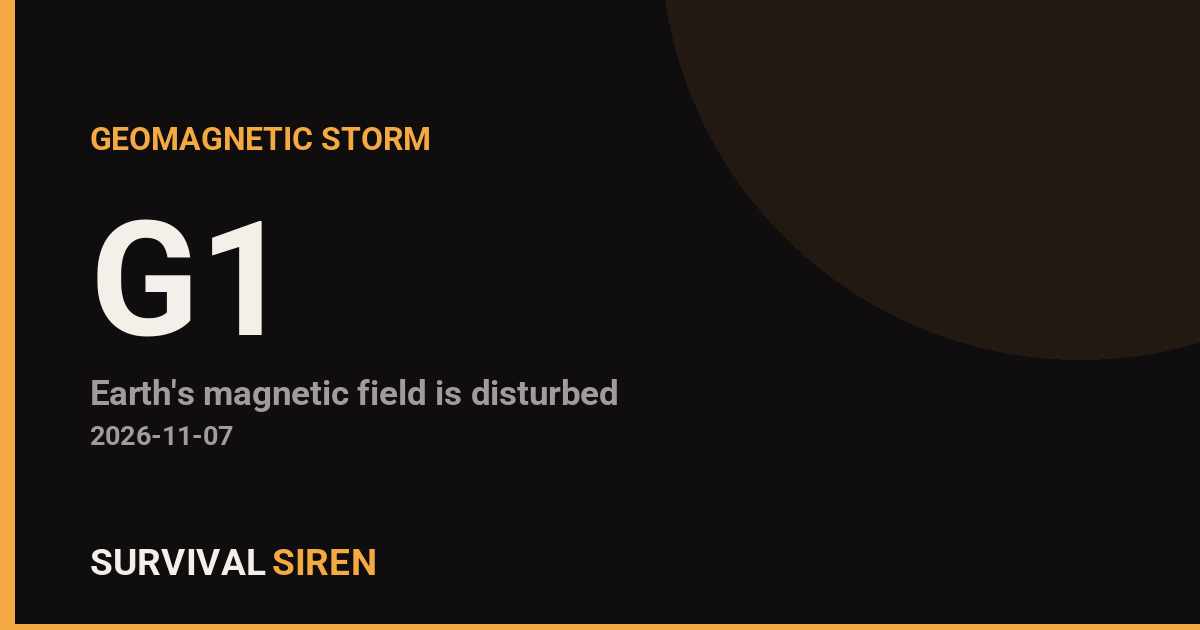
A minor geomagnetic storm is currently underway, with the planetary Kp index reaching 5.3 — enough to cross the threshold for a G1 (Minor) storm on NOAA’s five-level scale. This is the lowest level on that scale, and events like this happen fairly often, typically dozens of times per year.
The most noticeable effect for most readers will be the aurora borealis. At this storm level, the northern lights may be visible in high-latitude regions including Canada, Alaska, the northern-tier United States (such as Washington, Montana, North Dakota, Minnesota, Wisconsin, Michigan, and Maine), Scotland, and Scandinavia — assuming dark, clear skies away from city lights.
Practical impacts at G1 level are limited. Power grid operators may see minor fluctuations and could make small voltage adjustments, but household electricity is not expected to be affected. Satellite operators may notice minor impacts on spacecraft operations, and some migratory animals that navigate using Earth’s magnetic field can be temporarily affected. Everyday technology — phones, navigation apps, and radio — should continue working normally at this storm intensity.
What to keep in mind
If you live in a northern-tier state or another high-latitude area and want to see the aurora, head somewhere dark with a clear view of the northern horizon after nightfall, and check a cloud forecast first. There is nothing households need to do to prepare — G1 storms do not damage home electronics or appliances. Grid and satellite operators routinely monitor and manage conditions at this level. If the storm strengthens to G2 or higher, updated alerts will follow.
Data for this alert comes from NOAA’s Space Weather Prediction Center, which monitors geomagnetic conditions in real time.
Frequently Asked Questions
Will this storm knock out my power or damage my electronics?
No. G1 is the weakest storm category, and at Kp 5.3 any power grid effects are minor fluctuations managed by utility operators. Home electronics and appliances are not at risk at this level.
Can I see the northern lights tonight?
Possibly, if you are in Canada, Alaska, the northern-tier US states, Scotland, or Scandinavia, with dark, clear skies. Get away from city lights and look toward the northern horizon after full darkness.
Will my GPS or phone stop working?
No. At G1 intensity, impacts to satellites are minor operational issues handled by satellite operators. Consumer GPS, phones, and internet service should function normally.
Could this storm get stronger?
Geomagnetic conditions can change over hours, and the Kp index may rise or fall as the event evolves. If it escalates beyond G1, NOAA will issue updated watches or warnings, and we will post updates here.
Keep tracking this:
Source: NOAA Space Weather Prediction Center
Sky & Solar Conditions at the Time
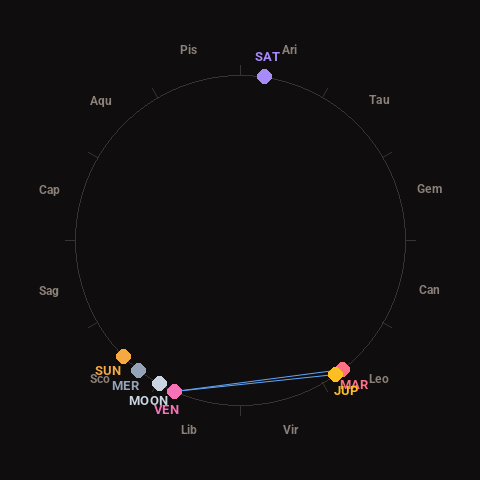
Moon: New Moon (2% illuminated), in Libra.
Notable planetary angles: Venus sextile Jupiter (58°), Venus sextile Mars (62°), Mars conjunct Jupiter (3°).
Concurrent space weather: planetary Kp index 5.3; strongest recent solar flare: M2.0-class.
This is a factual snapshot, not a claim of cause and effect – researchers are divided on whether lunar, planetary or solar factors influence seismic or weather activity. It’s included so readers can track the pattern for themselves over time.