
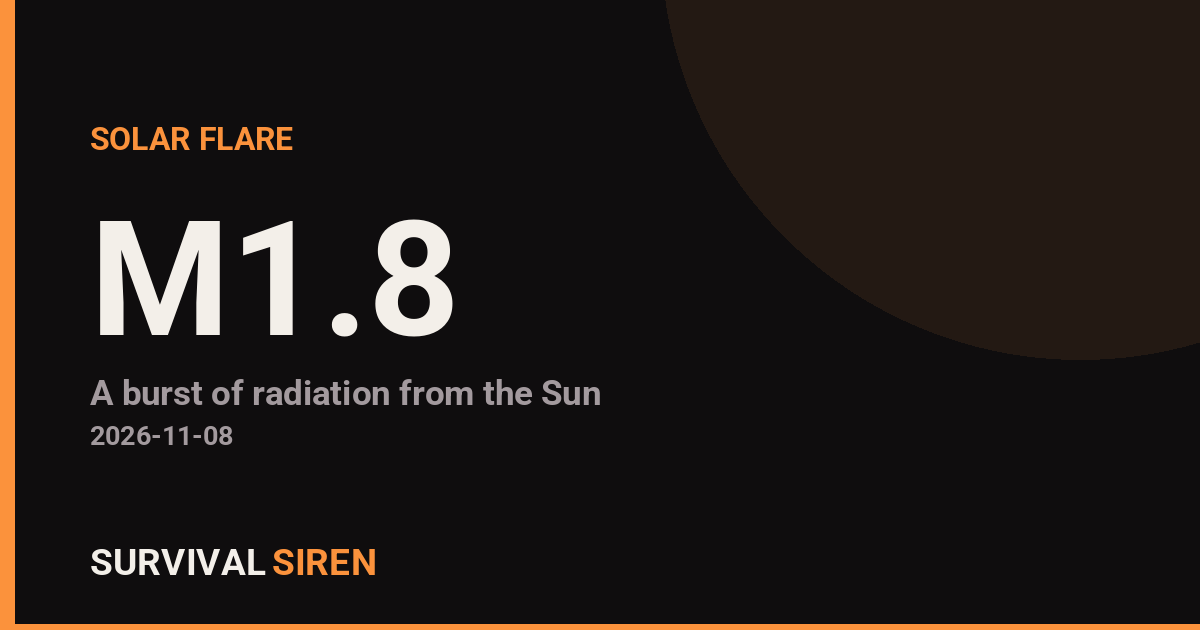
GOES satellites recorded a M1.8-class solar flare that peaked at 07:46 UTC on November 8, 2026. Solar flares are bursts of radiation from the Sun, ranked by strength from weakest to strongest as A, B, C, M, and X. An M-class flare is a mid-level event — noticeable, but not in the strongest category.
The flare’s X-ray output measured 1.8e-5 watts per square meter, which corresponds to roughly an R1 (minor) event on NOAA’s radio blackout scale. Because flares travel at the speed of light, any effects arrive within minutes and mainly hit the part of Earth in daylight at the time.
What you might notice: For most people, nothing at all. R1-level events can cause brief fades or dropouts in high-frequency (shortwave) radio communications on the sunlit side of Earth. That matters mostly to ham radio operators, mariners, aviators using HF radio over oceans, and some emergency communication networks. Your phone, TV, and internet are not affected by the flare itself.
Who is affected: Shortwave and aviation radio users on the dayside of Earth may have seen temporary signal degradation around the peak time. No impact to the public power grid or everyday electronics is expected from a flare of this size.
What to watch next
1. A possible coronal mass ejection (CME): Some flares launch a cloud of solar material toward Earth. If that happened here, it would arrive in about 1–3 days and could trigger a geomagnetic storm — the phenomenon that can cause auroras and, in stronger cases, grid and satellite issues.
2. The Kp index: This 0–9 scale measures geomagnetic activity. If a CME is inbound, forecasters will track rising Kp values. Values of 5 or higher indicate a geomagnetic storm.
3. Further flare activity: Active sunspot regions often produce multiple flares. Additional M-class or stronger flares from the same region are possible in the coming days.
No action is needed for most households — this is a routine space-weather event worth monitoring, not a reason for alarm. Data for this alert comes from NOAA’s GOES satellite measurements and the NOAA Space Weather Prediction Center.
Frequently Asked Questions
Will this solar flare knock out my power or electronics?
No. An M1.8 flare with an R1-level radio blackout rating only affects shortwave radio on Earth's sunlit side. It has no effect on the power grid, cell phones, or home electronics.
Could this flare cause auroras (northern lights)?
Not directly. Auroras come from geomagnetic storms driven by coronal mass ejections. If this flare launched an Earth-directed CME, auroras could become possible in 1–3 days — watch the Kp index for updates.
Should I be worried about radiation from the flare?
No. Earth's atmosphere fully protects people on the ground from flare radiation. Only astronauts and passengers on some high-latitude flights see any measurable exposure changes, and an M1.8 event is minor even for them.
How will I know if a geomagnetic storm is coming?
NOAA's Space Weather Prediction Center issues watches and warnings if a CME is heading toward Earth, typically giving 1–3 days of notice. A Kp index of 5 or above signals an active geomagnetic storm.
Keep tracking this:
Source: NOAA GOES X-ray Flux
Sky & Solar Conditions at the Time
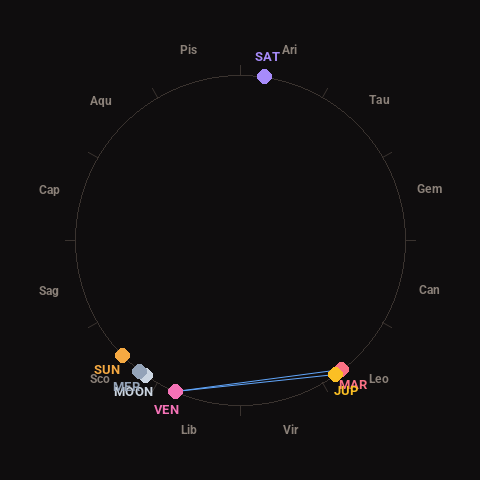
Moon: New Moon (1% illuminated), in Scorpio.
Notable planetary angles: Venus sextile Mars (61°), Venus sextile Jupiter (58°), Moon conjunct Mercury (3°), Mars conjunct Jupiter (3°).
Concurrent space weather: planetary Kp index 3.3; strongest recent solar flare: M1.8-class.
This is a factual snapshot, not a claim of cause and effect – researchers are divided on whether lunar, planetary or solar factors influence seismic or weather activity. It’s included so readers can track the pattern for themselves over time.