
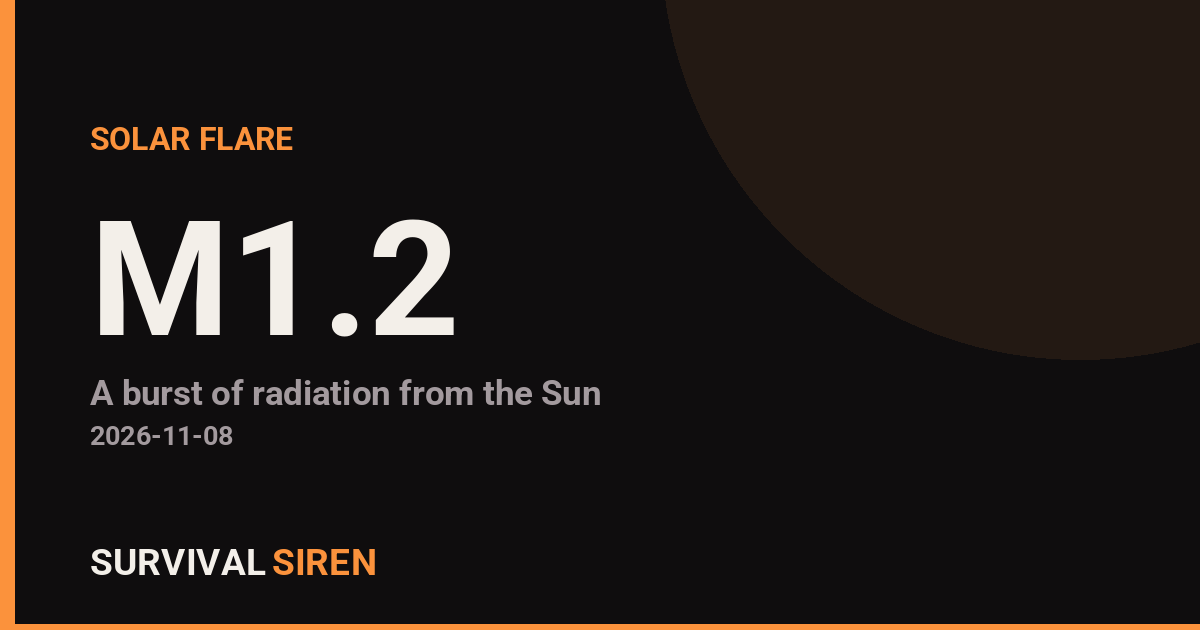
GOES satellites detected a moderate M1.2-class solar flare on the Sun, peaking at 15:37 UTC on November 8, 2026. The flare’s X-ray flux measured 1.2 × 10⁻⁵ watts per square meter, which corresponds to roughly an R1 (minor) event on NOAA’s radio-blackout scale. Solar flares are bursts of radiation from the Sun’s surface, and the X-rays from this one traveled to Earth at the speed of light, meaning any effects on the sunlit side of the planet began immediately at the time of the flare.
For most people, this event will go completely unnoticed. An M1.2 flare is on the lower end of the ‘medium’ class — significant enough to register on satellite instruments, but far below the X-class flares that cause widespread concern. The main real-world effect is a brief fade or blackout of high-frequency (shortwave) radio signals on the dayside of Earth, which can affect aviation communications over oceans, amateur radio operators, and some maritime users. These disruptions typically last minutes to tens of minutes and resolve on their own.
The one thing worth watching is whether this flare also launched a coronal mass ejection (CME) — a cloud of solar material that, if aimed at Earth, could arrive in one to three days and trigger a geomagnetic storm. If that happens, possible effects include minor fluctuations in power grids at high latitudes, slightly degraded GPS accuracy, and auroras visible farther from the poles than usual. Forecasters will confirm over the coming hours whether a CME is headed our way.
What to watch
1) Check NOAA’s Space Weather Prediction Center updates over the next 24–48 hours for any CME arrival forecast. 2) Keep an eye on the Kp index, the standard measure of geomagnetic activity — a rise toward 5 or higher would indicate a storm is underway. 3) If you rely on GPS for critical work, be aware accuracy could dip slightly during a geomagnetic storm, though everyday navigation apps are rarely affected by M-class events.
This information is based on data from NOAA’s GOES satellites and the Space Weather Prediction Center.
Frequently Asked Questions
Will this solar flare affect my phone, internet, or power?
No. An M1.2 flare is a moderate event — its only immediate effect is brief shortwave radio fading on Earth's sunlit side. Household electronics, internet, and the power grid are not affected by the flare itself.
Could a bigger geomagnetic storm still be coming?
Possibly, but only if this flare launched a coronal mass ejection toward Earth. Forecasters will confirm within hours; if one is inbound it would arrive in 1–3 days, so watch NOAA's Kp index forecasts.
Will I be able to see the northern lights from this?
Not from the flare itself. If an Earth-directed CME follows and sparks a geomagnetic storm, auroras could become visible at lower-than-usual latitudes in the next few days — check forecasts before heading out.
Is this kind of flare dangerous to people?
No. Earth's atmosphere and magnetic field fully protect people on the ground from solar flare radiation. Only astronauts and passengers on some high-altitude polar flights face elevated exposure, and only during much stronger events.
Keep tracking this:
Source: NOAA GOES X-ray Flux
Sky & Solar Conditions at the Time
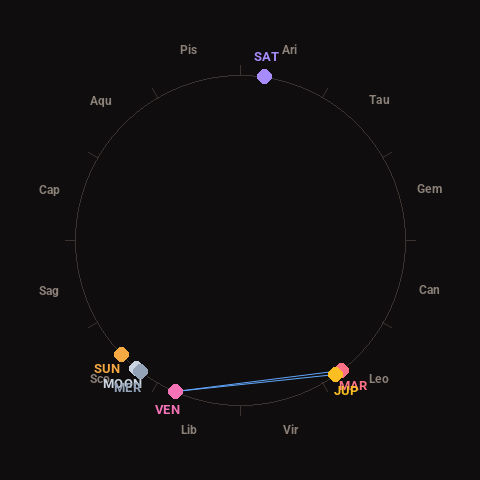
Moon: New Moon (0% illuminated), in Scorpio.
Notable planetary angles: Venus sextile Mars (61°), Venus sextile Jupiter (58°), Moon conjunct Mercury (2°), Mars conjunct Jupiter (3°).
Concurrent space weather: planetary Kp index 2.7; strongest recent solar flare: M1.2-class.
This is a factual snapshot, not a claim of cause and effect – researchers are divided on whether lunar, planetary or solar factors influence seismic or weather activity. It’s included so readers can track the pattern for themselves over time.