
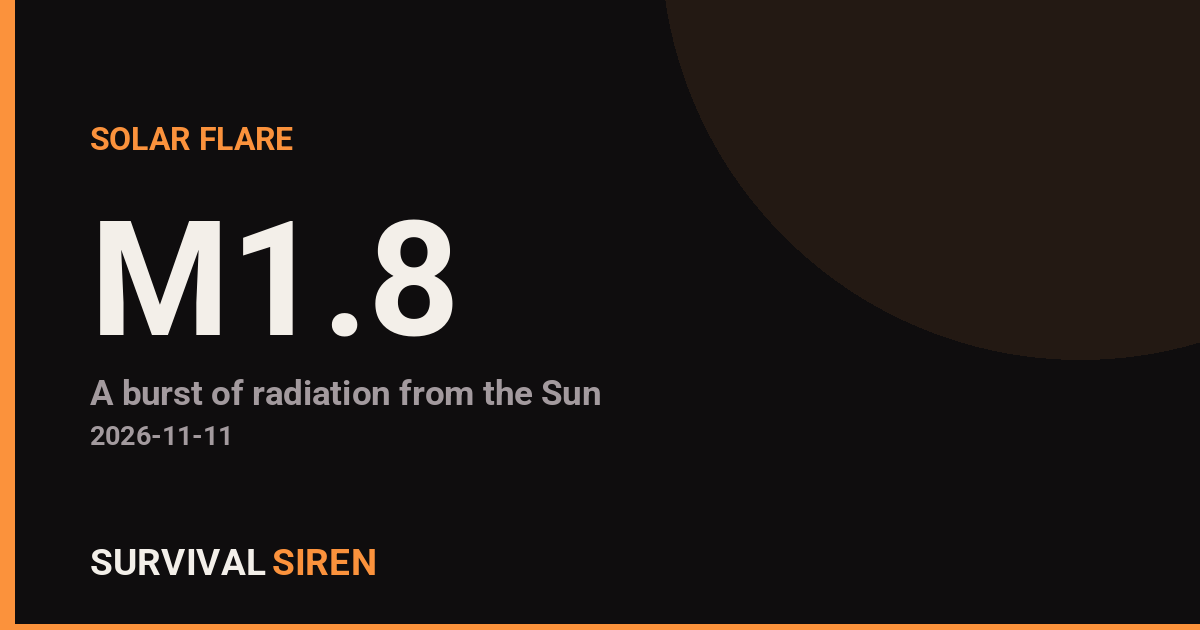
GOES satellites recorded an M1.8-class solar flare on the Sun, peaking at 21:21 UTC on November 11, 2026. The flare’s X-ray output measured 1.8e-5 watts per square meter, which puts it in the “moderate” range of the solar flare scale — well above background, but far short of the X-class events that cause the most serious disruptions. On NOAA’s radio blackout scale, this event rates around R1, the lowest of five levels.
Solar flares travel to Earth at the speed of light, so any direct effects happen almost immediately and are already over or winding down. An R1-level flare can cause brief, minor degradation of high-frequency (shortwave) radio communications on the sunlit side of Earth — the kind of radio used by aviation on polar and oceanic routes, maritime operators, and amateur radio enthusiasts. Most people will notice nothing at all. GPS, cell phones, power grids, and internet service are not affected by a flare of this size.
What to watch for next
The more interesting question is what happens over the next one to three days. Solar flares sometimes come with a coronal mass ejection (CME) — a burst of solar material that travels much slower than the flare’s light. If this flare launched a CME aimed at Earth, it could produce a geomagnetic storm when it arrives, typically 1–3 days later. That is the scenario that can bring auroras to lower-than-usual latitudes and, in stronger cases, stress on power grids and satellites.
There is no reason for alarm at this point. Practical watch-items:
First, space weather forecasters will analyze coronagraph imagery over the coming hours to determine whether a CME was launched and whether it’s Earth-directed — that determination drives any further alerts. Second, keep an eye on the Kp index, a simple 0–9 measure of geomagnetic activity; values of 5 or higher indicate a geomagnetic storm. Third, if a storm watch is issued and you live at higher latitudes, a modest CME from an M-class flare can sometimes produce aurora viewing opportunities — a pleasant side effect rather than a hazard.
For everyday preparedness, no action is needed. Events like this are routine during active periods of the solar cycle, and monitoring agencies issue watches well in advance if conditions escalate.
Data for this alert comes from NOAA’s Space Weather Prediction Center and the GOES satellite network.
Frequently Asked Questions
Will this solar flare affect my phone, GPS, or power?
No. An M1.8 (R1-level) flare is too weak to disrupt power grids, GPS, or cell service. Its only immediate effect is brief, minor degradation of shortwave radio on the sunlit side of Earth.
Could this flare knock out the power grid in the next few days?
Only if it launched an Earth-directed coronal mass ejection (CME), and even then, CMEs from M-class flares typically cause minor geomagnetic storms at most. Forecasters will confirm within hours whether a CME is headed our way.
Will I be able to see the northern lights from this?
Possibly, if a CME follows and arrives in 1–3 days. Watch the Kp index — if it climbs toward 5 or higher, auroras may be visible at higher latitudes, but that depends entirely on whether a CME was launched toward Earth.
Is there anything I should do right now?
No action is needed. M-class flares are common during active solar periods, and if a geomagnetic storm watch becomes necessary, NOAA issues it with 1–3 days of lead time.
Keep tracking this:
Source: NOAA GOES X-ray Flux
Sky & Solar Conditions at the Time
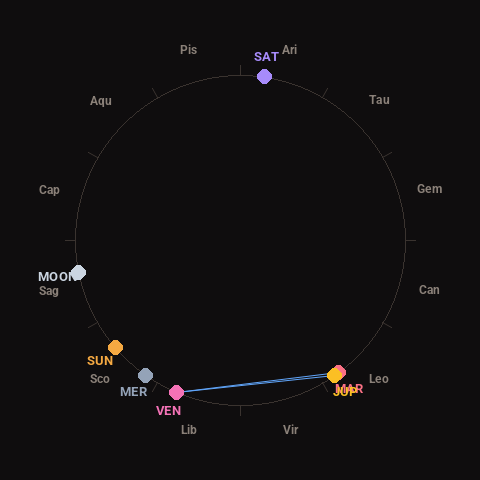
Moon: Waxing Crescent (6% illuminated), in Sagittarius.
Notable planetary angles: Venus sextile Mars (59°), Mars conjunct Jupiter (2°), Venus sextile Jupiter (57°).
Concurrent space weather: planetary Kp index 2.7; strongest recent solar flare: M1.8-class.
This is a factual snapshot, not a claim of cause and effect – researchers are divided on whether lunar, planetary or solar factors influence seismic or weather activity. It’s included so readers can track the pattern for themselves over time.