
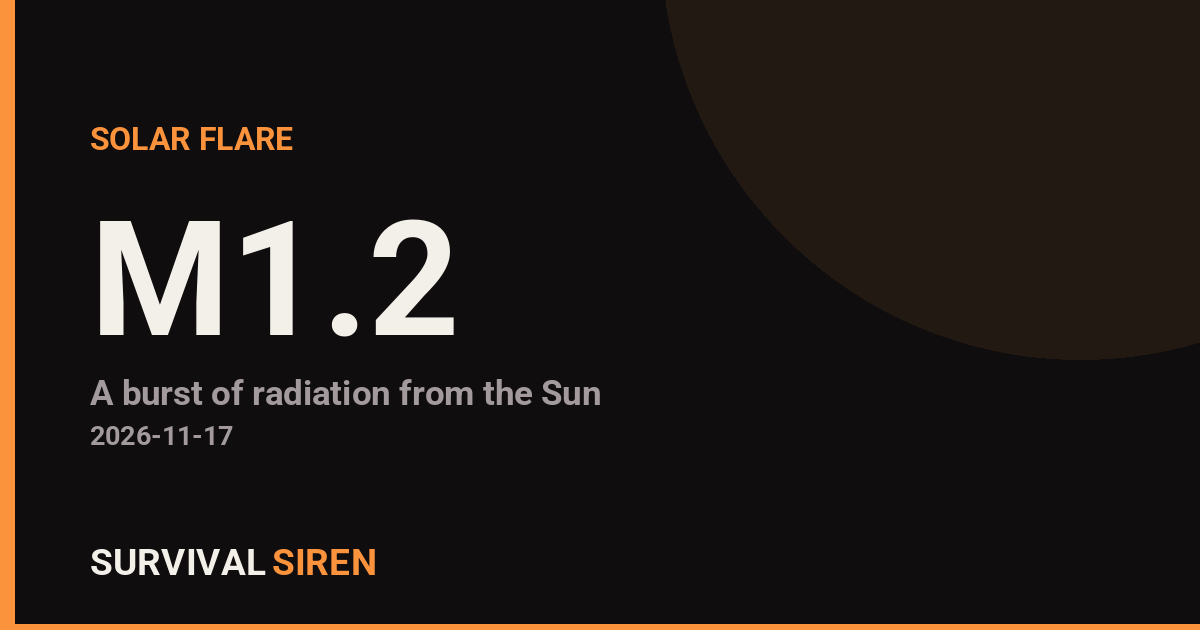
GOES satellites detected an M1.2-class solar flare on the Sun, peaking at 15:49 UTC on November 17, 2026, with an X-ray flux of 1.2e-5 W/m². Solar flares are ranked by strength — A, B, C, M, and X, from weakest to strongest — so an M1.2 sits at the low end of the ‘medium’ category. This is a routine event; the Sun produces flares like this regularly, especially during active periods of its 11-year cycle.
What you might notice: For most people, the honest answer is nothing. Flares at this level can cause brief, minor shortwave (high-frequency) radio fadeouts on the sunlit side of Earth — rated around R1, the lowest level on NOAA’s radio-blackout scale. Ham radio operators and some aviation or maritime radio users may have noticed a short-lived degradation in signal quality around the peak time. Everyday services — cell phones, GPS navigation, internet, and power — are not affected by a flare of this size.
Who is affected: Primarily shortwave radio users on the daylight side of the planet at the time of the flare, and only briefly. There is no risk to people on the ground from the flare itself.
What to watch over the next few days
The one thing worth monitoring is whether this flare also launched a coronal mass ejection (CME) — a burst of solar material — toward Earth. If it did, a minor geomagnetic storm could arrive in roughly 1 to 3 days. A few sensible pointers:
1. Watch the Kp index. This 0–9 scale measures geomagnetic activity. Forecasters will confirm within hours whether a CME is Earth-directed, and the Kp index will show any storm’s strength when it arrives.
2. Aurora watchers, stay tuned. Even a modest geomagnetic storm can push auroras farther from the poles than usual. If a CME is confirmed, check aurora forecasts for your latitude over the coming nights.
3. No special action needed. There is no indication of any threat to the power grid or satellites from an event of this size. This is a watch-and-wait situation, not a prepare-for-impact one.
This alert is based on data from NOAA’s GOES satellites and the Space Weather Prediction Center.
Frequently Asked Questions
Is an M1.2 solar flare dangerous to people?
No. The radiation from a solar flare is absorbed by Earth's atmosphere and never reaches the ground. An M1.2 is a minor, common event that poses no health risk.
Will this affect my phone, GPS, or power?
Not from the flare itself — it may only cause brief shortwave radio fadeouts. Any effect on GPS or radio would depend on a possible geomagnetic storm arriving in 1–3 days, and even then, impacts from an event this size would be minimal.
Could I see auroras because of this?
Possibly, but only if the flare launched a CME toward Earth, which forecasters will confirm within hours. If one is inbound, a minor storm could make auroras visible at somewhat lower latitudes than usual in the next 1–3 nights.
Should I be doing anything to prepare?
No special preparation is needed for a flare of this magnitude. It's simply worth keeping an eye on space-weather forecasts over the next few days in case a follow-up geomagnetic storm develops.
Keep tracking this:
Source: NOAA GOES X-ray Flux
Sky & Solar Conditions at the Time
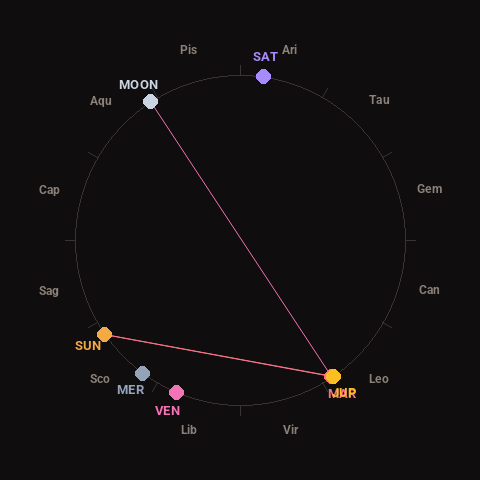
Moon: First Quarter (52% illuminated), in Aquarius.
Notable planetary angles: Mars conjunct Jupiter (0°), Sun square Jupiter (89°), Moon opposite Mars (179°), Sun square Mars (89°).
Concurrent space weather: planetary Kp index 0.7; strongest recent solar flare: M1.2-class.
This is a factual snapshot, not a claim of cause and effect – researchers are divided on whether lunar, planetary or solar factors influence seismic or weather activity. It’s included so readers can track the pattern for themselves over time.