
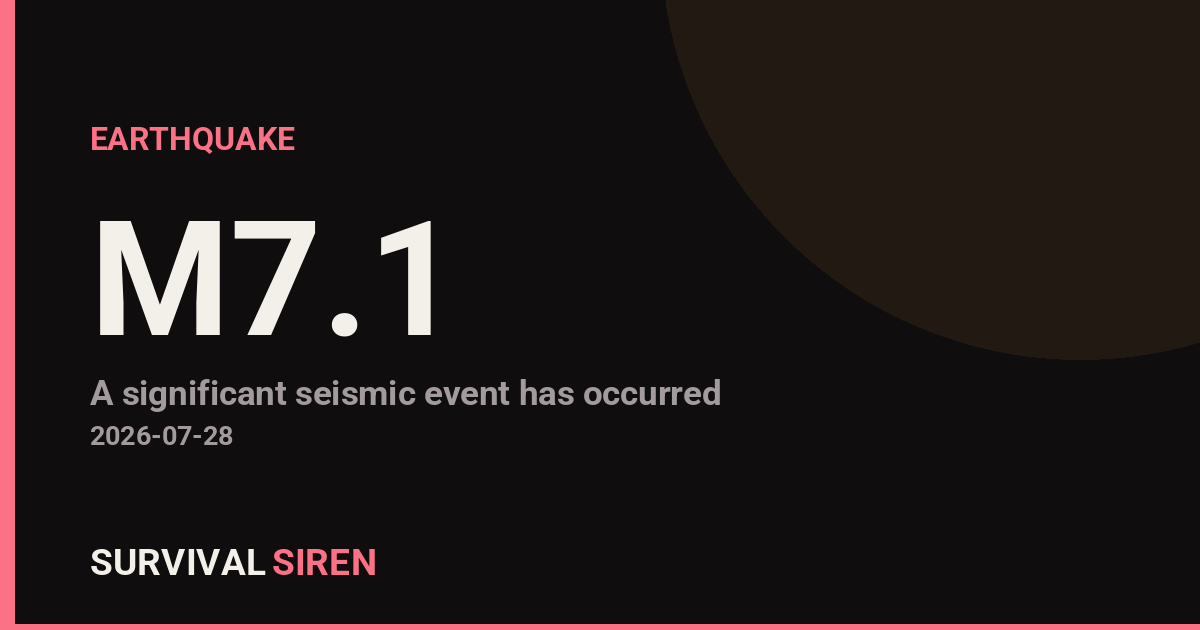
A magnitude 7.1 earthquake struck approximately 4 kilometers southeast of Uki, Japan, at a shallow depth of about 10 kilometers early today. The USGS confirmed the readings. Earthquakes of this magnitude are considered major and can cause significant damage in areas near the epicenter.
What This Means
The shallow depth—just 10 km down—means the shaking was felt strongly across the region. Japan’s earthquake monitoring systems activated immediately, and local authorities deployed response teams. If you have connections to Japan, check in with contacts in the affected area through calls or messaging apps, as cellular networks may be briefly congested.
Because this earthquake occurred on land rather than offshore, tsunami risk appears limited, though Japanese authorities will continue monitoring. Residents in the Kumamoto region, where Uki is located, should check for structural damage to homes and buildings and follow guidance from local emergency officials.
What to Watch For
1. Aftershocks: Magnitude 7+ earthquakes typically trigger significant aftershocks in the following hours and days. These can range from magnitude 5 to 6 and may cause additional damage to already-weakened structures. If you’re in Japan, expect continued shaking alerts.
2. Infrastructure updates: Monitor local news for reports on power, water, and transportation disruptions. Japan has excellent disaster response infrastructure, but service interruptions are common immediately after major quakes.
3. Global seismic activity: Large earthquakes sometimes trigger activity elsewhere along the Pacific Ring of Fire. Keep an eye on updated seismic maps over the next 48 hours if you live in earthquake-prone regions.
Practical reminder: If you haven’t recently checked your earthquake preparedness kit (water, first aid, battery-powered radio), today is a good prompt. Even in low-risk areas, these supplies have broad value for any emergency.
Follow the latest earthquake data and global seismic activity through NOAA and the USGS live dashboard at https://survivalsiren.com/spaceweather/feed.html.
Source: USGS
Related Reading
- Earthquake Survival: Precautions, Kit & Early Warning in 2026
- Analyzing Low-Radiation Nuclear Explosions: Tactical Assessments and Survival Strategies
Sky & Solar Conditions at the Time
Moon: Full Moon (98% illuminated), in Capricorn.
Notable planetary angles: Venus square Mars (90°), Sun conjunct Jupiter (1°), Moon trine Venus (121°), Mercury square Saturn (92°).
Concurrent space weather: planetary Kp index 1.3; strongest recent solar flare: nothing notable.
This is a factual snapshot, not a claim of cause and effect – researchers are divided on whether lunar, planetary or solar factors influence seismic or weather activity. It’s included so readers can track the pattern for themselves over time.
Earthquakes Within ~400 km, Past 30 Days
For context, here is other recent seismic activity in the surrounding region (M2.5+, via USGS):
| Date & Time (UTC) | Magnitude | Location |
|---|---|---|
| 2026-07-16 21:49 UTC | M5.2 | 48 km E of Nishinoomote, Japan |
| 2026-06-30 23:40 UTC | M4.8 | 10 km W of Hyūga, Japan |
Emergency number for Japan: 110 (police) / 119 (fire & ambulance) (General guidance – always verify locally, as this can vary by region.)