
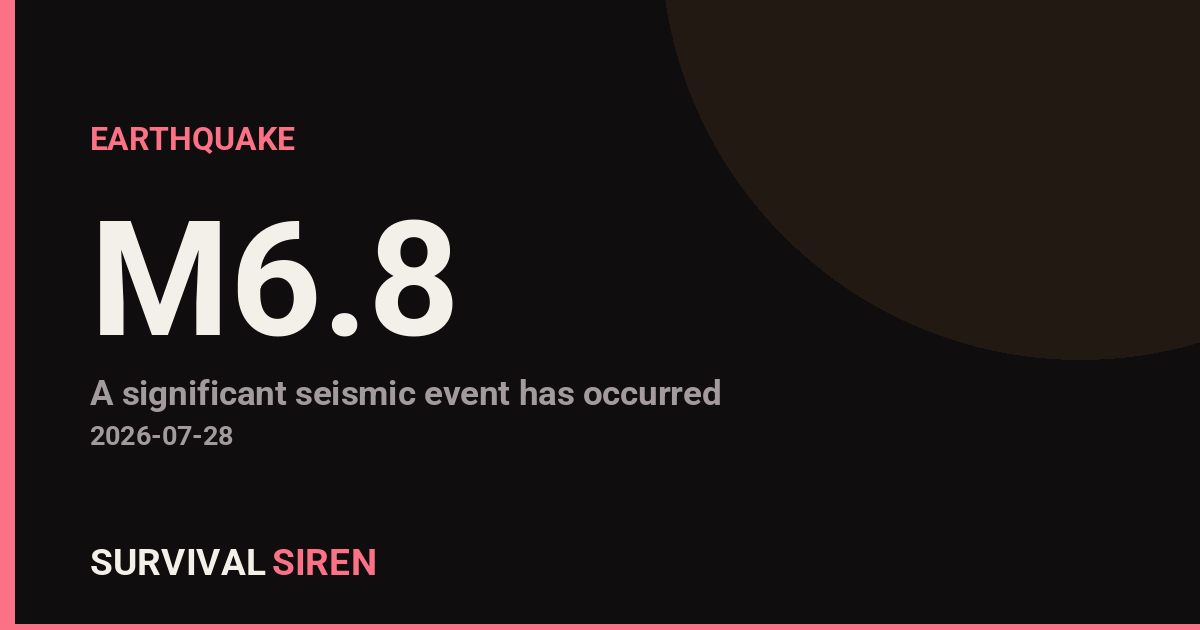
A magnitude 6.8 earthquake occurred approximately 5 kilometers east of Uto, Japan at a shallow depth of 10 kilometers on Tuesday. The USGS confirmed the event, which is considered a strong earthquake capable of causing significant damage to older buildings and vulnerable structures in the immediate area.
Residents within 50 kilometers of the epicenter likely felt strong shaking lasting 20–30 seconds. People in Uto and surrounding municipalities may have experienced items falling from shelves, cracked walls, or minor structural damage to older homes. The deeper the earthquake, the less surface damage typically occurs—this quake’s 10 km depth is relatively shallow, concentrating energy near populated areas.
Who Is Affected
Uto is located in Kumamoto Prefecture on Japan’s Kyushu island, a region with about 125,000 residents. Japanese building codes are among the world’s strictest due to frequent seismic activity, which significantly limits widespread structural failure. However, older buildings constructed before modern standards remain vulnerable.
Aftershocks are likely over the coming hours and days. Japan’s Meteorological Agency will issue updated assessments and aftershock forecasts as data arrives.
Practical Watch Items: If you’re in the affected region, monitor local authorities and the Japan Meteorological Agency for official damage reports and aftershock warnings. Second, secure heavy furniture and emergency supplies in case additional strong quakes follow. Third, keep communication devices charged—text messaging often works when phone lines are congested, so know your out-of-area contact person’s number.
This earthquake is a geologic reminder that seismic preparedness saves lives. Review your family’s emergency kit, practice drop-cover-hold-on drills, and identify safe spots in your home regardless of your location.
For real-time space weather and seismic updates, visit the live dashboard at https://survivalsiren.com/spaceweather/feed.html.
Source: USGS
Related Reading
- Earthquake Survival: Precautions, Kit & Early Warning in 2026
- Analyzing Low-Radiation Nuclear Explosions: Tactical Assessments and Survival Strategies
Sky & Solar Conditions at the Time
Moon: Full Moon (98% illuminated), in Capricorn.
Notable planetary angles: Venus square Mars (90°), Sun conjunct Jupiter (1°), Moon trine Venus (121°), Mercury square Saturn (92°).
Concurrent space weather: planetary Kp index 1.3; strongest recent solar flare: nothing notable.
This is a factual snapshot, not a claim of cause and effect – researchers are divided on whether lunar, planetary or solar factors influence seismic or weather activity. It’s included so readers can track the pattern for themselves over time.
Earthquakes Within ~400 km, Past 30 Days
For context, here is other recent seismic activity in the surrounding region (M2.5+, via USGS):
| Date & Time (UTC) | Magnitude | Location |
|---|---|---|
| 2026-07-16 21:49 UTC | M5.2 | 48 km E of Nishinoomote, Japan |
| 2026-06-30 23:40 UTC | M4.8 | 10 km W of Hyūga, Japan |
Emergency number for Japan: 110 (police) / 119 (fire & ambulance) (General guidance – always verify locally, as this can vary by region.)