
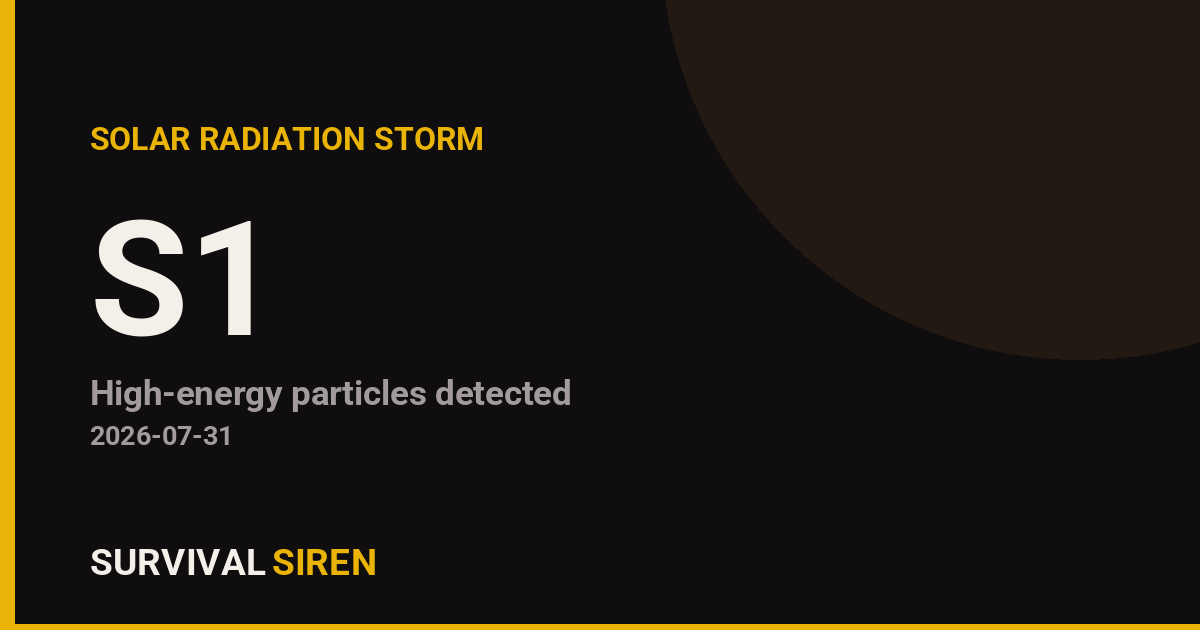
A solar radiation storm (S1 level) is currently underway, with proton flux measurements reaching 11 pfu according to NOAA data. Here’s what that means and who should pay attention.
What Happened
The sun has released high-energy particles that are traveling toward Earth. On NOAA’s five-tier scale (S1 through S5), today’s S1 rating is minor—the lowest category of concern—but it warrants awareness.
Who Is Affected
Most people won’t notice any direct effects. The main impacts fall on three groups: satellites in orbit, astronauts aboard the International Space Station, and flight crews on polar routes (Arctic and Antarctic flights). These populations are exposed to higher radiation levels at altitude and in space. Additionally, high-frequency (HF) radio communications in polar regions may experience degradation, potentially affecting emergency responders and aviation in far northern areas.
What You Might Notice
If you live in far northern latitudes, you may see aurora displays over the next day or two—a natural light show caused by solar particles interacting with Earth’s magnetic field. Technology disruptions are unlikely at the S1 level, though satellite operators and airlines may implement precautions.
Three Practical Watch Items
First, if you fly frequently on polar routes or work in aviation, stay informed through airline alerts. Second, amateur radio operators in polar regions should monitor HF band conditions. Third, anyone who depends on satellite-based services (GPS, communications, weather) should keep a backup plan: a physical map, a battery-powered radio, and offline navigation tools are smart additions to any emergency kit.
For real-time updates on solar activity and space weather conditions, monitor NOAA’s live dashboard at https://survivalsiren.com/spaceweather/feed.html.
Source: NOAA GOES Proton Flux
Sky & Solar Conditions at the Time
Moon: Full Moon (98% illuminated), in Aquarius.
Notable planetary angles: Venus square Mars (91°), Sun conjunct Jupiter (1°), Moon trine Mars (118°).
Concurrent space weather: planetary Kp index 1.0; strongest recent solar flare: nothing notable.
This is a factual snapshot, not a claim of cause and effect – researchers are divided on whether lunar, planetary or solar factors influence seismic or weather activity. It’s included so readers can track the pattern for themselves over time.