
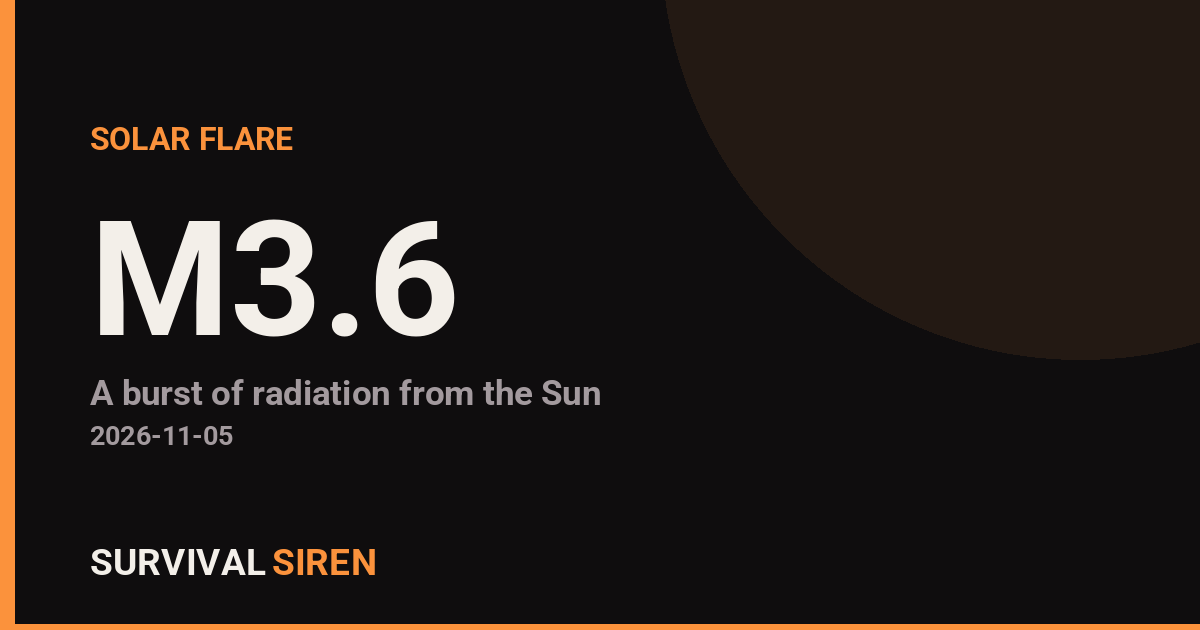
GOES satellites detected a moderate M3.6-class solar flare on the Sun, with the burst of X-ray energy peaking at 18:33 UTC on November 5, 2026. The flare registered an X-ray flux of 3.6×10⁻⁵ watts per square meter, putting it at roughly an R1 (minor) level on the NOAA radio-blackout scale.
Solar flares travel at the speed of light, so any effects from the flare itself have already happened. The main impact of an event this size is a brief fadeout of high-frequency (shortwave) radio signals on the daylight side of Earth, typically lasting minutes to tens of minutes. This primarily affects ham radio operators, aviation and maritime HF communications, and some emergency services that use shortwave — not cell phones, Wi-Fi, or broadcast TV.
Everyday readers are unlikely to notice anything at all from the flare itself. The bigger question is what comes next: if the flare also hurled a coronal mass ejection (CME) — a large cloud of solar material — toward Earth, it could arrive in one to three days and trigger a geomagnetic storm. That is the type of event that can, at stronger levels, affect power grids, satellite operations, and GPS accuracy, and it can also produce auroras visible farther from the poles than usual.
What to watch
First, keep an eye on the Kp index over the next 1–3 days — a rising Kp value indicates a geomagnetic storm is underway. At this point, no storm has been confirmed; forecasters need satellite data to determine whether a CME was launched and whether it is aimed at Earth. Second, shortwave radio users and aviators should be aware of the possibility of additional flares from the same active region while it remains visible. Third, if you simply enjoy auroras, check the forecast in the coming nights — a glancing CME from even a moderate flare can sometimes produce a nice display at higher latitudes. No action is needed for the general public; this is a watch-the-forecast situation, not an emergency.
Data and classifications in this report come from NOAA’s Space Weather Prediction Center and the GOES satellite program.
Frequently Asked Questions
Will this solar flare knock out my power or internet?
No. The flare itself only caused brief shortwave radio fadeouts on Earth's sunlit side. A geomagnetic storm from a follow-up CME could affect power systems, but only if a CME was launched toward Earth — that has not yet been confirmed.
What does M3.6 actually mean?
Flares are classed A, B, C, M, and X, with M being the second-strongest category. M3.6 is a moderate flare — notable, but well below the levels that cause serious disruption.
Is a geomagnetic storm coming?
Possibly, but not certain. If this flare launched a CME toward Earth, it would arrive in 1–3 days; watch the Kp index and NOAA forecasts for updates.
Could I see auroras from this?
It's possible in the next few nights if a CME arrives, especially at higher latitudes. Check the aurora forecast rather than assuming a display is guaranteed.
Keep tracking this:
Source: NOAA GOES X-ray Flux
Sky & Solar Conditions at the Time
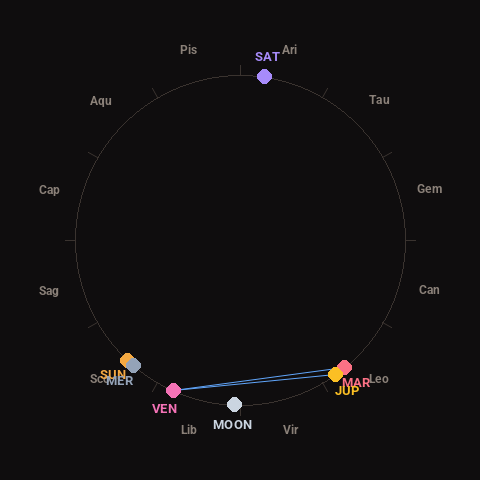
Moon: Waning Crescent (12% illuminated), in Libra.
Notable planetary angles: Venus sextile Jupiter (59°), Sun conjunct Mercury (3°), Venus sextile Mars (63°), Mars conjunct Jupiter (4°).
Concurrent space weather: planetary Kp index 0.7; strongest recent solar flare: M3.6-class.
This is a factual snapshot, not a claim of cause and effect – researchers are divided on whether lunar, planetary or solar factors influence seismic or weather activity. It’s included so readers can track the pattern for themselves over time.