
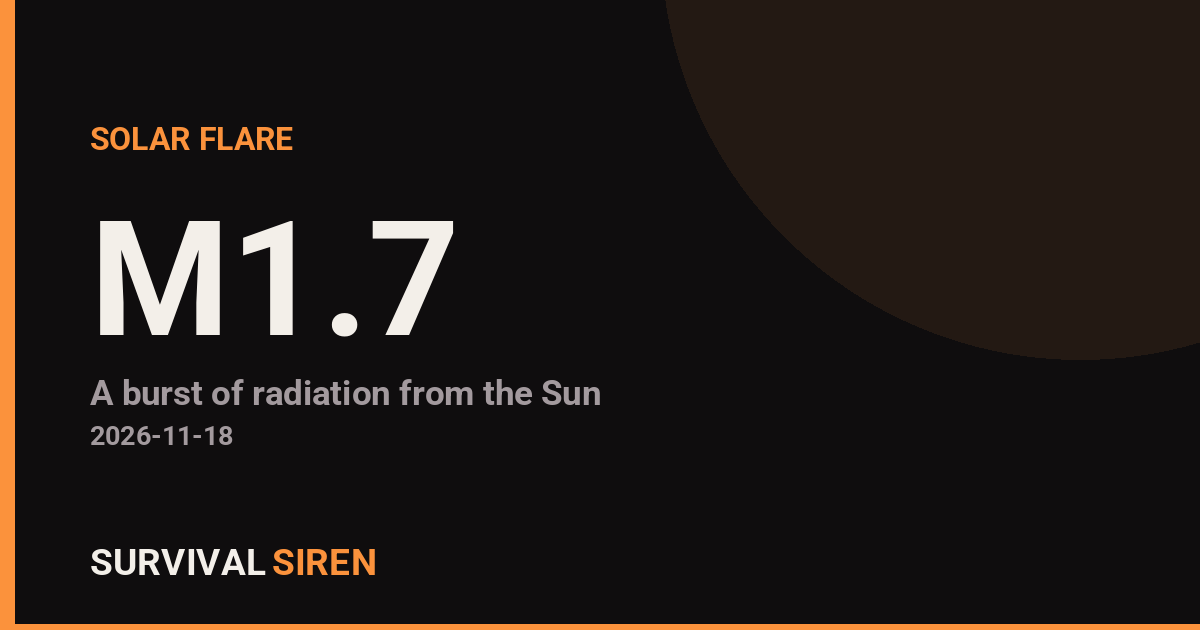
The GOES satellites recorded a moderate M1.7-class solar flare on the Sun, peaking at 21:39 UTC on November 17, 2026. Solar flares are sudden bursts of energy from the Sun’s surface, and they are ranked by strength on a letter scale – A, B, C, M, and X – with X being the strongest. An M-class flare sits in the middle: noticeable to scientists, but not a major event.
The flare’s X-ray output measured 1.7e-5 watts per square meter, which corresponds to roughly an R1 (minor) event on NOAA’s radio blackout scale. Because flares travel at the speed of light, any direct effect happens within minutes on Earth’s sunlit side – and by the time you read this, that immediate effect has already passed. People who might have noticed anything include shortwave (ham) radio operators and ships or aircraft relying on high-frequency radio, who could have experienced brief static or signal dropouts on the daytime side of the planet.
Everyday readers are unlikely to notice anything at all. Cell phones, home internet, power grids, and GPS navigation are not meaningfully affected by a flare of this size.
What to watch next
The one thing worth monitoring is whether this flare launched a coronal mass ejection (CME) – a cloud of solar material – toward Earth. If it did, that material would arrive in one to three days and could trigger a geomagnetic storm. Forecasters track this with the Kp index, a 0-9 scale of geomagnetic activity. Sensible steps right now:
1. No action needed for most people – this is a routine, moderate event.
2. Ham radio operators and mariners can check NOAA’s space weather forecasts over the next 1-3 days for any CME arrival.
3. Aurora watchers at high latitudes may want to follow the Kp index in case a follow-up storm boosts northern lights visibility.
Data for this alert comes from NOAA’s Space Weather Prediction Center and the GOES satellite network.
Frequently Asked Questions
Is this flare dangerous to people on the ground?
No. Earth's atmosphere protects us from flare radiation, and an M1.7 flare is a moderate, fairly common event. There is no health risk at the surface.
Will this knock out my power or cell phone?
Almost certainly not. A flare of this strength can only cause brief, minor shortwave radio fadeouts on Earth's sunlit side, and that immediate window has already passed.
Could this cause northern lights?
Possibly, but not from the flare itself – only if it also launched a CME toward Earth, which would arrive in 1-3 days. Watch the Kp index for updates.
Is a bigger flare coming after this one?
Flares of M-class size happen regularly, and a single M1.7 flare doesn't predict a larger event. Forecasters will continue monitoring the active region that produced it.
Keep tracking this:
Source: NOAA GOES X-ray Flux
Sky & Solar Conditions at the Time
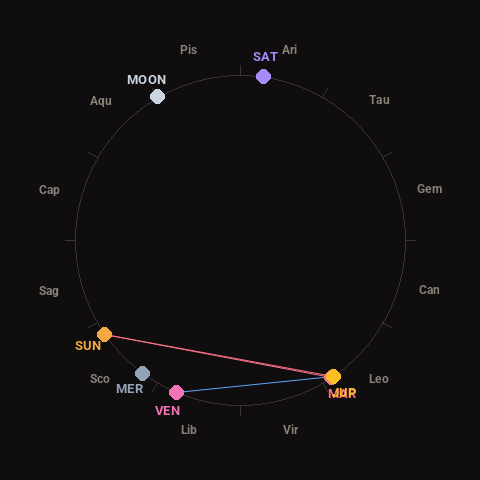
Moon: First Quarter (54% illuminated), in Pisces.
Notable planetary angles: Sun square Jupiter (90°), Mars conjunct Jupiter (1°), Sun square Mars (89°), Venus sextile Jupiter (57°).
Concurrent space weather: planetary Kp index 3.0; strongest recent solar flare: M1.7-class.
This is a factual snapshot, not a claim of cause and effect – researchers are divided on whether lunar, planetary or solar factors influence seismic or weather activity. It’s included so readers can track the pattern for themselves over time.