
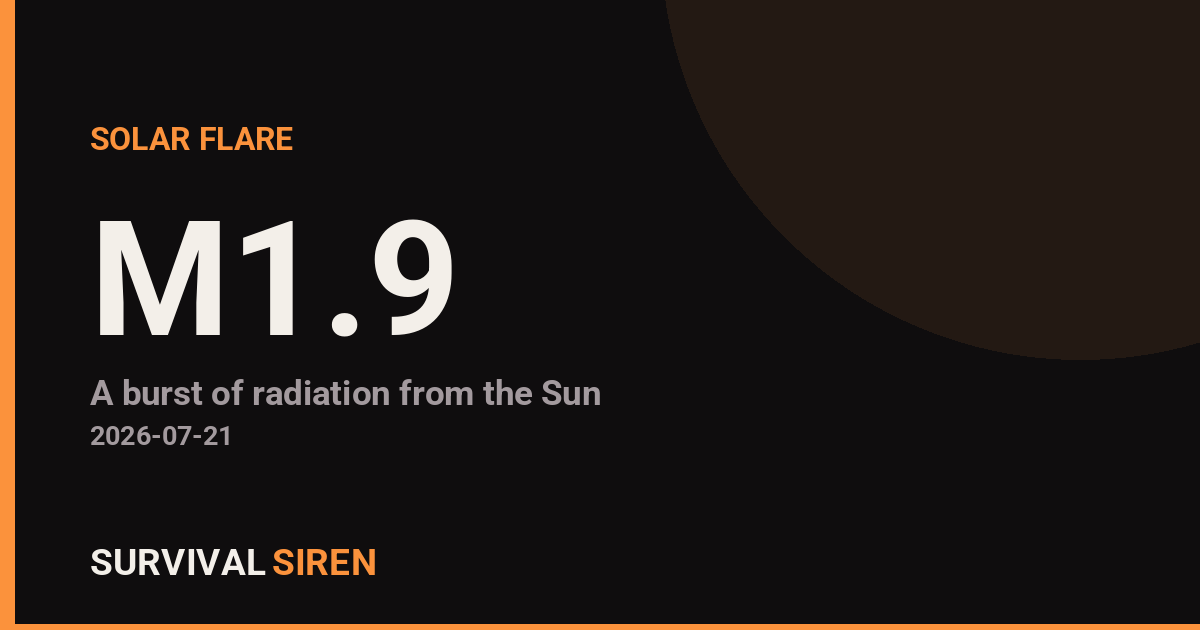
A moderate solar flare erupted on the Sun at 5:27 PM UTC on July 21, 2026, measured at M1.9-class strength by NOAA’s GOES satellites. The flare produced an X-ray burst of 1.9×10⁻⁵ watts per square meter, strong enough to disrupt shortwave radio communications across Earth’s daytime hemisphere for approximately one hour.
What You Might Notice
If you use shortwave radio, aviation radio, or maritime communications, you may have experienced brief disruptions during the flare peak. GPS users in affected regions might have seen momentary signal loss. Most everyday GPS devices and cell phones were unaffected. Amateur radio operators on HF bands likely noticed the blackout.
The Bigger Picture
The main concern now is whether this flare launched a coronal mass ejection (CME)—a cloud of plasma traveling toward Earth. If one was ejected, it could arrive in 1 to 3 days, potentially triggering a geomagnetic storm. Geomagnetic storms can affect power grids, satellites, and auroras visible at higher latitudes. Moderate storms (Kp index 5–6) cause minor disruptions; severe storms are rare.
What to Watch
Monitor the Kp index (geomagnetic activity scale) over the next 72 hours. If a CME arrives, the Kp index will rise, usually with 6–12 hours’ notice before impact. Check the NOAA Space Weather Prediction Center or SurvivalSiren’s live dashboard daily.
If you rely on critical GPS, aviation, or maritime systems, have backup navigation methods ready—printed maps, compass, or radio beacons. Power-grid operators are already monitoring conditions; widespread blackouts from this flare alone are unlikely.
If auroras appear in your region over the coming days, they’re a harmless sign of geomagnetic activity and a natural light show worth stepping outside for.
For real-time updates and detailed solar data, visit the NOAA Space Weather Prediction Center dashboard.
Source: NOAA GOES X-ray Flux
Sky & Solar Conditions at the Time
Moon: First Quarter (53% illuminated), in Scorpio.
Notable planetary angles: Mars sextile Saturn (61°), Mercury square Saturn (92°), Moon square Jupiter (88°), Venus square Mars (87°).
Concurrent space weather: planetary Kp index 2.7; strongest recent solar flare: M1.9-class.
This is a factual snapshot, not a claim of cause and effect – researchers are divided on whether lunar, planetary or solar factors influence seismic or weather activity. It’s included so readers can track the pattern for themselves over time.