
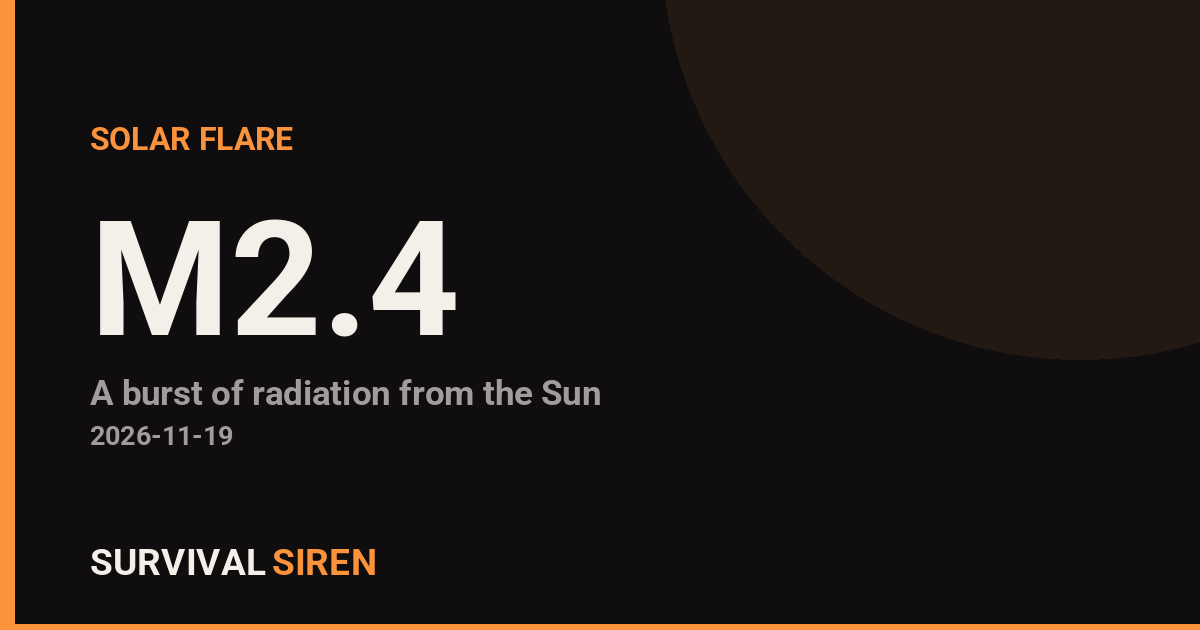
GOES satellites recorded an M2.4-class solar flare on the Sun, peaking at 13:24 UTC on November 19, 2026. The flare registered an X-ray flux of 2.4e-5 watts per square meter, putting it in the middle of the ‘M’ or moderate range of the flare scale — well below the strongest ‘X-class’ events, but strong enough to have brief, real effects.
The most immediate impact is on high-frequency (shortwave) radio on Earth’s sunlit side. This flare corresponds to roughly an R1 (minor) radio blackout, meaning shortwave signals in that region can fade or drop out for minutes to around an hour. That mainly affects ham radio operators, some aviation and maritime communications, and emergency radio users. Everyday readers are unlikely to notice anything directly: cell phones, television, internet, and household power are not affected by a flare of this size.
One thing still being assessed is whether the flare launched a coronal mass ejection (CME) — a cloud of solar material — toward Earth. If it did, that material typically arrives in one to three days and can trigger a geomagnetic storm, which at modest levels can produce auroras farther south than usual and, in stronger cases, stress on power grids and satellite operations. For an M2.4-class event, any resulting storm would most likely be minor, but forecasters will know more as satellite imagery is analyzed.
What to watch
1. The Kp index over the next 1–3 days. This 0–9 scale measures geomagnetic activity. Values of 5 or above indicate a geomagnetic storm is underway.
2. Aurora forecasts if you’re at higher latitudes. Even a modest storm can make the northern lights visible farther south than normal — a bonus, not a hazard.
3. Shortwave radio users: expect possible brief signal degradation on the daylit side of Earth around the flare time and again if a storm follows.
Data for this alert comes from NOAA’s Space Weather Prediction Center and the GOES satellite network.
Frequently Asked Questions
Will this flare affect my power, phone, or internet?
No. An M2.4 (moderate) flare does not damage power grids or disrupt cell service or home internet. Its only immediate effect is brief fading of shortwave radio on Earth's sunlit side.
Could this cause a geomagnetic storm later?
Possibly. If the flare launched a coronal mass ejection toward Earth, it would arrive in about 1–3 days. Any storm from an M2.4 event would most likely be minor, but forecasters are checking satellite imagery now.
Will I be able to see the northern lights?
Only if a CME follows and produces a geomagnetic storm. Watch the Kp index over the next couple of days — readings of 5 or higher can push auroras farther south than usual.
Is there any health risk from a solar flare?
Not at ground level. Earth's atmosphere shields us from flare radiation. Passengers on polar flights during much stronger events can see slightly elevated exposure, but an M2.4 flare poses no practical risk.
Keep tracking this:
Source: NOAA GOES X-ray Flux
Sky & Solar Conditions at the Time
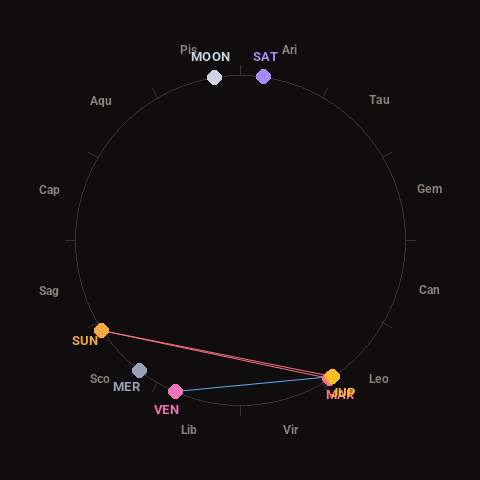
Moon: Waxing Gibbous (70% illuminated), in Pisces.
Notable planetary angles: Sun square Mars (90°), Sun square Jupiter (91°), Mars conjunct Jupiter (1°), Venus sextile Jupiter (57°).
Concurrent space weather: planetary Kp index 1.3; strongest recent solar flare: M2.4-class.
This is a factual snapshot, not a claim of cause and effect – researchers are divided on whether lunar, planetary or solar factors influence seismic or weather activity. It’s included so readers can track the pattern for themselves over time.