
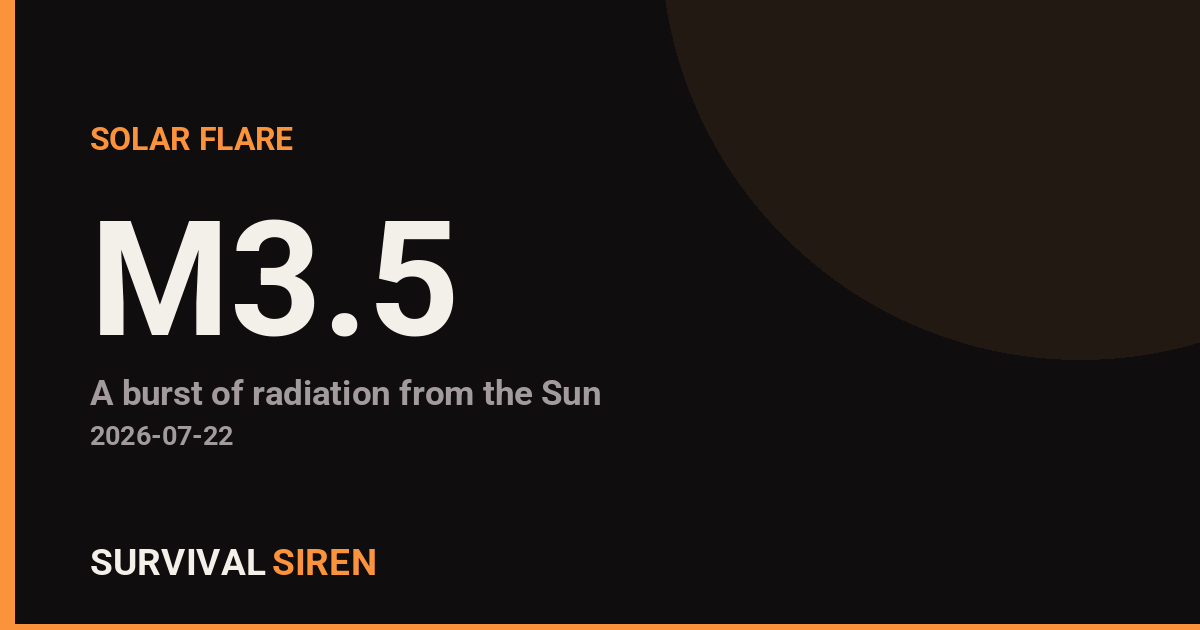
A moderate M3.5-class solar flare erupted from the Sun on July 22 at 6:34 AM UTC, releasing energy equivalent to millions of nuclear bombs. GOES satellites detected X-ray radiation at 3.5e-5 W/m², placing this event on the R1 (minor) radio-blackout scale.
What You Might Notice Right Now
If you’re in North America, Europe, Africa, or the Middle East (the sunlit side of Earth), shortwave radio users may experience signal loss or degradation for the next hour or two. Airline pilots using high-frequency radios and amateur radio operators are the most affected groups. Most everyday technology—cell phones, Wi-Fi, GPS—operates on different frequencies and should work normally.
The more significant concern is whether this flare launched a coronal mass ejection (CME) toward Earth. If one was ejected, it typically arrives 1–3 days later, potentially triggering a geomagnetic storm that could disrupt power grids, satellites, and aurora visibility at high latitudes.
Who Should Pay Attention
Power utility operators, satellite operators, and telecommunications companies are already monitoring the situation. For most households, a minor geomagnetic storm poses no direct risk, though aurora watchers in northern regions (and as far south as the northern U.S.) could see displays.
What to Watch Over the Next 72 Hours
1. Monitor the Kp index: This number (0–9) measures geomagnetic activity. Values above 5 indicate storm conditions. Check it daily through July 25.
2. Back up critical files: If a stronger storm develops, surges could affect electronics. A precautionary backup of irreplaceable data takes minutes.
3. Keep devices charged: Maintain phone and laptop batteries above 50% through Friday—standard practice during space weather alerts.
Live data and updates are available from NOAA at https://survivalsiren.com/spaceweather/feed.html.
Source: NOAA GOES X-ray Flux
Sky & Solar Conditions at the Time
Moon: First Quarter (58% illuminated), in Scorpio.
Notable planetary angles: Mars sextile Saturn (62°), Mercury square Saturn (92°), Venus square Mars (87°), Mercury sextile Venus (57°).
Concurrent space weather: planetary Kp index 3.3; strongest recent solar flare: M3.5-class.
This is a factual snapshot, not a claim of cause and effect – researchers are divided on whether lunar, planetary or solar factors influence seismic or weather activity. It’s included so readers can track the pattern for themselves over time.