

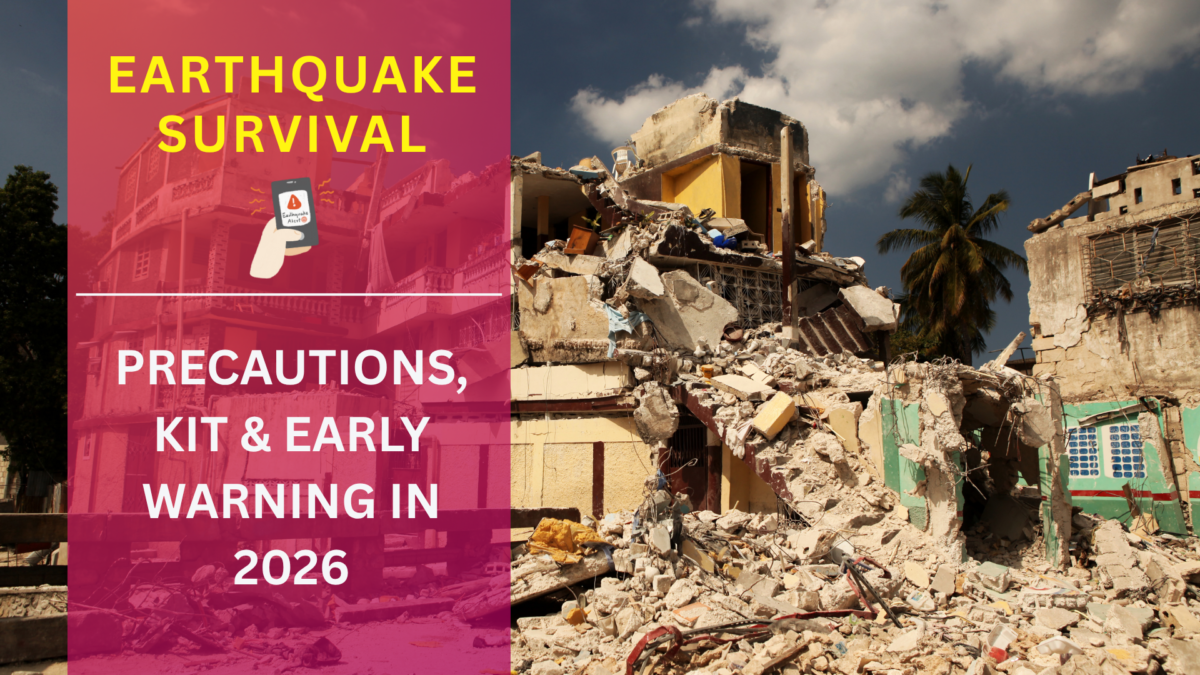
Ninety percent of the world’s earthquakes happen along the Pacific Ring of Fire, and the United States has more of that ring running through it than most Americans realize. The scientific community currently puts the probability of a magnitude 7.0 or higher earthquake striking California within the next 30 years at above 90 percent, and yet only about 13 percent of California homeowners carry earthquake insurance. That gap between known risk and actual preparation is the real story here, and it is not confined to insurance paperwork. It shows up in how few households have a plan for the ninety seconds that actually matter.
Worldwide, earthquakes are not a rare event. Seismologists expect roughly 15 magnitude-7-range earthquakes and one magnitude-8-or-greater earthquake in any given year, on top of thousands of smaller ones that go largely unnoticed outside seismograph readings. What has changed is not the underlying frequency of large earthquakes, which has stayed relatively constant over the past century, but the density of population and infrastructure now sitting on top of active fault lines. A quake that would have been a geological curiosity a century ago is now a mass-casualty event if the wrong city sits above it.
What the Science Actually Says to Do When the Shaking Starts
Every credible emergency management body, from the USGS to the CDC to state-level agencies in California, Oregon, and Washington, converges on the same protocol: Drop, Cover, and Hold On. Drop to your hands and knees before the shaking knocks you down. Get under a sturdy desk or table if one is within reach, and if not, move next to an interior wall away from windows and anything that could fall. Hold on to whatever shelter you have, or protect your head and neck with your arms, until the shaking stops.
The protocol is simple mainly because the alternatives people intuitively reach for are worse. Standing in a doorway, once standard advice, has been dropped because modern door frames are no stronger than the rest of the structure and offer no real head protection while leaving you exposed to a swinging door. The so-called “triangle of life,” which claims curling up next to large furniture rather than under it creates a survivable pocket of space, has been rejected by every major emergency management organization as a misreading of how buildings actually collapse. And running outside during shaking is arguably the most dangerous instinct of all, since the area immediately surrounding a building, where glass, signage, and facade material fall first, is more hazardous during an earthquake than the interior of a structurally sound room.
Seconds Now Matter More Than They Used To
Earthquake early warning has moved from research concept to functioning infrastructure faster than most people appreciate. The USGS-managed ShakeAlert system, which covers California, Oregon, and Washington, received a significant technical upgrade in 2026, incorporating real-time satellite data alongside its existing seismometer network to estimate earthquake magnitude faster and push alerts to phones and public systems sooner. Congress allocated roughly $34.9 million to continued ShakeAlert development this year, with a portion of that earmarked for extending the network into Alaska, where warning times of over a minute are possible depending on the earthquake’s location relative to population centers.
A minute does not sound like much until you consider what it buys: enough time to drop and take cover before shaking arrives, for automated systems to slow trains and halt elevators at the nearest floor, and for surgeons mid-procedure to pause. The system is not universal and does not eliminate the need for the Drop, Cover, and Hold On reflex, since some of the most damaging quakes originate too close to the surface for meaningful warning time. But where it works, it converts an earthquake from a total surprise into an event with a few precious seconds of lead time, and that gap continues to widen as the underlying seismic network expands.
The Cascadia Question Is Getting More Attention, Not Less
Much of the West Coast earthquake conversation in 2026 has centered on the Cascadia Subduction Zone, the roughly 700-mile fault running offshore from northern California to British Columbia that is capable of producing a magnitude-9 megathrust earthquake. Research published this year using 13 years of ground motion data suggests the fault may not be as uniformly locked as previously assumed, with the central segment showing signs of slow-slip events and fluid movement that could be relieving pressure in ways the northern segment is not. Separately, scientists studying sediment layers from underwater landslides found evidence suggesting a major Cascadia rupture could plausibly trigger a subsequent quake on the San Andreas Fault, raising the uncomfortable possibility of a coast-wide sequence rather than an isolated event.
None of this constitutes a prediction of an imminent quake, and researchers have been careful to frame the findings as improving hazard models rather than issuing a countdown. But the pattern of research is consistent: the more instrumentation gets deployed offshore, the more segmented and variable Cascadia’s behavior turns out to be, which cuts against the older assumption of one big fault behaving uniformly. In June 2026, three moderate earthquakes near the Blanco Fracture Zone off the Oregon coast, including a 5.7-magnitude event, produced no damage or tsunami alert but were enough to renew public attention on the region’s seismic activity.
Building the Kit Before You Need It
FEMA’s baseline recommendation is a minimum of 72 hours of self-sufficient supplies per person in a portable go-bag, and a seven-to-fourteen-day supply for a home base kit, since a major earthquake can knock out water, power, and road access well beyond the first three days. That means a gallon of water per person per day at minimum, shelf-stable food that requires no cooking or added water, a hand-crank or battery flashlight, and a hand-crank NOAA weather radio, since cell networks are frequently among the first systems to fail or become overloaded after a significant quake.
Earthquake-specific additions matter more than generic disaster prep. Sturdy, closed-toe shoes kept under each bed prevent injury from broken glass during the scramble to safety in the dark, since a large share of post-earthquake injuries come from stepping on debris rather than the shaking itself. Earthquake straps or braces securing water heaters and heavy furniture to wall studs prevent two of the more common causes of injury and secondary damage, tipping furniture and ruptured gas lines. A trauma-capable first aid kit, including tourniquets, goes further than a basic adhesive-bandage kit given that structural collapse injuries tend to be more severe than the cuts and bruises most household first aid kits are built for. Copies of insurance policies, identification, and photographs of valuable possessions stored in a waterproof container round out the kit, since claims processing after a major quake moves faster with documentation in hand rather than reconstructed from memory.
The Insurance Gap Nobody Talks About Until After
The most consequential earthquake preparedness failure in America is not a missing flashlight, it is a missing insurance policy. Standard homeowners insurance in the United States does not cover earthquake damage, full stop, and yet the overwhelming majority of homeowners in the highest-risk state in the country have chosen to go without the separate coverage that would actually protect them. The California Earthquake Authority alone underwrites roughly two-thirds of the state’s residential earthquake policies, and premiums running from several hundred to a few thousand dollars a year strike many homeowners as an unnecessary expense right up until the moment a quake proves otherwise. FEMA disaster assistance is not a substitute; it is capped, slow, and was never designed to rebuild a home from the studs up.
Preparation Is a Bet on Probability, Not Certainty
Nobody can say with precision when the next major quake will hit Los Angeles, Seattle, or Anchorage, and the researchers pushing Cascadia’s hazard models forward this year would be the first to say their findings sharpen the picture rather than supply a date. What the data consistently shows is that the underlying risk has not been overstated, that early warning technology is closing the gap between shaking and reaction time, and that most households in high-risk zones remain under-prepared relative to what the science already knows. The 90-second drill costs nothing to learn. The question is whether more people start treating it as a certainty they are preparing for, rather than a statistic they are hoping to outrun.
30 Comments