
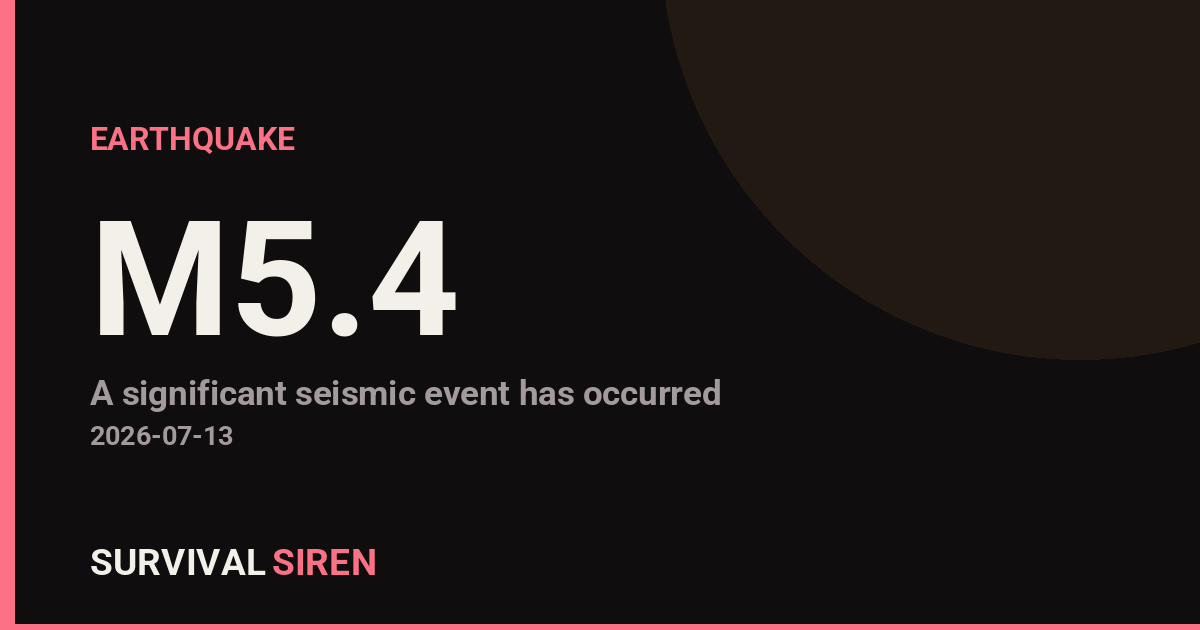
A magnitude 5.4 earthquake occurred 24 kilometers west-southwest of Mabiton, Philippines early today at a shallow depth of approximately 10 kilometers, according to the U.S. Geological Survey. Earthquakes of this size typically produce noticeable shaking across a regional area.
What You Might Notice
Residents within 50-100 kilometers of the epicenter likely felt moderate shaking lasting several seconds. People reported items moving on shelves, some difficulty standing, and swaying of buildings. This magnitude is generally strong enough to cause minor damage to older structures or poorly constructed buildings, though modern buildings in the area are designed to withstand such movement.
Who Is Affected
The Philippines sits on the Pacific Ring of Fire, an active seismic zone. Communities closest to Mabiton in the western region are most impacted. The shallow 10 km depth means energy reached the surface efficiently, increasing the range of noticeable shaking.
What to Monitor
1. Aftershocks—Check official USGS or Philippine Institute of Volcanology and Seismology (PHIVOLCS) updates. Aftershocks of magnitude 3-4 can follow major earthquakes over the next hours or days.
2. Building Safety—If you live in affected areas, inspect your home for new cracks, structural damage, or gas leaks. Do not ignore warning signs, especially in older construction.
3. Tsunami Potential—For submarine earthquakes near coastlines, monitor local tsunami warnings through official agencies, though initial reports suggest no significant tsunami risk from this event.
If you haven’t already, now is a good time to secure heavy furniture to walls, practice your household earthquake plan, and ensure your emergency kit includes water, first aid supplies, and a battery-powered radio. The Philippines regularly experiences seismic activity, making preparedness part of everyday life.
For ongoing space weather monitoring and earthquake tracking, visit the NOAA-integrated live dashboard at https://survivalsiren.com/spaceweather/feed.html
Source: USGS
Related Reading
Sky Conditions at the Time
Moon: New Moon (3% illuminated), in Cancer.
Notable planetary angles: Sun conjunct Mercury (0°), Moon sextile Venus (62°).
This is a factual snapshot, not a claim of cause and effect – researchers are divided on whether lunar, planetary or solar factors influence seismic or weather activity. It’s included so readers can track the pattern for themselves over time.
Earthquakes Within ~400 km, Past 30 Days
For context, here is other recent seismic activity in the surrounding region (M2.5+, via USGS):
| Date & Time (UTC) | Magnitude | Location |
|---|---|---|
| 2026-07-14 07:18 UTC | M4.8 | 18 km WSW of Mabiton, Philippines |
| 2026-07-14 07:04 UTC | M5.2 | 14 km WSW of Mabiton, Philippines |
| 2026-07-14 01:03 UTC | M4.6 | 6 km NW of San Rafael, Philippines |
| 2026-07-09 16:46 UTC | M4.9 | 28 km ESE of Dulag, Philippines |
| 2026-07-08 20:32 UTC | M4.9 | 69 km NE of Sulangan, Philippines |
| 2026-07-07 20:37 UTC | M4.5 | 12 km S of Calatagan, Philippines |
| 2026-07-04 04:33 UTC | M4.2 | 13 km SSE of Cabacao, Philippines |
| 2026-06-23 01:22 UTC | M4.4 | 4 km ESE of Lalawigan, Philippines |
Emergency number for Philippines: 911 (General guidance – always verify locally, as this can vary by region.)