
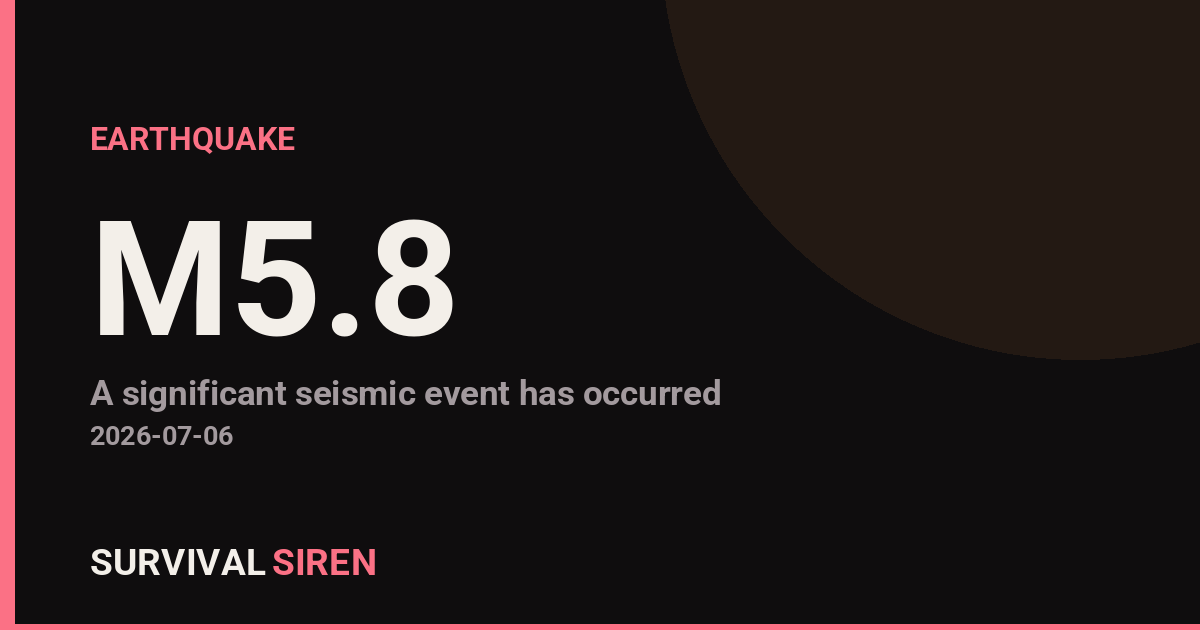
A magnitude 5.8 earthquake occurred 48 kilometers south-southwest of Sarangani, Philippines, at a depth of approximately 35 kilometers, according to the U.S. Geological Survey. Shaking from this moderate-strength quake would likely be felt across the surrounding region.
What You Might Notice
Residents in Sarangani Province and nearby areas may have experienced noticeable shaking lasting several seconds. A magnitude 5.8 quake typically causes moderate ground motion—strong enough to be felt indoors and outdoors, and capable of moving lightweight objects. People in cities like General Santos and other nearby communities could have observed similar effects.
Who Is Affected
The Philippines sits on the Pacific Ring of Fire, a seismically active zone where earthquakes are relatively common. This region experiences frequent tectonic activity, so local residents and infrastructure are generally built with seismic considerations in mind. The depth of 35 kilometers places this earthquake at a moderate depth, which typically reduces surface damage compared to shallower events.
What to Monitor
Watch for official updates from the Philippine Institute of Volcanology and Seismology (PHIVOLCS), which provides authoritative local information on earthquake activity and any aftershocks. Aftershocks are common following magnitude 5+ earthquakes and are usually smaller in size. Additionally, if you’re in the affected region, stay alert for any tsunami warnings—the USGS and regional authorities monitor coastal risks after significant earthquakes in this area. Finally, if you’re in a seismic zone anywhere, keep your emergency kit accessible and ensure family members know your communication plan.
For ongoing space weather and natural event monitoring, visit the live dashboard at https://survivalsiren.com/spaceweather/feed.html. Data sourced from NOAA and the U.S. Geological Survey.
Sky Conditions at the Time
Moon: Last Quarter (64% illuminated), in Pisces.
Notable planetary angles: Sun square Saturn (90°), Moon trine Jupiter (123°), Moon trine Mercury (116°).
This is a factual snapshot (timed to this post’s publish time, as an approximation), not a claim of cause and effect – researchers are divided on whether lunar, planetary or solar factors influence seismic or weather activity. It’s included so readers can track the pattern for themselves over time.