
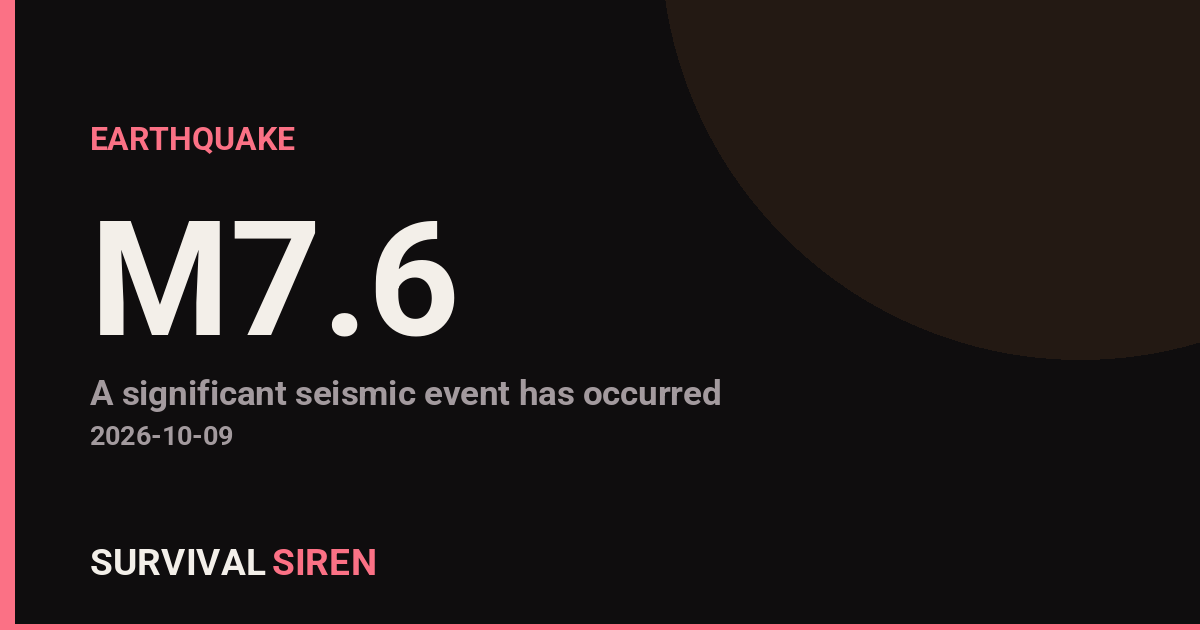
A major magnitude 7.6 earthquake struck roughly 10 kilometers west-southwest of Pitaloza Arriba, Panama, at a shallow depth of about 10 kilometers, according to the USGS. Shallow quakes of this size release their energy close to the surface and can cause severe shaking and significant damage near the epicenter.
Residents in western Panama would have felt strong to violent shaking, with the potential for damaged buildings, downed power lines, broken water mains, and blocked roads in communities nearest the epicenter. Because the epicenter is close to Panama’s Pacific coast, tsunami conditions are a concern for nearby shorelines, and coastal residents should follow any evacuation instructions from local authorities immediately.
Panama City, home to about 1.7 million people, lies roughly 205 kilometers away. Shaking there would likely have been noticeable — swaying high-rises, rattling windows, and items falling from shelves — but the most serious damage is expected much closer to the epicenter in the Pitaloza Arriba area.
This region has been seismically active: this is at least the fifth magnitude 5.0 or greater earthquake recorded within about 300 kilometers of this location in the past year. That history means structures in the area may already be stressed, and emergency crews will be watching for building failures and landslides.
What to do and watch for
If you are in the affected area: expect strong aftershocks over the coming hours and days, some potentially large. Move away from damaged buildings, check on neighbors, and shut off gas if you smell a leak. If you are near the coast and feel strong shaking or receive a tsunami alert, move to higher ground immediately without waiting for an official order.
Monitor official local channels for road closures, power restoration updates, and shelter information before traveling in the region.
Data in this alert comes from the United States Geological Survey (USGS), with tsunami information from NOAA’s tsunami warning centers.
Frequently Asked Questions
Was the earthquake felt in Panama City?
Yes, most likely. Panama City is about 205 km from the epicenter, so residents there would typically feel moderate shaking — swaying buildings and rattling objects — though the heaviest damage is expected near Pitaloza Arriba.
Is a tsunami possible from this quake?
Yes, it's possible. The quake was shallow (about 10 km deep) and close to Panama's Pacific coast, which is the type of event that can generate a tsunami. Coastal residents should follow official tsunami alerts and move to higher ground if instructed.
Are aftershocks likely?
Yes. After a magnitude 7.6 earthquake, strong aftershocks — some potentially above magnitude 5 or 6 — are common for days to weeks. Avoid damaged buildings and be ready to drop, cover, and hold on.
Is this part of an ongoing pattern of earthquakes in Panama?
This is at least the fifth magnitude 5.0+ quake within about 300 km of this location in the past year. Panama sits near active tectonic boundaries, so significant earthquakes are a known hazard in the region.
Keep tracking this:
Source: USGS
Related Reading
- Global Seismic Stress Report: Southern Ocean Activity Rises While Six Segments Go Quiet
- Earthquake Survival: Precautions, Kit & Early Warning in 2026
- Analyzing Low-Radiation Nuclear Explosions: Tactical Assessments and Survival Strategies
Reported Impact
6 people have reported feeling this quake to USGS’s “Did You Feel It?” system so far; the maximum reported shaking intensity is 4.6 on the Community Decimal Intensity scale.
Impact figures are from USGS as of when this alert was generated and can rise as more reports come in – this is not a final damage assessment.
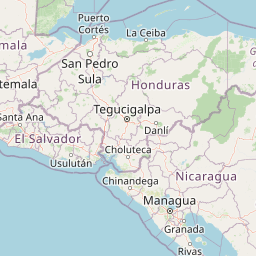

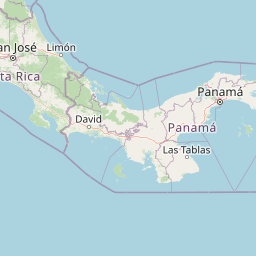
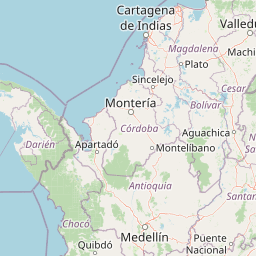

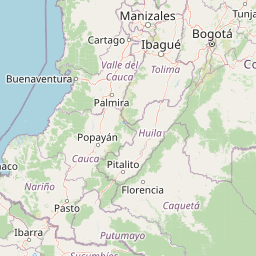
Map centered on the epicenter (7.60, -80.76). Map data © OpenStreetMap contributors.
Sky & Solar Conditions at the Time
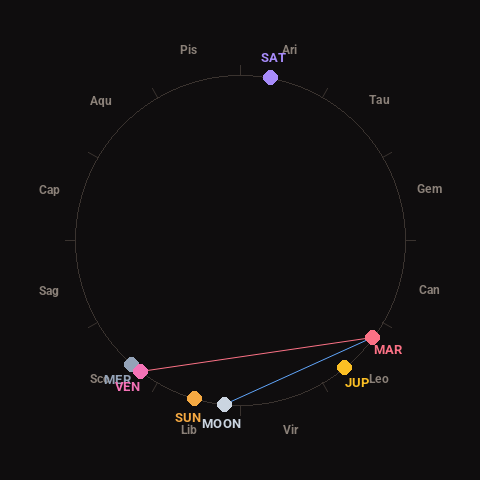
Moon: New Moon (1% illuminated), in Libra.
Notable planetary angles: Venus square Mars (91°), Moon sextile Mars (59°), Mercury conjunct Venus (4°).
Concurrent space weather: planetary Kp index 1.0; strongest recent solar flare: M1.4-class.
This is a factual snapshot, not a claim of cause and effect – researchers are divided on whether lunar, planetary or solar factors influence seismic or weather activity. It’s included so readers can track the pattern for themselves over time.
Earthquakes Within ~400 km, Past 30 Days
For context, here is other recent seismic activity in the surrounding region (M2.5+, via USGS):
| Date & Time (UTC) | Magnitude | Location |
|---|---|---|
| 2026-10-04 14:06 UTC | M5.0 | 295 km S of Burica, Panama |
| 2026-09-18 22:09 UTC | M3.9 | 8 km W of Cañas Gordas, Panama |
| 2026-09-18 08:45 UTC | M4.4 | 7 km SW of Juradó, Colombia |
| 2026-09-16 07:02 UTC | M4.8 | 45 km WSW of Bahía Solano, Colombia |
| 2026-09-12 01:59 UTC | M4.7 | 0 km NE of Manaca Civil, Panama |
| 2026-09-10 08:26 UTC | M5.0 | 44 km SSE of Quepos, Costa Rica |
Emergency number for Panama: 911 (General guidance – always verify locally, as this can vary by region.)