
Anyone can start doing intelligence work tonight, from a laptop, using nothing but a browser and a search bar, and that fact alone has quietly rewired how conflicts get exposed, how disinformation gets debunked, and how ordinary people end up doing work that used to require a security clearance. Open-source intelligence, OSINT for short, is the discipline of turning publicly available information into verified, actionable conclusions. It is not new, it is not glamorous in the way spy fiction makes intelligence work look, and it is more accessible right now than it has ever been in its history.
A Discipline Older Than the Internet
OSINT’s institutional roots trace back to February 1941, when the US government stood up the Foreign Broadcast Monitoring Service inside the Federal Communications Commission, tasked with recording and analyzing foreign radio broadcasts after officials worried that a wartime closure of American embassies in Europe would cut off diplomatic reporting. That agency, later renamed the Foreign Broadcast Information Service, produced its first analytic report on December 6, 1941, warning that Tokyo’s broadcast tone had turned sharply belligerent. The Japanese attack on Pearl Harbor followed the very next day. It is one of the earliest demonstrations that patient, systematic attention to openly available material can surface warning signs that classified channels miss entirely.
Wartime analysts got even more resourceful than radio monitoring suggests. One of the more remarkable stories from the period involves Allied analysts tracking fluctuations in the retail price of oranges in occupied Paris as an indirect signal of successful railway bombing campaigns, reasoning that disrupted transport networks would show up first in the price of goods that depended on them. That is the essence of OSINT even now: taking an ordinary, unclassified data point and reading it correctly.
What Actually Counts as an Open Source
The term covers more ground than people expect. Social media posts, satellite imagery available commercially rather than through classified channels, court records, corporate filings, academic papers, news broadcasts, shipping manifests, and even the metadata embedded in a photograph all qualify. What unifies them is that no illegal access or covert collection is involved. If it takes a hack, a bribe, or a breach to get it, it stops being OSINT and becomes something else entirely, a distinction that matters both legally and ethically.
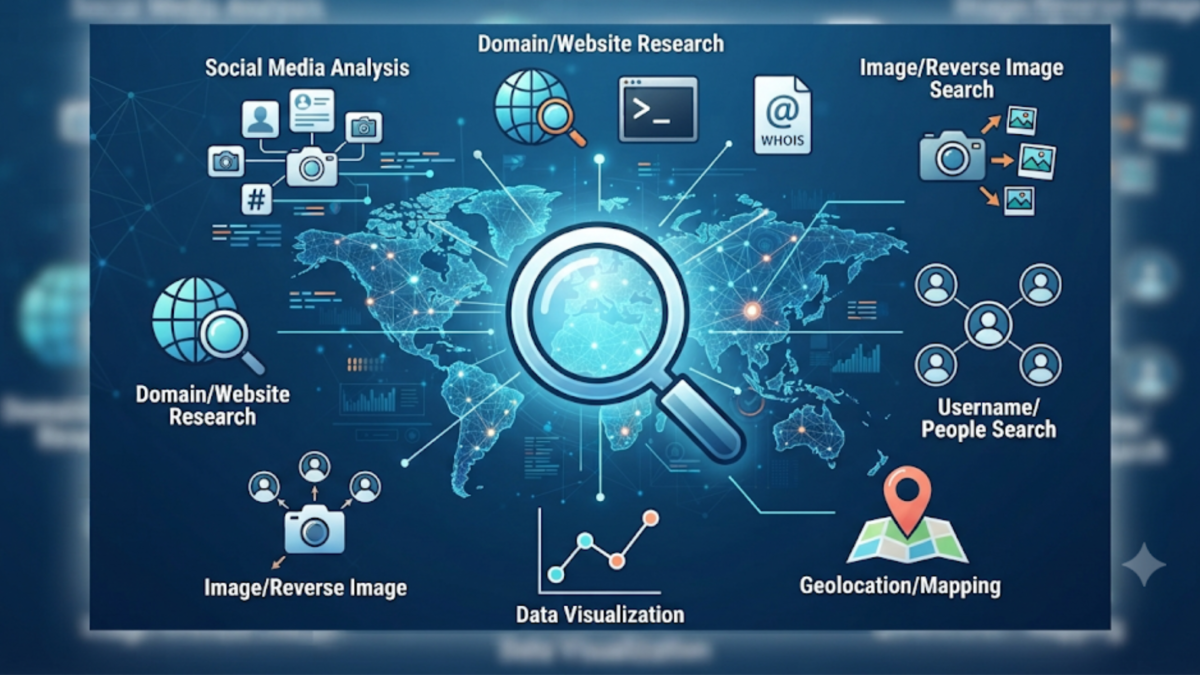
The modern reference point for organizing all of this is the OSINT Framework, a free directory built by security researcher Justin Nordine that arranges hundreds of tools into a browsable tree spanning categories like email, domain and IP infrastructure, social media, geolocation, and metadata analysis. It is less a single tool than a map of the entire discipline, and it is usually the first stop for anyone trying to figure out what exists before committing to a specific investigative path.
The Tools an Investigator Actually Reaches For
Username and account discovery tools like Sherlock and Blackbird search hundreds of platforms simultaneously for a given handle, which matters because people are inconsistent about privacy settings across the accounts they hold, and a locked-down profile on one platform often has a wide-open twin on another. On the infrastructure side, tools like DNSDumpster map a domain’s subdomains and network footprint, useful for anyone investigating who actually runs a website behind a shell company or a vague registration.
Geolocation work, figuring out exactly where a photo or video was taken from visual clues alone, has become its own specialty largely thanks to organizations like Bellingcat, whose methodology typically starts by identifying the single most distinctive feature in an image, whether that’s a building facade, a road sign, or a distant ridgeline, and then narrowing the search radius until independent features confirm each other. This is the same corroboration principle that runs through all serious analysis: one clue is a hypothesis, three independent clues pointing the same direction is a finding. Reverse image search tools like TinEye round out the toolkit by tracing where an image first appeared online, which is often the fastest way to catch a photo being recycled from an unrelated event and passed off as current.
Where the Ethics Get Genuinely Difficult
Legality and ethics are not the same test, and conflating them is where a lot of beginners go wrong. Scraping someone’s public Instagram, cross-referencing it against a property record, and layering in a workplace LinkedIn profile is, in most jurisdictions, entirely legal. Whether it is ethical is a separate question, because stitching together enough individually public data points can produce an intimate profile of someone’s life that they never consented to having assembled, even if no single piece of it was private on its own. That aggregation effect is the discipline’s central ethical tension, and it does not resolve neatly. A journalist verifying a war crime and a stalker building a target profile can use identical techniques.
Responsible practice generally comes down to a short list of habits: collecting only what a specific, legitimate investigative question actually requires rather than everything available, verifying claims against multiple independent sources before treating them as fact, and being honest with yourself about whether the target of an investigation is a public figure whose conduct is genuinely newsworthy or a private citizen who has simply been unlucky enough to attract attention. None of that is a legal requirement anywhere. It is a professional discipline that separates investigators worth trusting from people who happen to be good at Google.
The 2026 Problem Nobody Fully Solved Yet
The discipline’s newest and hardest challenge is verifying whether the source material is even real in the first place. Deepfake identity fraud is on pace to rise nearly 500 percent in 2026 compared with the year before, and generative tools can now produce a convincing fabricated video in the time it takes to write this paragraph. The old OSINT assumption, that seeing a video or hearing an audio clip constituted reasonable confirmation, no longer holds, and the field is scrambling to adapt.
Part of the industry’s answer is provenance metadata baked in at the point of capture. The Coalition for Content Provenance and Authenticity standard, backed by major camera and phone manufacturers, cryptographically signs an image or video the moment it is recorded, so investigators can later check whether the file has been altered since. But provenance standards only help with content captured on compliant devices going forward, and most of the internet’s existing footage was never signed. That leaves human analysts doing the harder work manually: checking for unnatural pixel blending, inconsistent lighting, and the kind of physically implausible details that generative models still occasionally get wrong. Analysts who spent the last decade learning to spot doctored photographs are now relearning the craft against a much faster-moving target.
None of that makes the discipline any less accessible to a newcomer starting from zero. It just means the honest starting point in 2026 is not simply learning the tools, but learning to distrust the raw material those tools return until it survives independent corroboration. Whether the next wave of provenance standards catches up to generative video before deepfakes fully overwhelm open-source verification is the question the entire field is quietly racing against.