
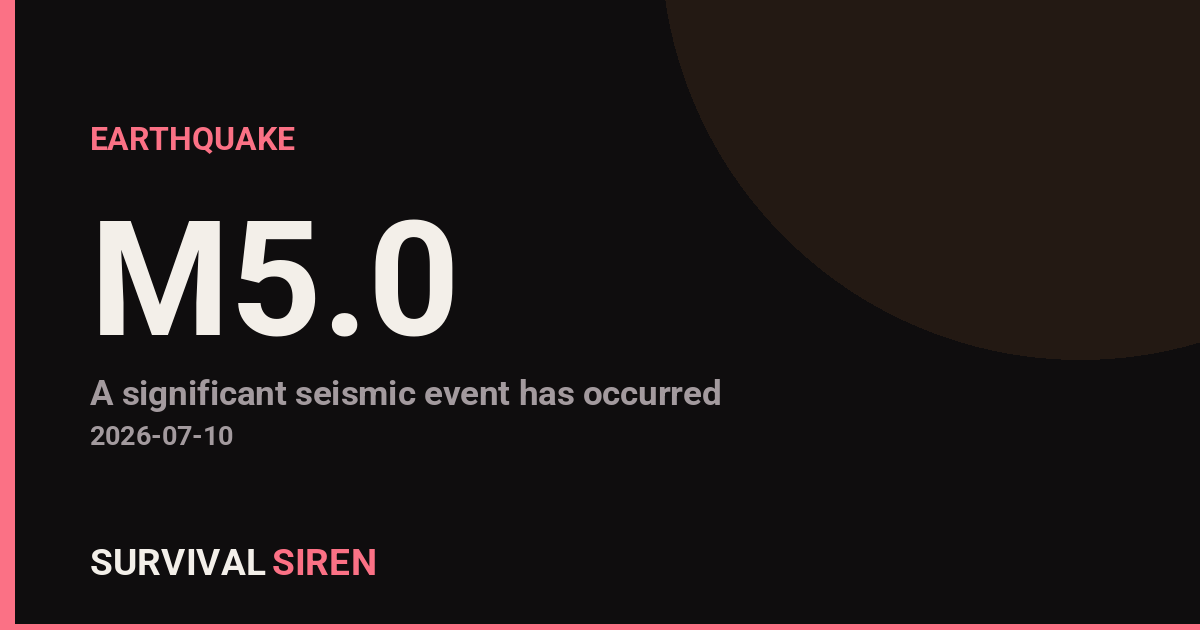
A magnitude 5.0 earthquake occurred west of Macquarie Island at approximately 10 kilometers depth, according to the U.S. Geological Survey. While this is a moderate-strength quake, the remote Southern Ocean location limits immediate impact to populated areas.
Macquarie Island, located roughly halfway between Australia and Antarctica, is an Australian territory with a small research station but no permanent civilian population. The earthquake would have been felt across the island itself and possibly detected by sensitive instruments in nearby regions, but widespread damage is unlikely given the isolation of the epicenter.
This event is a reminder that seismic activity occurs constantly across the globe—most earthquakes go unnoticed by the general public simply because they occur far from cities or in sparsely populated zones.
What to Watch
Aftershock potential: Moderate earthquakes sometimes produce smaller follow-up quakes. Monitor USGS earthquake data if you track seismic activity in the Southern Hemisphere.
Regional monitoring: If you live in Australia, New Zealand, or nearby Pacific regions, maintain awareness of your local earthquake preparedness plan. These distant events don’t affect immediate safety but reinforce why having an emergency kit and knowing your response steps matters year-round.
Data reliability: Use USGS and official geological surveys as your primary sources for earthquake information. Magnitude and depth can be refined within hours as seismologists analyze more data.
For those interested in real-time Earth and space monitoring, staying informed about natural events—whether seismic or space weather—helps build situational awareness without requiring constant anxiety. A basic preparedness checklist (water, first aid, flashlight, battery radio) addresses most natural hazards whether earthquakes, storms, or solar events occur.
Track live space weather data and seismic updates at https://survivalsiren.com/spaceweather/feed.html, powered by NOAA and USGS monitoring networks.
Source: USGS
Related Reading
Sky Conditions at the Time
Moon: Waning Crescent (18% illuminated), in Taurus.
Notable planetary angles: Moon square Venus (93°), Sun conjunct Mercury (4°), Sun square Saturn (94°).
This is a factual snapshot, not a claim of cause and effect – researchers are divided on whether lunar, planetary or solar factors influence seismic or weather activity. It’s included so readers can track the pattern for themselves over time.
Earthquakes Within ~400 km, Past 30 Days
For context, here is other recent seismic activity in the surrounding region (M2.5+, via USGS):
| Date & Time (UTC) | Magnitude | Location |
|---|---|---|
| 2026-07-02 21:52 UTC | M4.6 | west of Macquarie Island |