

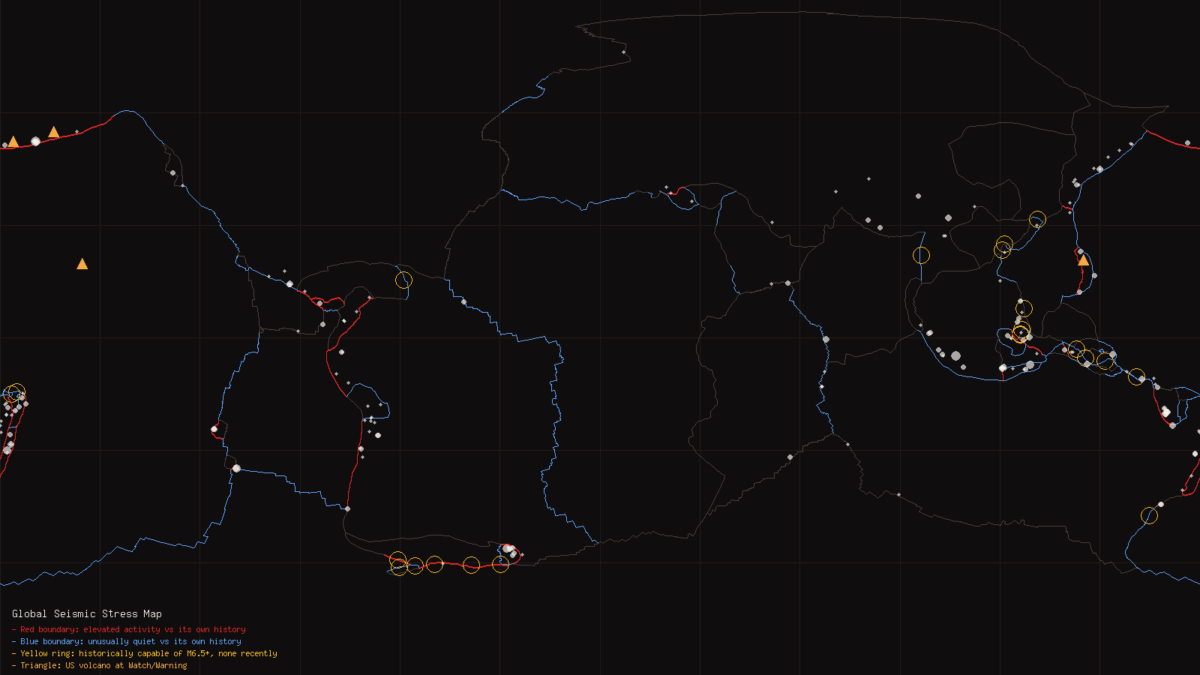
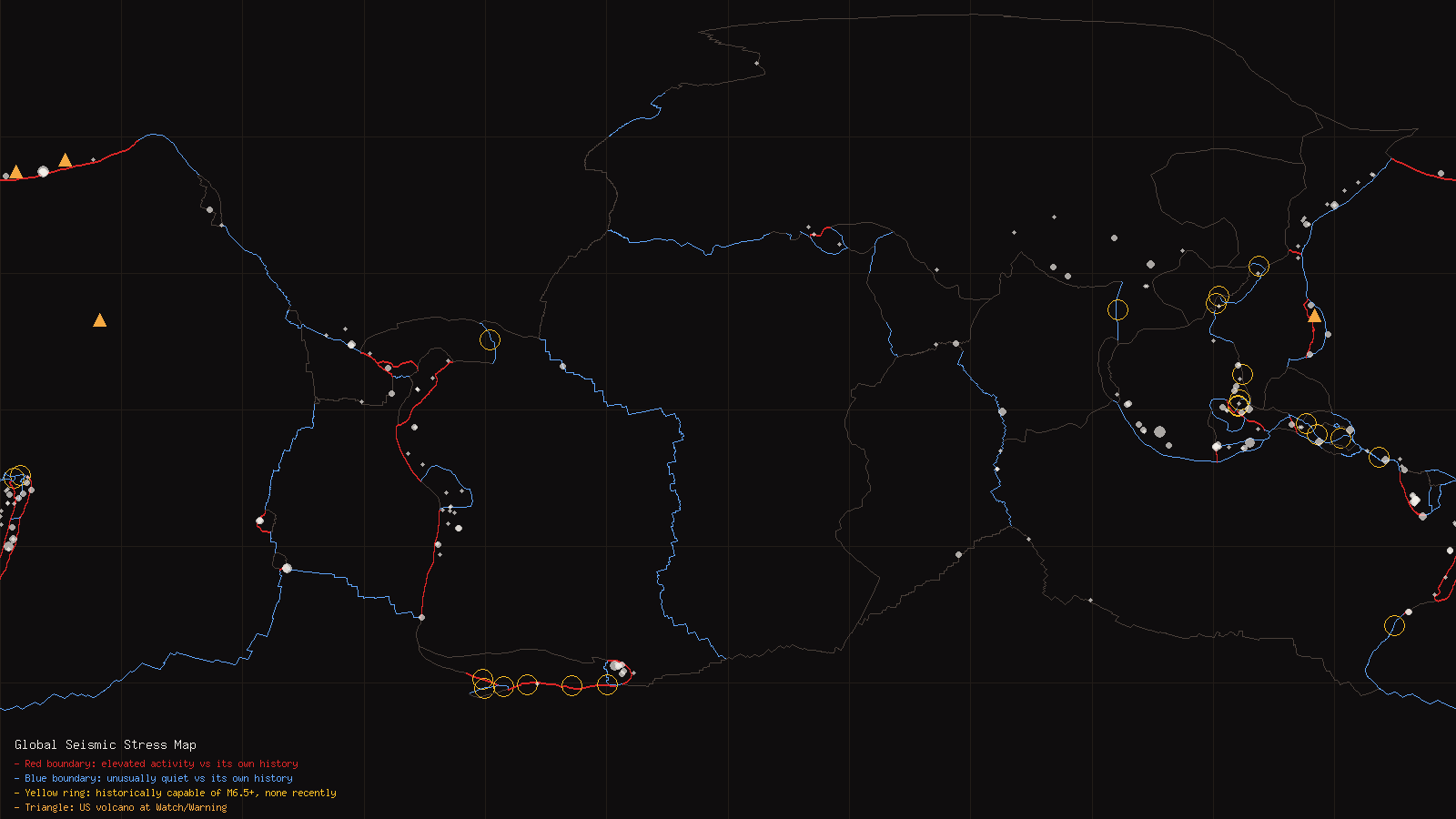
This fortnight’s Global Seismic Stress Report covers the last 14 days of earthquake activity measured against each segment’s own 3-year baseline. Across 241 plate-boundary segments tracked worldwide, 200 M4.5+ earthquakes were recorded in the period. Before anything else, a plain statement: this is pattern-observation over real data, not a forecast. No scientist can predict the timing of a specific earthquake, and nothing below should be read as one.
Overview
Two hundred magnitude-4.5-or-greater earthquakes across 241 monitored segments is a workable global sample, and the distribution this fortnight is interesting. A cluster of Southern Hemisphere plate boundaries – around New Zealand, the southern Pacific, and the southern Atlantic – is running well above its own recent historical norm, while six segments scattered across the Indian Ocean, Mediterranean, and southern oceans have produced zero qualifying earthquakes despite baselines showing they can and do generate significant events.
Elevated Segments
The most elevated segment this period is AU\PA (near -44.5, 167.8, off the southwest of New Zealand’s South Island), which recorded 2 quakes in 14 days against a normal average of just 0.04 – roughly 52 times its baseline rate. The largest recent event was M5.3, against a 3-year baseline maximum of M5.9. That M5.3 likely represents stress released at that location rather than stored, but elevated activity here is worth noting because stress transfer onto neighboring fault segments (the documented Coulomb stress transfer effect) is a real phenomenon.
EA-PA (near -24.6, -115.2, on the East Pacific Rise system) recorded 3 quakes versus a 0.09 average (33.5x), largest recent M5.2 against a baseline max of M5.5. JZ-AN (near -34.8, -110.1, on the Chile Rise) saw 2 quakes versus 0.06 (31.3x), with a notable largest recent event of M5.9 – close to its 3-year baseline maximum of M6.3, meaning this segment just released an event near the top of its recent range.
Three segments each recorded a single quake against a 0.04 average (26x): KE-AU (near -37.8, 176.9, the Kermadec area northeast of New Zealand’s North Island, largest recent M4.5), SC-AN (near -60.4, -49.6, the Scotia Sea region, largest recent M4.6, baseline max M6.2), and ND-SA (near 6.2, -72.4, northern South America/Colombia region, largest recent M4.5, baseline max M5.5). Individually these are small numbers, but the geographic spread – and the fact that several sit adjacent to historically more active boundaries – makes the pattern worth tracking over coming periods.
Quiet / Possible-Gap Segments
Six segments recorded zero qualifying quakes in the last 14 days against low but nonzero baselines. The ones that stand out are those with strong 3-year maximums: AU-SO (near -16.8, 67.4, Central Indian Ocean) has a baseline max of M6.3 and produced nothing; EU-AF (near 38.1, 15.3 – the Italy/Calabria region of the Mediterranean) has a baseline max of M6.2 and went silent; AF-SA (near -35.8, -15.6, South Atlantic) and PA-AN (near -53.9, -135.7, Southeast Pacific) both carry M6.2 baseline maximums with zero recent events. AN-NZ (near -39.9, -91.5) and IN-SO (near 3.8, 63.1, western Indian Ocean) round out the list with baseline maximums of M5.7 and M5.4 respectively.
The seismic-gap concept – a segment that hasn’t ruptured recently may be accumulating unreleased stress – is real but imprecise. Quiet segments of the kind listed here are the closest thing our data offers to a gap signal. The EU-AF segment near Italy is arguably the most preparedness-relevant of the six, given population density and that region’s documented history of damaging earthquakes. Fourteen quiet days, however, is a very short window against a 3-year baseline for segments with inherently low event rates.
Volcanic Activity
Volcanic unrest is one of the ways accumulated plate-boundary stress expresses itself, and four U.S.-monitored volcanoes are at ADVISORY or above. Kilauea (Hawaii) is at WATCH/ORANGE, intermittently erupting short precursory lava flows with over 100 recorded since activity began September 7; HVO notes episode 55 fountaining is likely imminent if inflation patterns hold. Great Sitkin (Aleutians) is at WATCH/ORANGE with slow lava eruption continuing in the summit crater. Shishaldin (Aleutians) sits at ADVISORY/YELLOW with low-level seismic unrest, and Ahyi Seamount (Northern Mariana Islands) is at ADVISORY/YELLOW based on faint water discoloration in satellite imagery. Note the Aleutian and Mariana systems sit along the broader Pacific plate boundary network where several of this period’s elevated segments also reside – a regional stress context worth keeping in mind, without over-reading it.
Honesty and Caveats
Small-number statistics dominate this report: a segment averaging 0.04 quakes per fortnight will show a 26x elevation from a single routine M4.5. Elevated segments mostly reflect stress already released, not stress about to be, and quiet segments are not necessarily about to rupture – many are simply low-rate boundaries where silence is normal. The honest takeaway: keep supplies current, know your local fault and volcano exposure, and treat this report as situational awareness. This is pattern-observation over real data, not a prediction, and no quiet or active segment named above should be treated as a forecast of any specific earthquake.